Ban on social transition is cruel and anti-science

In December 2023, the UK government released school’s guidance, proposing restrictions on social transition, including a complete ban on social transition at primary school.

The guidance is non-statutory, meaning schools do not need to follow it. Indeed, leaked civil service legal advice revealed that even government lawyers recognise the guidance as likely to be illegal, and likely to fail when it will be challenged in court. Any school considering following this guidance needs to know that their actions will likely be found unlawful when challenged in court.

Here I want to outline the reasons the guidance is not just cruel, but also anti-science. I will focus on one aspect of the guidance, the proposed restrictions on social transition, and the proposed ban on social transition at primary school. I am well-qualified to write on this topic, having focused my entire PhD on researching the experiences of trans children and families who socially transitioned at primary school in the UK, and being myself a parent of a trans child who similarly socially transitioned at primary school.

The guidance claims to be an effort to address ideology, but it is very clear that the guidance is entirely driven by anti-trans ideology, rather than by evidence, science, or indeed by listening to the experiences of those with lived experience of being or supporting a trans child.

Last week I published my 14th peer reviewed article on the topic of trans children. Within science and evidence based policy-making, peer review in credible journals is a vital part of assessing evidence, ensuring our decisions are based on the best available evidence. My latest peer reviewed article analyses and synthesises all existing studies on the topic of social transition. It examines them in detail, clarifying what evidence underpins their conclusion. Within all modern (post 2013) literature, evidence concludes that social transition is either beneficial, or neutral. The vast majority of studies conclude that social transition is beneficial for trans children. Just two studies conclude that social transition is neutral, neither beneficial nor harmful. My latest article examines one of those two studies, highlighting a wide range of limitations that undermine its stated conclusions.

The latest government guidance states that social transition is not neutral, raising the suggestion that it is either beneficial or harmful. If they looked to the evidence they can see that there is zero modern (post 2013) evidence that social transition is harmful, and multiple studies, of multiple types (qualitative, quantitative, retrospective), from multiple countries (UK, USA, Spain) demonstrating that social transition is beneficial, indeed critical for trans children’s well-being, self-esteem and happiness.

Claims that social transition is harmful are supported by the most pathetically flimsy of evidence, comprised of two main strands.

One flimsy strand of evidence used by opponents of social transition, looks to a 2011 published study of 2 Dutch girls, who changed their gender expression (wore trousers or cut their hair short) and then regretted changing their clothing and haircut due to the bullying that ensued. Neither child asked to be seen as a boy, neither child changed pronoun. There was no social transition in this study, nor is it clear that the children in question were even trans. I wrote about this back in 2017. The 2011 study on two girls who never socially transitioned was used by WPATH in their standards of care version 7 (published in 2013) to caution against social transition, guidance that has caused uncalculated harm across the world. (This poor science from 2011 also made it to version 8 of the standards of care).

You cannot tell me that 2023 social policy on social transition should be governed by a 13+ year old study of two children, neither of whom socially transitioned, or even asked to socially transition. The fact this same study is influencing gov guidance in 2023, ignoring all the continually growing body of modern evidence that social transition is vital and life-saving, is beyond belief.

The second flimsy strand of evidence used by opponents of social transition, argues that it is social transition itself that makes children remain trans. It argues that support for social transition somehow changes a child’s future trajectory, keeping children trans who would otherwise escape into a life of cis normality. The evidence for this claim of social transition ‘concretising’ identity is entirely speculative. Anti-trans voices look to the high degree of consistency in trans children in 2023, where a majority (but not all) of socially transitioned trans children continue to identify as trans into adolescence and adulthood. They compare this with studies from the 1950s-2000s, where children in gender clinics did not commonly identify as trans in adolescence. There is one humungous problem with this pet theory. Gender clinics in the 1950s-2000s did not focus on trans children at all. Instead they focused on boys who were deemed excessively and problematically feminine, boys who were referred to by research study leaders as ‘sissy’ or ‘proto-gay’. Clinics were not focused on trans children at all, instead they were focused on making feminine boys ‘man-up’, lest they become either gay or trans in the future. A scholar who experienced such gender clinics as a boy, who has written about the deep harm the experience had on him, is now a gay man. He wrote how conversion therapy at gender clinics left him feeling that there was something deeply wrong with him, that he was unacceptable for being gender non-conforming. These older abusive studies should in no way guide modern practice for two reasons. One, they did not focus on trans children. Indeed, one analysis from this cohort claimed, without no self-awareness, that they had deducted that a good way of distinguishing the children who would grow up to be a trans woman from those who would grow up to be a gay man was to actually ask them, whether they were a girl, with the majority i) not identifying as a girl and ii) not growing up to be a trans woman. Almost like researchers need to actually listen to those whose lives they seek to understand! The second reason to discount the findings from these earlier studies conducted from the 1950s onwards, is that there were deeply abusive and coercive sites of conversion therapy, a practice now recognised as abusive and harmful.

Literature conducted in the modern era in fact reveals the opposite conclusion to that speculated by anti-trans actors. A study by Olson et al concluded that social transition did not concretise identity, but was in fact a consequence of the children who felt most strongly and consistently being most likely to be supported to social transition.

All modern (post 2011) studies on social transition shows either neutral or positive impacts. The vast majority of studies show overwhelmingly positive impacts of social transition. The only two studies that show neutral impacts, were situated in gender clinics and have significant study limitations, including not bothering to actually ask the children in question for their views.

Positive benefits concluded by a majority of studies on the topic include reduced anxiety, reduced depression, increased self-worth, reduced suicidal ideation, reduced suicidal behaviour, improved mood, increased confidence, increased happiness.

Trans children have a right to their identity. They have a right to health, happiness, equality. They have a right to social transition. Denying a child’s social transition is oppressive, abusive and harmful.

For more detail, please do click on this article here:

The importance of child voice in trans health research: a critical review of research on social transition and well-being in trans children

Please see these articles on experiences of social transition:

“Euphoria”: Trans children and experiences of prepubertal social transition

“I never wanted her to feel shame”: parent reflections on supporting a transgender child

Read this research on the harms of denying social transition

“I Was Losing That Sense of Her Being Happy”—Trans Children and Delaying Social Transition

And these articles on trans children’s experiences at school:

Gender minority stress in education: Protecting trans children’s mental health in UK schools

Institutional cisnormativity and educational injustice: Trans children’s experiences in primary and early secondary education in the UK

Thriving or Surviving? Raising Our Ambition for Trans Children in Primary and Secondary Schools

Trans children have a right to a safe and happy childhood. Trans children have a right to social transition.

You can respond to the government’s abusive proposal here

Trans kids in 2023: Optimism and defiance

Caring about trans kids in 2023 continues to be heart-breaking. Worry and far too many tears.

Over the past 4 years, most ‘spare’ hours in my day (or more usually in the night) have been focused on my PhD: “Cis-supremacy: Experiences of trans children and families in the UK”. I chose to embark on a PhD in frustration at the bad science that informed policy and practice across the UK, frustration borne from failed attempts to advocate for trans children’s rights since 2015.

I have now submitted my PhD (phew), having already published 12 peer reviewed articles on the experiences of trans children and supportive families (research that has to date been ignored by UK media, NHS and policy makers…).

At this point of transition from PhD to what comes next, I’ve been taking stock on the last 7+ years of trying to advocate for trans children in the UK.

At first, my reflection was rather subdued. Since 2015, year upon year, across a host of different indicators of progress, the situation in the UK has got worse. Healthcare for trans kids has gone from abysmal to worse than abysmal. Media coverage has got worse. Discrimination appears harder to combat. Guidance for schools has got worse.

Having tried for so many years to help build a better world for trans kids than the one I saw in 2015, it has been beyond dispiriting to see everything year upon year seem worse. Year upon year it has been harder to make room for hope.

But

That is not the end of the story.

I was actively searching for the signs of optimism that I need to keep up the fight.

The thing I ended up on, our greatest strength, (and the reason why we will win) lies in supported and self-confident trans kids.

Since 2015, year upon year, more and more trans kids are being supported by their families. Amidst private forums, the numbers of affirming families continue to rise. Families whose kids know that they are respected, valued and cherished for who they are.

Year upon year I have seen families supporting trans kids at a younger age, families waiting shorter and shorter periods before affirming and embracing their trans kids, requiring trans kids to fight less hard for parental love. Year on year I have seen more families react with instant positivity, affirmation and love to a child sharing their identity. A noticeable shift from even 5 years ago when that was a rarity.

Year upon year I have seen majority discourse within family support groups shift from a focus on ‘loss’ or worry about a child’s identity to love and pride.

Year upon year I have seen more families stand up alongside their child at any age and argue for their equal rights.

Year upon year I see more trans kids who can speak up and claim their rights even in primary school (not that I think trans kids should carry this burden…)

Year upon year I see more families and kids demand genuine equality and respect from their wider families, schools and communities, not settling for tolerance or segregated accommodations.

I see within communities of trans kids the difference that this trans positivity makes. I meet trans kids who have been supported, who have grown up expecting to be treated as genuine equals to their cis peers. Trans kids surrounded by love and support can grow up without the heavy blanket of shame that so many older folks carry through our lives (see toxic shame).

When I look back over the past years of advocacy, the issue that gives me most pride is every family who I have in some small way supported to gain the knowledge and confidence to support and advocate for their trans kid. Every single supported trans kid makes a difference.

Those supported trans kids go out into the world a bit stronger, a bit less kicked down by this trans-hostile world. Many such trans kids and trans positive families end up providing a safe space for trans kids without affirming families. Many trans kids (whether supported at home or not) end up supporting a whole network of trans youth, providing peer advice, validation and mutual aid.

Every trans kid makes the world a better place.

This is why transphobes are so afraid of social transition.

Because trans kids who are supported young are less likely to grow up overwhelmed by shame or self-hatred.

Trans kids with self-respect will fiercely demand their rights. And they will fight even harder for the rights of their friends.

Trans kids are no longer isolated and alone.

Some trans kids stand on many strong pillars of support and trans-positivity. Some trans kids wobble on only a few. Every bit of support and trans-positivity matters.

Transphobes, including in the NHS, are trying to formally discourage social transition. To deny trans kids support. To deny them connection. To instil in them shame.

But, in the internet age, that boat has already sailed. Trans kids can’t be kept in the dark any longer. Their route to self-knowledge and self-actualisation cannot be controlled by the NHS, the media, transphobic parents or transphobic politicians.

Families of trans kids are now able to connect to each other. Amongst private parent support groups the case for social transition is recognised fact. Family after family after family report what is glaringly obvious to any trans person. Trans kids need love and support, and with love and support they can thrive.

So yes, the UK context is dire. It is dire in a way that continues to cause immense harm to trans people, especially trans children.

But, the fight does not primarily lie in legislation or in policy or in the NHS. Those fights are vitally important and will continue.

But even while those fights are slow, demoralising, unjust and depressing as hell, the real victory is coming from every single trans kid who grows up without being overwhelmed by shame. From every trans kid who grows up expecting equality. From every trans kid who believes there is space for them in this world.

That is where the real battle lies. And that is where we will win.

Because trans kids are easy to love. They are easy to respect.

Trans kids who have love and respect will claim their place. Trans kids can and do have childhoods filled with excitement and joy.

Trans kids change the world, family by family, school by school, community by community.

Happy trans kids change the world. Pissed off and angry at all the bullshit trans kids change the world.

Every single time you show love and support for a trans kid (or for a family struggling to stick up for a trans kid) you are shifting our world towards a better place. Towards a kinder place.

So, for everyone beaten down by cis-supremacy and transphobia – think how many individual lives you have touched in some way with trans-positivity. That matters.

For every family who is struggling to keep their trans kid happy and safe – know that being affirmed and celebrated in childhood is setting your kid up for the future, and that is a huge part of this fight.

It is so easy to be overwhelmed by fear and stress.

It is so easy to see no light at the end of the tunnel.

Focus on the trans kids in our world. They probably don’t even want to go through that tunnel anyway. Follow their lead (with swords at the ready).

Keep up the fight.

Diagnostic Overshadowing

In this short blog I want to draw our attention to the term ‘diagnostic overshadowing’ and its use by anti-trans actors to mask attempts at conversion practices.

Diagnostic overshadowing is a medical term used to describe the situation where one medical condition or diagnosis ‘overshadows’ another one, leading to mis-diagnosis.

Trans communities will recognise the concept in the well documented ‘trans broken arm syndrome’. Transphobic or inexperienced medical practitioners can go into panic when treating a trans person, and mistakenly attribute completely unrelated medical issues to a person being trans or taking gender affirming hormones.

Trans patient: Look, my arm is clearly broken in several places, I need a plaster cast.

Emergency care Dr: Oh, you are trans! Are you on HRT? I don’t know how to treat you, we’d better send you to the psychologist.

In trans communities this type of ‘diagnostic overshadowing’ is recognised as a problem that we want and need medical providers to acknowledge and avoid. Trans people should not receive poorer medical care from professionals who presume their transitude is at the root of unrelated health conditions.

In these cases, diagnostic overshadowing is a problem, and something to be avoided.

HOWEVER,

Transphobes like to use the term diagnostic overshadowing in a different way, one that we need to be aware of and protect against.

Transphobes do not recognise self-identification as trans. They focus on transness as a diagnosis or medical condition, with an emphasis on people suffering from the condition of ‘gender dysphoria’. Rather than considering a trans person ‘being trans’ with affirmative healthcare are a route to self-actualisation and gender euphoria, they focus on a person ‘suffering from gender dysphoria’ with affirmation one of many potential ‘treatments’ for that distress.

 Transphobes then use the term diagnostic overshadowing in a manipulative way that masks their true intentions.

For a transphobe, a trans child or teen is likely to have ‘mis-diagnosed’ themself as suffering from gender dysphoria. They are likely to ‘misattribute’ their anxiety, depression or suicidal ideation as being wrapped up in their mis-diagnosis. They are likely to argue that gatekeepers should ‘protect’ trans youth from mis-diagnosing their depression or anxiety as being linked to dysphoria or to being trans in a transphobic world. Transphobes argue that the first step in any service is to look for other causes and other ‘treatments’ for anxiety or depression before enabling affirmation. They argue that an affirmative approach (where clinicians accept a child’s identity) is going to result in ‘diagnostic overshadowing’ of other past traumas or mental health issues. Transphobes do not accept that being trans is a healthy part of human diversity, and do not recognise the mental health burden of being trans in a transphobic world. Importantly, their transphobic approaches to ‘treating’ gender dysphoria by denial of affirmation are already proven to be harmful, unethical and ineffective.

Transphobes then wield the term ‘diagnostic overshadowing’ to criticise affirmative healthcare. They say that any healthcare professional who accepts a child or teenager’s ‘self-diagnosis’ of transitude or dysphoria or transphobia as at the root of their mental health problems, is practicing ‘diagnostic overshadowing’ – allowing a self-diagnosis of gender dysphoria to explain other mental health issues (that, transphobes claim, are instead driving their gender confusion). Transphobes argue that to avoid ‘diagnostic overshadowing’ health professionals and teachers and parents need to take a ‘critical’ approach to a youth’s self-understanding. Clinicians need to look for ‘causes’ and ‘treatments’ for all areas of trauma, neurodiversity, depression, anxiety etc BEFORE enabling affirmation.

Florence Ashley’s scholarship is relevant here see (here, here and here)

The Danger

Diagnostic overshadowing is already recognised as a ‘bad practice’ in healthcare. Something that we all want to avoid.

So, when transphobes say ‘we want to avoid diagnostic overshadowing’ this can easily be interpreted as something benign, as something positive.

BUT they are manipulating the term, to enable conversive practices. To enable harm to trans youth.

I am therefore extremely concerned to see the term used multiple times by Cass, including in her recent response to the draft NHS service specification.

I am extremely concerned at a lack of community push back to Cass’ use of this term – I have spoken to folks who didn’t really understand the term and simply assumed it was something benign, which is why I wanted to publish this blog.

I do think ‘diagnostic overshadowing’ is a genuine problem in trans healthcare. But in a transphobic NHS it is primarily a problem leading to denial of trans healthcare. Youth who are neurodiverse, disabled or mentally ill routinely experience ‘diagnostic overshadowing’ with clinicians focusing on their co-existing differences as a potential driver of their gender distress, with neurodiverse, disabled or mentally ill trans youth denied affirmative healthcare.

 Cass is not tackling this type of ‘diagnostic overshadowing’. Instead, she is presuming that the NHS at present is allowing self-identification as trans to ‘overshadow’ other mental health problems or allowing mis-diagnosis as trans to get in the way of more pressing need to ‘treat’ anxiety or depression (without gender affirmation).

This interpretation is baked into the proposed service specification.

A service that was trying to ensure neurodiverse, mentally ill, disabled or traumatised trans youth have equitable access to trans healthcare would be designed with steps to ensure those youth have equitable access without their diversity counting against them. The new service spec does the opposite.

The new service spec instead looks for ‘solutions’ and ‘treatments’ outside of affirmation and affirmative healthcare.

This way conversion therapy lies.

Cass is enabling this without clearly saying so, using the term ‘diagnostic overshadowing’ to justify a marked shift to a conversion therapy adjacent model.

Cass is dangerous because she is enabling conversion practices by saying ‘we need to avoid diagnostic overshadowing’. This unclear term leads most people to just nodding in agreement, assuming the NHS knows best, always underestimating the power of institutional transphobia and trans-pathologisation.

When folks caution about the rise of fascism they remind us that fascism doesn’t (always) come with Heil Hitler salutes and swasticas, it comes with calls to protect family, nation, tradition.

We need to similarly recognise that a return to conversion therapy doesn’t come with a banner saying ‘Conversion here’. It comes wrapped in ‘gender exploratory therapy’ and a call to avoid ‘diagnostic overshadowing’.

I’m deeply concerned for trans children and teens under the NHS

I’m sick of folks (and organisations) giving Cass the benefit of the doubt just because she avoids inflammatory rhetoric.

Trans kids deserve better – they have a right to evidence-based affirmative healthcare. They have a right to safety from harmful conversive practices.

Ten Easy Tips for Trans Inclusive Education on Puberty and Bodies

Schools have a duty of care to trans pupils, with a requirement to provide LGBTQI+ inclusive PSHE. However, many schools still struggle to provide trans inclusive primary and early secondary school education on puberty and bodies, with schools often drawing upon outdated and exclusionary curricula.

Research has shown that trans children can experience exclusionary curricula, especially on bodies and puberty, as upsetting, delegitimising and harmful. Schools providing trans exclusionary education are associated with high levels of minority stress for trans pupils, with minority stress leading to poor levels of mental health and increased chances of trans pupils dropping out from education.

The good news is that trans inclusive education should not be difficult, once educators become confident in a slightly different and more inclusive way of approaching the subject.

In this blog I will share 10 recommendations for trans-inclusive puberty education, with quotes from educational resources that are trans inclusive. Importantly, this blog and the content highlighted herein focuses on how to ensure mainstream education on puberty and bodies is trans inclusive (it is aimed at ensuring the education every child receives is trans-inclusive, rather than aiming to specifically cater to trans children’s unique needs). (I’d also be interested in any additional advice on ensuring trans inclusive materials like these are intersex inclusive as well as disability inclusive).

This blog will primarily focus on a new educational resource called You-ology. It is produced by the American Academy of Pediatrics (the world’s biggest organisation of paediatricians), and aims to provide puberty education tailored for EVERY body. It is available in e-book form for £8.

You-ology: A puberty guide for EVERY body

This book does a couple of important things well:

1. It acknowledges, and frames puberty according to, the important role played by hormones.

On hormones:

“During puberty there are hormones that tell your body to grow faster, hormones that tell your breasts or testes (also known as testicles or balls) to start growing, hormones that tell your hair to sprout in new places, and hormones that cause new smells to creep out of your armpits”.

Growing bigger:

“Growing is one of the first signs of puberty. A hormone called growth hormone increases a ton during puberty to make you grow fast. Your hands and feet start to grow! So when you find yourself outgrowing your trainers faster than normal, you can smile to yourself and know puberty is starting!”

Testosterone and oestrogen:

“There are hormones called oestrogen and testosterone that cause most of the changes. A tiny, pea-sized gland in the brain, called the pituitary gland, sends a chemical messenger (yep, another hormones) to the testes or ovaries to tell them to start making hormones. Testes make a lot of testosterone. Ovaries make a lot of oestrogen and a little testosterone. Throughout this book, we will tell you more about what each of these hormones does.”

2. It considers the changes that happen to a majority of bodies. It emphasises shared experiences in puberty, rather than suggesting humans have two completely distinct and separate puberties. Rather than presenting ‘girl puberty’ in one lesson and ‘boy puberty’ in another, it instead divides up pubertal changes into the different types of changes. It provides one chapter on hair changes, one chapter on body odour changes, one on emotions. The similarities are emphasised as well as the differences, emphasising within the section on hair that in puberty most bodies develop increased hair on the legs and under the arms, while some bodies, especially bodies with a lot of testosterone, also develop hair in other places. Below is a quote from the You-ology chapter on hair.

On hair:

“where you sprout hair depends on – you guessed it – hormones. EVERY body begins to make the hormone testosterone early in puberty. Testicles make a lot. Ovaries make a little. Even a little testosterone will cause EVERY body to grow darker, thicker hair on their legs, in their armpits, around their private parts; around their nipples or on their face. The amount of testosterone you have determines how much and where the hair shows up. If you have a lot of testosterone, you will grow more hair on your face. You might also (later in puberty) grow hair on your chest, abdomen (belly) and back”.

3. Where changes are significantly gendered, with most girls having a different experience to most boys, it divides the content according to the specific type of change, rather than dividing into girls vs boys. It provides one chapter on breasts and chests, one chapter on periods, one on testosterone driven changes. It manages to talk about these changes without excluding, shaming or delegitimising trans children.

On vaginas:

“If you have a vagina. So let’s get back to body parts and start with outside private parts that most girls, and some nonbinary and trans kids have. If you have these parts, you know some of the names for them. If you don’t have these parts, it’s a great time to learn more about them!

On penises:

“Let’s shift to talking about the genitals that most boys and some trans and non-binary kids have. If you were born with a penis, you’ve been looking at and touching it since you were a baby, right? And at some point (hopefully a long time ago!), you learned to hold your penis to aim it into the toilet when you pee. So if you’re like most kids with a penis, you have been pretty familiar with your genitals for a long time, and you know the names too, but let’s go through them just to be sure. If you don’t have a penis, it’s still important to learn about these parts to understand how EVERY body works!”

On uterus and ovaries:

“Most girls and some trans/non-binary kids have some pretty cool inside parts that work together. First, remember how we talked about the opening of the vagina? The vagina is actually a soft tunnel that starts at the vulva and goes inside the body to connect the inside parts to the outside world…”

On sperm & testes:

“Most boys and some trans/non-binary kids have bodies that can make sperm, and the penis is involved. Do you wonder how? We already mentioned that urine travels in the urethra as it passes through the penis and out of the body. But guess what also comes out through the uretha? Sperm. The cool thing is that urine and sperm comes from very different places inside the body. Urine is made by the kidneys and then sent into the bladder to be stored. Sperm …etc ”

On breasts:

“If you are like most girls, or some nonbinary or transgender kids, you have ovaries, which also help puberty start by making oestrogen. The very first thing oestrogen usually does is telling the breasts that it’s time to start growing”.

Where diagrams are used to show specific body parts, there is no reductive label provided of ‘boy’ or ‘girl’ bodies. This kind of title is not needed and alienates and invalidates trans pupils in front of their peers. Below is an example of a diagram of body part that does not need to have a ‘girl’ or ‘boy’ heading.

4. It recognises and is not afraid of acknowledging diversity, explicitly recognising the existence of trans people, intersex people, and the reality that not every person experiences puberty in the same way. Key to this inclusive approach is bringing in the word ‘Most’. When talking about gendered changes, this resource talks about, for example, periods being something that happens during puberty for ‘most girls, and some trans and non-binary kids’. Addition of the word ‘most’ is really important for trans, non-binary and intersex kids, making space for the reality that all bodies are different. Addition of the word ‘most’ is also important for cis girls who may not have periods for a variety of reasons.

5. I also like the way that this resource talks about puberty as inherently about moving from a child’s body towards having an adult’s body, in comparison to other puberty resources that describe puberty as building bodies ready for reproduction. De-centring fertility and reproduction during education on puberty is helpful, especially for individuals who are likely to have a non-traditional route to building (chosen) families, a category that is likely to include a significant proportion of LGBT youth.

6. Hormone driven changes. The resource is clear that the changes of puberty are driven by hormones. It finds a way to talk about hormones explicitly, talking about the changes that are caused by oestrogen, and the changes caused by testosterone. It talks about breast development being a pubertal changes that occurs in bodies with a large amount of oestrogen. It acknowledges that a majority of all bodies have some testosterone. It talks about the types of changes that are typical for bodies that have a large amount of testosterone.

7. Clear and upfront on body parts. Where body parts are integral to a particular pubertal change, this resource again is clear and upfront. When talking about periods, it talks about the changes that happen to people with a uterus, which includes most girls. Most girls, and anyone else with a uterus, when they have a large amount of oestrogen during puberty, are likely to start having periods.

8. It avoiding ruse of the reductive term ‘biological sex’. Within any trans inclusive puberty education it is important to avoid simplistic and reductive definitions of sex or ‘biological sex’. Where biological characteristics are relevant, it is important to refer to them in the plural, as ‘biological sex characteristics’. The Endocrine Society (global experts on hormones or endocrinology) advises against using the term biological sex noting that “the terms ‘biological sex’ and ‘biological male’ or ‘biological female’ are imprecise and should be avoided”. There are multiple sex characteristics (chromosomes, gonads, hormone levels etc), and humans do not fall into only two binary divisions in terms of sex characteristics. This recognition is critical to including trans and intersex people, as well as to including people who may not have a specific sex characteristic for a variety of reasons (eg cis women who have had a hysterectomy).

9. Likewise, it is important to avoid using gendered language like ‘male’ or ‘female’ to define body parts. Within this specific You-ology resource, there are a couple of references to ‘male bodies’. This type of reductive language goes against the ethos of the wider book and is rather frustrating. Let’s be clear here – using the word male to describe bodily features is just as exclusionary and harmful as talking about a ‘boy’s body’. There is no way to respectfully (or even accurately) describe a trans girl as having a ‘male body’. This type of language is delegitimising, inaccurate and disrespectful. If we care for the well-being of trans pupils, non-binary pupils or intersex pupils, we need to evolve away from inaccurate and binary language that excludes, delegitimises and stigmatises. (the image below comes from work by Sophie Labelle)

10. Being up front about the diversity amongst humans is easy to do, it simply requires educators who are themselves educated, and unafraid of talking about diversity. In the UK however, we have a generation of teachers who have themselves grown up under section 28, who have not have the opportunity to themselves receive diversity informed education. This is why inclusive educational resources like this one are so very important.

Further resources

I’ll include here a few other recommended resource, but please send me other ideas to add in.

What makes a Baby by Cory Silverberg and Fiona Smyth provides visually appealing information on babies, reproduction, fertility and families, suitable for any age. It is designed to be trans inclusive, and inclusive of all ways of building a family, including IVF, adoption, chosen families.

A guide for adults to help children engage with the book is also available here

A new resource (You know, sex) by the same team aims at a slightly older audience, covering bodies, puberty, and sex ed. with the same visually engaging and inclusive style.

The above resources are all paid-for US resources, not included in the curricula of major UK providers of PHSE education. The limited UK PHSE materials that I have seen have had woeful trans inclusivity, and would require adaptation by individual teachers to avoid harming trans pupils. This is obviously poor, and more is needed to pull up the standard of generic and off-the shelf PSHE materials, especially from PSHE specialist providers.

A downside of these resources shared above is that they do not include practical class materials or worksheets. (Mainstream UK puberty worksheets can often be trans-exclusionary and harmful, requiring individual adaptation by any teachers who care for their trans pupils). If any educators have produced free to access class worksheets or other materials that are trans inclusive, please email me (c.horton@gold.ac.uk) with links to any trans inclusive educational materials or worksheets.

Trans inclusive education is not difficult to do. It is time to make sure education is fit for every pupil.

Update: Someone has also recommended this book (that I’ve not yet read) The Every Body Book: The LGBTQ+ Inclusive Guide for Kids about Sex, Gender, Bodies, and Families by Rachel Simon and Noah Grigni

Supporting Trans Children in Schools – Peer Reviewed Education Resource


image blog

I’m pleased to share the publication of my new peer reviewed journal article. The article synthesises the literature on how to best support trans children in primary and secondary schools, together with analysis and recommendations on school guidance.

Thriving or Surviving? Raising Our Ambition for Trans Children in Primary and Secondary Schools

article

Thriving or Surviving? Raising Our Ambition for Trans Children in Primary and Secondary Schools

The article is free to read and or download here

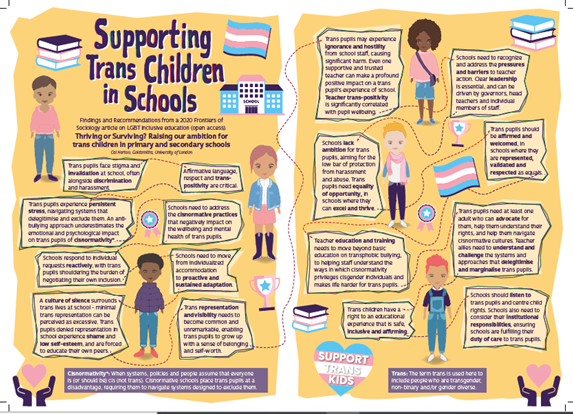
1 Page Infographic Resource and Poster

For teachers and schools there is a short infographic with some key recommendations (available to download or share in A3 or A4 versions linked below):

Infographic summarising article findings and recommendations. Yellow background with images of children and text in boxes.

A Free to Use Infographic providing findings and recommendations on how trans children can be enabled to thrive in schools.


Please view and download the Supporting Trans Children in Schools infographic here in your preferred version:

Web Version

Infographic PDF A3 Web Version

Infographic PDF A4 Web Version

Print Version

Infographic PDF A3 Print Version

Infographic PDF A4 Print Version

This infographic is free to use and share.

TGEU Rapid Response: Europe Failing Trans Children

Europe trans flag

Every year TGEU (Transgender Europe) releases an index of key indicators on trans rights, along with a map highlighting the performance across the continent (Europe and Central Asia).

The 2020 map, indicator and key stats are available here.

Frustratingly, in spite of requests for inclusion, there is still no analysis specific to trans children’s rights across Europe..

Taking the TGEU data, I’ve selected the six indicators that relate specifically to trans children, and highlighted the performance across the continent. These relate to the areas of Legal Recognition (3 indicators), Health (2 indicators) and Non-Discrimination (1 indicator). These six indicators are the only data collected by TGEU which have relevance for transgender children & young people and provide coverage of basic or fundamental rights.

The results are absolutely shameful.

RED: Actively hostile with little or no fundamental rights for trans children.

63% (31 out of 49 countries) meet 0 or 1 indicators with 9 scoring 0 for failing to provide even the very basics of non discrimination. The country is actively hostile to the very existence of trans children.

AMBER: Rudimentary rights for trans children.

30% (15 countries) meet only a few of the basic rights of trans children (score 2 or 3), These countries are failing trans children. This includes the UK where there is no legal recognition, nor coverage of health indicators, including no anti-conversion therapy legislation, in spite of signposting for government prioritisation following the National LGBT survey of 2018.

YELLOW: Moderate fundamental rights for trans children.

The single country meeting 4 or 5 indicators is Luxembourg, which meets the basics for Legal protection and non discrimination but does not meet either of the indicators for health.

GREEN: Fundamental rights for trans children are met.

Only 4% (two countries), meet all the fundamental rights of trans children and young people with 6 indicators in all three areas. Spain and Malta.

https://datastudio.google.com/embed/reporting/7a0a692c-6d2d-4b38-a903-56d57c8cc471/page/LgMQB

Europe2

Only 6% (3/49) of European countries have even moderate fundamental rights for transgender children and young people.

We need more people to care about this.

We need rights organisations (Stonewall, Amnesty, TGEU, Save the Children, UNICEF, Plan International) to collect data, and analyse this data, to help us hold government’s to account for the gross failings towards the rights of trans children across Europe. We need TGEU members to start asking TGEU to provide analysis specific to trans children and young people.

The six indicators above are a snapshot, taken from the TGEU 2020 dataset. There are other indicators that could be tracked that would give an even clearer picture of the ways in which Europe fails trans children. We need to start including dis-aggregated data in our analysis on trans rights, dis-aggregation that shows the specific ways in which trans children are failed. We need to start collecting data specific to trans children. We need dis-aggregated analysis of the data that we do have. And we need to start raising our voices about the rights violations that trans children face across Europe and beyond.

Who can help in this endeavour?

Watchful Waiting – A Parent’s View

penguin

Some more UK commentators, and even the Royal College of General Practitioners, have recommended a ‘watchful waiting’ approach for trans children.

I’ve written previously that this UK guidance is out of synch with the medical recommendations in the US, Canada, Spain, New Zealand, Australia. How it is out of synch with experts in other countries who consider watchful waiting, which they more accurately describe as ‘delayed transition’, to be harmful to trans kids.

Here I want to share my own experience, and the experience of other parents, on how watchful waiting plays out in practice. For me watchful waiting is a misleading term – it sounds very benign and sensible. While the term used to describe this elsewhere, ‘delayed transition’, is a more accurate description, the reality for those living through it is that ‘prolonged rejection’ is a better description of what ‘watchful waiting’ means in practice.

From as soon as my child could properly speak, they asserted ‘I am a girl’. For some initial time, in total ignorance about gender diversity, I opted for active rejection: ‘No, you are not a girl you are a boy’.

Months and months of daily (multiple times a day) active rejection followed. My child would insist their gender several times a day. Active rejection was not leading to any change in my child’s insistence (just an increase in my child’s distress and depression). I researched and came across the UK guidance for ‘watchful waiting’, whereby they recommend a supposedly neutral approach where a child is not actively rejected (ie stopping saying ‘no you are not a girl’) but without any active affirmation (without saying, ‘ok we will call you a girl’).

We really tried that watchful waiting approach with our child. This is how it played out in practice with an insistent, consistent, persistent and increasingly distressed trans child (and these are the children who we are talking about, who most obviously benefit from affirmation).

Every single day my child would cry and say ‘I’m a girl’. During watchful waiting we would tell them I loved them and we didn’t need to talk about gender – They were left thinking their mum and dad did not understand or did not care about this thing that was so important to them.

Every day they would cry themselves to sleep saying ‘But I’m a girl’. I would hug them and tell them I loved them, whilst ignoring the thing that was causing their distress. – They were left thinking that one part of them was broken – un-loveable – unacceptable. How shame inducing? How pathologizing?

Every day I would try to actively break down gender stereotypes, try to break down gender roles or restrictions around gender expression without supporting my child’s identity. This only made my child sadder as their mum was missing the point entirely. In one conversation that sticks in my mind:

Child: ‘But mummy I am a girl’

Me: ‘Boys and girls can do all the same things. Would you like a doll?’

Child: ‘I don’t like dolls, I am a girl…. can I have a spiderman’

In another one:

Child: ‘I’m a girl’

Me: (Desperately thinking about what my child might associate as typically ‘girl activities)… Would you like to try out ballet classes?’

Child: ‘I don’t like dancing’

Me: ‘What do you like?’

Child: ‘Climbing trees. Girls can like climbing trees’.

I was not listening to my child. I was rejecting her.

Every day they spent sad, rejected, and fixated on the topic of gender. They were losing out on the carefree fun childhood of their peers. Every day spent sad and depressed and rejected is a lost day of childhood. Every day spent feeling that who they are is unacceptable to their mum, is a day piling on shame, self-hate, low self-esteem.

I watched them get lower, get less happy, get less curious about the world, get less excited about life get sadder, get more isolated and alone. This is what I was watching. What was I waiting for? My child had told me in very consistent, persistent and insistent terms what she needed. She needed to be loved and accepted as a girl. It was the only thing that mattered to her and she felt deeply rejected, deeply broken, deeply unacceptable. Was I waiting for her mental health to crash? Was I waiting for her to snap out of it? Was I waiting for her to reach an arbitrary age? Was I waiting for her to turn 10?

What would waiting until age 8 or age 10 until I stopped passively rejecting her mean for my child? What would be the benefit to her, of keeping her in a state of continued rejection, depression and sadness until age 8 or 10 as the NHS advises?

What are the risks of waiting until age 8 or age 10 until I stop rejecting her?

What is at stake?

For me the biggest stake is her childhood, her happiness, her self-esteem, her self-worth, her curiosity, her interest, her learning, her education. I care about her happiness right here and now.

During our phase of watchful waiting, my child was on pause, she was stuck, she was unable to thrive.

As soon as we moved to affirmation, everything changed.

Affirmation was a much easier thing to do in practice.

She said:

‘I’m a girl’

And we said: ‘ok we will call you a girl’.

We switched pronouns. As far as our family life was concerned, that was a very quick and easy switch. We switched pronouns and our daughter thrived. She has never once cried herself to sleep since that day. She no longer wanted to talk about gender every time we were alone. She started to talk about animals, and space, and nature, and how things work. She started to explore. She started to have a childhood. She became lighter and carefree. A huge burden lifted from her shoulders (and noticeably shifted to ours as we sought to get the wider world to respect her identity).

The price of watchful waiting was very high for my family. The price was very high for my daughter.

Watchful waiting robbed my daughter of a period of her childhood. A period when she could have been happy and loved and accepted and carefree. When instead she was left feeling rejected and broken. For a child like mine, watchful waiting causes harm.

I am thankful that we had access to other sources of information (my next blog will be on the evidence base for affirmation versus watchful waiting).

I am thankful that the period of rejection was not so long, and that the damage to her self-esteem was not deep.

I am thankful that since the day we stopped rejecting her, the simple change of pronoun, she has flourished in every way.

She laughs, she can dream, she can learn, she can play. She is having a carefree happy childhood. This was literally not possible under prolonged rejection (ie watchful waiting).

Many other parents tell the same story. Of trying watchful waiting for months or years and watching their child sink.

People with no experience of living daily with trans kids need to start listening to the impact ‘watchful waiting’ has in practice. They need to start listening and understand that it is neither neutral, nor benign, nor easy. It is hard to passively reject your child daily. It is hard to watch them sink. It is an approach that fundamentally misunderstands insistent, consistent, persistent trans children. It is an approach that fundamentally undervalues the right of a trans child to a happy childhood.

Trans kids only get one childhood. They need to know they are loved as who they are. They need to know their parents and carers have their backs, will listen to them, will accept them, will stand up for them.

Stop rejecting trans kids. Passive rejection can hurt as much as active rejection. Quiet rejection, rejection through silence and omission can hurt as much as loud rejection.

Listen to your trans kids. Love your trans kids.


Review: A House For Everyone, interview with author, Jo Hirst

There are too few books which speak with authenticity about the experience of transgender or gender diverse children.

The majority of books about gender diverse children (10,000 dresses, My Princess Boy, The Boy in The Dress) focus on gender expression. These stories should be commended for celebrating children who break free of strict gender boundaries, but their message, that some boys, some potentially trans kids, can wear ‘girls clothes’ – always dresses, can be seen as subtly reinforcing the very stereotypes they aim to break – clothes after all, do not have a gender. These books rarely focus on gender identity, ie. who that child is, instead focusing on what they wear, or their play and friendship preferences.

Many of these stories follow a well worn trope of a child who is initially picked on for being different, is upset by this, and then following an event or intervention, is accepted by others. This simple message of celebrating difference might be helpful for children not experiencing these issues to understand the experience of those who are, but has the potential to cause shame and upset in those children who are already experiencing stigma due to their gender non conformity.

While there have been a handful of attempts to tackle gender identity in children in an accessible way, these frequently rely upon the same gender stereotypes of the gender expression books above. It is difficult, even for adults to get to grips with gender identity, how then can this be successfully handled for a child while avoiding pitfalls of stereotyping toy choices or the pink = girl, blue = boy gender binary.

Jo Hirst’s book, A House for Everyone, is a revelation. The picture book tells the story of a group of friends who are gender diverse. Together, they build a tree house and each child is introduced to the reader in turn. It is a simple and short book with delightful art. There is a strong and fast girl who has short hair and never wears dresses, a trans boy, a non binary child, a boy who loves dresses, and a boy with long hair who likes art, flowers and sport.

IMG_4052.jpeg

Jo, is both a parent of a transgender child, and a feminist critical of gender stereotypes. She is one of the voices leading the call for school uniform reform in Australia, and has spoken out about gender stereotypes.

I spoke to Jo about her book and what her hopes are for trans children:

@DadTrans: Your story includes both a trans boy and a non binary child, what motivated you to include these characters?

Jo:  I wanted a story that would include transgender children and children who’s gender expression might differ from the social ‘norm’. It was important to me to show a clear difference between gender identity and gender expression. And at the same time let all children know that wherever you fit on the gender spectrum, no one is tied down to any stereotypes. Toys, clothes haircuts- these things don’t have a gender, it’s about what makes you feel comfortable.  I chose a trans boy because of my son but also because they are underrepresented in children’s literature and in the media space in general.(Compared to trans girls) I’m not sure why that is as they are certainly out there in large numbers.

It was also very important to include a non binary child. While we are starting to see more young adult books with non binary characters, there are almost no books for young children, apart from “Are you a Boy or a Girl” [By Fox and Owl]. When the Trans Pathways research was done in Australia last year, 46.8% of the young people surveyed identified as non binary. I meet a lot of young non binary people here in Australia. If your child has not met a trans or non binary person yet, it won’t be long! It’s a good idea to get the conversation started

@DadTrans: We’ve found a lack of books which both cater to trans & gender diverse children and also don’t fall back on gender stereotypes. How did you address this issue in A House for Everyone?

Jo: I was very aware of not only not wanting to fall back on gender stereotypes but also to make the story a very positive one. The plan was to just have the story without any explanation of Gender initially. But after testing the first version on groups of parents and teachers, I found that the pronouns alone were not enough to explain who the children were, and what their gender identity was. I added some ‘notes for grown ups’ including terms, as well as a lesson plan, links to resources and further reading.

@DadTrans: A House for Everyone is your second book focusing on gender identity in children. How does your first book, The Gender Fairy, differ? What lessons did you learn along the way?

Jo: The Gender Fairy was about two binary transgender children making a social transition. The main purpose of that book was to let transgender children know they are normal and they are not alone, that there are other children like them. While The Gender Fairy doesn’t have the same focus on gender stereotyping, there is an opportunity to talk about how society stereotypes boys and girls especially at the beginning of the book. At the same time, many young transgender children do gravitate towards stereotypical boy and girl toys and clothes, just the same way cisgender children do. I do love that the gender fairy themselves are non-binary, and my favourite line is the last one when the children ask the fairy whether they are a girl or a boy, and the fairy answers “does it matter?”

@DadTrans: What other books would you recommend for trans or gender diverse children and their parents?

Jo: The Rainbow Owl website has a fantastic list of books and resources which they keep up to date with latest releases. (That’s recommended for parents by the Australian Psychological Society and reviews books for all ages from all over the world)

@DadTrans: What do you see as the biggest challenges facing transgender children and young people?

Jo: I would quote the trans Pathways research which found without family, school and community support 48% of trans youth had attempted suicide. It’s an uphill battle to get support in the face of backlash from transphobic conservatives and media. At a time when (in Australia at least) our doctors and psychologists are telling us to support our kids they are making it really hard. The hardest part is when kids are weaponised is political debates.

@DadTrans: You have spoken before about the lack of gender stereotyping in your own childhood. How much do you think that has influenced your books?

Jo: Parental roles, clothing and toys were not overly gendered in my own early childhood. My mother was a builder when I was growing up in the 1970’s with her own “Handywoman Service” and my dad was an English and History teacher who was an equal hands on parent which was unusual for that generation. My mother has what some people would describe as a masculine gender expression and has always identified as cisgender. I have always been able to see the distinction between gender identity and gender expression. The character ‘Ivy’ in A House for Everyone is very like my mum. She likes to have her hair cut very short, never wears dresses, was the fastest runner at school and was always the leader.

@DadTrans: As the mother of a trans child, what are your hopes for your child and the current generation of trans & gender diverse children?

Jo: I’ll be really happy when one day we don’t need books like this because everyone understands gender diversity.

I would like a world for my child and all children where being trans or gender diverse does not put you in danger. Where being trans and gender diverse does not mean you have less human rights than your cisgender siblings. Where all children have equal access to safe schooling, healthcare and supportive families and good friends. Pretty much what every parent wants for their child.

IMG_3704.jpeg

Final thoughts:

Review from @Fiercemum: A House for Everyone is exactly the book I’d been looking for, a book that includes and recognises and has space for, children who are transgender as well as those who are gender non-conforming. I’ve read it with a wide variety of children – and I see how much representation of diversity matters.

The book includes a trans boy and a non-binary child, two categories that are under-represented in books aimed at primary school age. One of the biggest responses I’ve had whilst reading the book, was from a gender non-conforming 5 year old cis boy, who was incredibly moved and validated by the book’s depiction and acceptance of gender non-conforming boys, boys with long hair, or who like sparkly dresses. The strong and fast girl Ivy, the group’s leader, is a character who would have spoken to me as a child, as a dress-hating cis ‘tom boy’, and is a character who resonates strongly with my trans daughter, who similarly loves climbing trees and having adventures.

In a world where many books about trans girls depict ultra femininity, in a world where many books about trans kids conflate and blur the differences between trans identity and gender non-conformity, A House for Everyone is a welcome breath of fresh air.

I recommend it for parents and schools to read with trans kids, for gender non-conforming kids, for kids who are diverse or different to their peers, for kids who love adventure, for kids who need to know that this world is diverse, that being different is ok, that there really is a space for everyone.

IMG_3889.jpeg

Other children’s books on gender we’ve enjoyed:

You may also want to check out the following books we’ve liked (in a rough order of reading age):

Red, A Crayon Story

‘Pink is a Girl Color’ and other silly things people say

Are you a boy or a girl?

Vincent the Vixen

George

Lily and Dunkin


Why does a biological underpinning to gender identity matter?

science

Biological essentialism vs social constructivism

Biological essentialism (or biological determinism), is the idea that behaviours, interests or abilities are biologically pre-determined, rather than shaped by society. In an essentialist interpretation, innate differences between men and women result in  ‘natural’ gender divisions  – with men inherently (innately) better at decision making and women better at nurturing.

Feminists, Freudians, and queer theorists have all challenged biological essentialism. Second wave feminists argued that gender-based inequalities and differences were not natural, and were instead socially constructed. Girls are not inherently worse than boys at physics (due to having pink and fluffy brains) but rather, are often denied the opportunities offered to boys. Social constructivists demonstrated the many ways in which observed gender differences between men and women are socially engineered. Some went a step further, arguing that gender is purely a learned behaviour or a performance.

Brains are complex, and social constructivists, like the popular science writer Cordelia Fine, have rightly debunked the simplified and shoddy science that underpins essentialist claims that men are from Mars with their manly brains, and women are from Venus, with feminine brains.

Gender identity and the neurology of ‘trans brains’

Where then does gender identity fit in?

Some scientists have conducted neurological imaging studies on trans people, exploring whether there are specific, sexually dimorphic areas of the brain in which trans people differ from their assigned sex (the sex they were presumed to have at birth).

Published research findings, often with low sample sizes, have been interpreted as indicating that trans women have a brain more similar to a cis (not trans) woman’s brain than to a cis man’s brain. Such findings have been publicised in newspaper headlines as proof of the existence of trans people.

Such scientific studies, and their shallow interpretation and presentation in the media, have received strong criticism from a wide number of transgender commentators. There are a range of extremely valid reasons for criticism:

  • The suggestion that one specific variable can define ‘transness’ is reductive and overlooks the ways in which society, culture and experience impact on every individual including on the structure of the brain.
  • The reliance on any study as legitimacy for human rights is extremely dangerous – if the study results are later rejected, what happens to these rights?
  • The idea that any brain can be easily classified as male or female is simplistic and overly binary.
  • The suggestion (made by inaccurate media representation of the studies) that one specific variable can be used as a diagnostic test for transness also fills people with fear that any such test could be used by gatekeepers to judge who is accepted as trans and who can be denied support and denied rights. Any such diagnostic test would be entirely at odds with autonomy, with respecting people’s lived experience, with self-identification and dignity.

These reasons for fearing how science will be politically used, or for criticising simplified interpretations of scientific data, make total sense and have historical antecedents – I understand the fear and upset.

Rejection of biology

However, such comments very often seem to take one step further, rejecting not only biological essentialism and the unhelpful simplified, ‘soundbite’ biology loved by the media, but also moving into a sweeping rejection of any mention of a link between biology and gender identity. A culture in which the very mention of biology is discouraged.

This is where as a cisgender (not trans) parent of a transgender child I feel uneasy. I’ll attempt here to explore this from my cis parent’s perspective.

Pathologisation of diversity

For many decades, psychologists and psychiatrists have been aware of trans children expressing distinct gender identities at an early age – 2 or 3 years old.

Across the twentieth century mainstream medical convention, with some exceptions, rejected out of hand any possibility of a biological underpinning to gender identity. The consensus then was that a trans gender identity was a delusion, a mental illness that could, and should, be ‘cured’.

For young trans children, misogynist male psychologists and psychiatrists, frequently working in the field of sexology, focused their attention on the mother.

Therapy and treatment for young trans children focused on presumed maternal abuse or maternal failings.

Does it even matter why trans adults are trans?

When I hear people say ‘does it even matter why people are trans’ – when I hear people dismiss as offensive and unnecessary any consideration of any biological influence on gender identity, I have an emotional response. I also see this reaction in some other parents of trans children (though certainly not in all).

The denial of any possibility of a ‘biological underpinning to gender identity’ is historically tied up with the denial of the existence of younger trans children. The erasure of the existence of younger trans children has caused untold suffering.

As a parent of a trans child who is loving life, it makes me think of the trans children from decades past (and present in too many places in the world) who were traumatised and institutionally abused by medical systems designed to prevent or convert their gender identity. Neither the genitals = sex = gender approach of simplified biology, nor the feminist ‘gender is a social construct’ mantra, left any space for younger children to be trans. Trans children did not fit with either theory so therefore could not exist.

Impact of denial on families

Denial of the possibility of some young children being trans makes me think of the consequences of this denial. It makes me think of the mums who were coerced into distancing themselves from their trans daughters, based on some unsubstantiated theory that an overly close mother-‘son’ bond might lead to a child ‘misidentifying’ as female. How unbelievably cruel to do that to a family.

Shon Faye, whose work I greatly admire, recently wrote that she disagrees with anyone who suggests gender identity is innate and that it should not matter why people are trans. CN Lester, another writer whose work, and excellent book, I’ve learnt a lot from, critiqued the reporting of the research study under discussion  and recommended reading work by Cordelia Fine, author of ‘Delusions of Gender’.

This particular recommendation makes me want to cry.

Delusions of gender as a book has real merits in its debunking of simplified biology,  in its understanding that gender-based inequalities are not natural, and that men are not inherently better at parking. So far so commendable.

However, Cordelia Fine replaces the simplified biology of biological essentialism not with nuanced and complex biology, but a nod to social constructivism. Her work is routinely used by those who argue that gender is merely a ‘performance’ and that trans identities do not exist, except perhaps as a non-conforming person’s misguided response to gender norms.

The view that gender is purely a construct and therefore not ‘real’ is pervasive and extremely dangerous. Adherents of this view may well tolerate trans adults – with a patronising assumption that trans adults made a ‘choice’ to ‘change gender’ as a response to their non-conformity. But whilst adherents of social constructivism may begrudgingly  tolerate the existence of trans adults to some degree, they allow no such tolerance for younger trans children.

The gender as purely a social construct contingent see social influence and gender stereotyping as the only reason for trans identities. They see no valid reason for the existence of young trans children.

Some of the more fringe, actively transphobic, elements of this group, throw their hate and bile at parents of trans children, accusing us of child abuse, demanding that the state take our children away, demanding that children be protected from ‘transing’.

The recommendation to read Cordelia Fine hit a particular nerve as ‘Delusions of Gender’ had a direct impact on my family. We had a family friend who was unable ‘ideologically’ to accept the possibility of the existence of a trans child. They rejected our child and through that rejection, our family entirely. In a parting gesture, they pleaded for us to read ‘Delusions of Gender’. This very book had been the germ of our now former friend’s belief that any trans identity is a delusion, and that pandering to childhood delusion is parental abuse.

Through my shock and upset, I was struck at the time by the unbelievable arrogance. The recommendation that instead of loving my daughter, I should ‘read up on Fine’ and learn that gender isn’t real. This was not to be the first such recommendation.

Fine’s work is populist and best selling, and over the years I’ve had countless similar comments from ‘well meaning’ individuals. It is not that I am ignorant or closed minded, far from it, I’d hazard I know more of Fine’s exploration of gender than those dabblers. I have read, considered, understood the theoretical position being proffered. The same cannot however be said of the Fine pushers. Their position is based on an assumption (from those who have no first hand experience of trans children) that trans children do not, indeed cannot, exist.

The recommendation to read Cordelia Fine is also, depressingly, front and centre in the advice that the UK Children’s Gender Service’s website provides for parents of trans kids. No space here for a clear and much needed message that ‘some kids are trans – get over it, try to be kind’. Instead they present a false dichotomy between simplified biological essentialism reduced to mention of “a boy’s brain in a girl’s body” and “academic psychologist Dr Cordelia Fine” and “gender as a social construct”, with differences based on experiences rather than biology. Parents wondering whether to accept and love their trans child are instead advised to read about the delusion of gender.

When parents and their children reach the children’s gender service in the UK, if they are allocated one of several apparently deeply transphobic clinicians (clinicians who hold so much power over trans children and families), they may then endure literally years of probing and questioning on parental views on gender, as the clinicians probe for the ‘root cause’ of gender diversity.

The social constructivist view also makes me think of the school teachers and class parents and wider community who argue that a child is too young to make a ‘choice’ to be trans and should wait until adolescence or adulthood. Who don’t see the harm of denying a child a happy childhood.

It makes me think of the people who look at us with suspicion, hostility, scrutiny, when I mention I have a trans child. Of the parents who steer their child away from ours, in case being trans is socially contagious.

It makes me think of the people who are no longer in our family’s life, who are unable to see a trans child as anything other than ‘social conditioning gone wrong’.

It makes me think of the people online and in person who target parents of trans children and accuse them of child abuse for loving their child. It makes me think of the haters who want trans children erased from our schools and communities. Who want trans children to be marginalised, made invisible, kept apart from other children.

The existence of trans children poses a challenge both to the simplified biology of biological essentialism and to social constructivism (the idea that gender is merely a performance).

Who cares whether or not biology has any role?

Many people argue that it should not matter whether being trans is partly influenced by biology or fully shaped by culture, society and upbringing. They argue that acceptance will not come through identifying a ‘cause’ for transness, but through people getting to know trans people.

I imagine and hope that acceptance will gradually emerge for trans adults. I think things are slowly moving forward.

What about trans children though? How do we ensure that gains in acceptance and visibility and legislative rights do not leave out trans children, the most vulnerable, those without a voice.

Too many advocates for the rights of trans adults are silent on the topic of young trans children. Many have no understanding or awareness that trans children exist. Others, consider trans children too controversial, too divisive to stick up for.

Trans children are nearly completely invisible. And whilst there remains a default assumption that gender identity is shaped not at all by biology but purely by culture and upbringing, then there will remain a reluctance to support younger transgender children.

Those who believe that gender is purely a performance, who believe that trans identities are socially constructed, do not believe in the existence of young trans children.

The erasure of trans children allows haters to paint themselves as crusaders saving children from being socially influenced or indoctrinated into being trans.

With no openness to the possibility of a trans child being part of natural diversity, they look for a reason. With young children it is blame the parents. With older children it is social contagion. In the first scenario they advocate removing children from abusive parents. With the second scenario they ask that trans identities never be mentioned, embraced or supported at school. For parents who are afraid and unsure how to react to a trans child, they advise conversion therapy.

Another way

Yet, as soon as people open their minds to the idea that there might be a (complex, messy, unattributable) biological underpinning to trans identities, that trans children exist, and have in fact, always existed, the whole deck of cards upon which the transphobes build their hate comes crashing down.

This opening of minds is possible. This opening of minds and shifting of world view happened to me.

Growing up as a gender non-conforming feminist, tired of sexist societal restrictions and expectations, I was instinctively drawn to a social constructivist view point. I had never met a trans person, but had subconscious, lazy, uneducated assumptions about trans people being enthralled to gender stereotypes. I have former friends who are still tied to this world view.

My world view was shaken when I had the good fortune to have a child who opened my eyes. An assigned male child who was insistent, consistent and persistent that she was a girl from the youngest age.

Learning to reset my assumptions

At first, I really struggled to accept my child as a girl. I told her she was wrong. Mistaken.

I did not believe it was possible for a young child to be trans.

I was certain that this child was too young to understand or reject gender norms or sexism or heteronormativity. I knew they were not making a choice, and certainly weren’t being influenced to be trans (she had never come across any representation of a trans person and I was unconsciously transphobic). She wasn’t even gender non-conforming in her interests. A suggestion I sometimes hear (from people who have barely met a trans person) that she was repressing internalised homophobia in infancy is absurd.

She had a persistent, consistent, insistent knowledge that she was a girl that withstood all forms of persuasion.

Like hundreds of parents all around the world who have experienced the same, I had to learn to reset my assumptions about gender identity. I learnt to love and accept my child for who she is. I have never looked back. She is happy and thriving.

I see how people who emphasise ‘gender as a social construct’ utilise that simplistic maxim to make my daughter’s life impossible. How they use it to argue against her rights. How they use it to accuse parents of abuse.

I see how people who claim genitals = sex = gender similarly use simplified biological essentialism to argue that my child is defined and invalidated by parts of her anatomy.

Neither the simplified biology of essentialism, nor simplistic social constructivism, leaves space for my daughter to exist.

Is there an alternative paradigm?

Holistic views of gender

I recently had a short email exchange with Julia Serano and she kindly shared a chapter she wrote on this topic back in 2013 (Excluded: Making Feminist and Queer Movements More Inclusive – chapter 13: Homogenizing Versus Holistic Views of Gender and Sexuality). What follows is what I took away from her chapter, adapted into my own words – I recommend reading her chapter first hand.

In this chapter, Julia critiques the failings of both simplified biology, (gender determinism) and social constructivism, which she terms gender artifactualism.

She outlines how biological essentialists and biological determinists, (often genital obsessed religious conservatist non-scientists), misrepresent and misunderstand biology and science. They present a simplistic last century school child’s version of human biology, assuming that a simple gene or hormone or chromosome works unilaterally triggering a domino rally of binary outcomes.

She also outlines the failings in social constructivism. For decades children’s gender services were dominated by social constructivists who believed that children could not really be trans and that such children could be engineered into accepting their assigned gender. Yet these efforts failed. Medical consensus is now absolutely clear that conversion therapy is unethical and ineffective – conversion therapy did not change a person’s gender identity, merely produced shame, self-hate and depression. Julia notes that gender identities are often ‘profound, deeply felt and resistant to change’. She notes that some people have a fluid gender identity, and that some people do experience a shift in their identity over time, but that such shifts do not result from external pressure and are ‘almost always inexplicable, unexpected’.

She advocates rejection of both simplified biology (biological determinism) and social constructivism (gender artifactualism). In its place she presents a holistic model of gender.

This holistic model of gender acknowledges that biology is complicated. Human biology is not the simplistic yes/no on/off approach that non-scientists and biological essentialists like to pretend. Real biology is complex, multi-faceted, interactive. Just because some people misuse (simplified) biology, does not mean biology itself is essentialist, deterministic, reductionist or sexist.

Julia notes that ‘the human genome has 20,000-25,000 genes. Any given gene or hormone is affected by countless different interacting factors. Because genes and other biological factors act within intricate networks, any given factor will push a system in a particular direction, but will not single-handedly determine a particular outcome’.

Julia argues that ‘while our brains are shaped by learning and socialisation, they are not infinitely plastic ie they are not blank slates. Some traits have a strong intrinsic component’. She notes that though ‘socialisation has a significant impact on brains and behaviours’ it ‘cannot fully override certain intrinsic inclinations’.

She makes a comparison with left-handedness, which is observed in utero before any socialisation. Even with societal pressure to conform to right-handedness some individuals maintain a preference for using their left-hand.

A holistic model of gender allows space for a biological underpinning to gender identity. A holistic model of gender considers the complex interactions between biology, society, experience.

Biological underpinning to gender identity

A wide number of scientific studies have concluded that there is a durable biological underpinning to gender identity.

This supports what other parents with experience like mine have been saying for decades from their lived experience. This backs up what some trans adults remember from their earliest childhood memories.

There is increasing evidence of trans children who have clear gender identities at a very young age. This evidence of young trans children is present in diverse countries and cultures across the world.

The growing scientific consensus of a biological underpinning to gender identity led to the global endocrine society publishing a position statement last year:

“The medical consensus in the late 20th century was that transgender and gender incongruent individuals suffered a mental health disorder termed “gender identity disorder.” Gender identity was considered malleable and subject to external influences. Today, however, this attitude is no longer considered valid. Considerable scientific evidence has emerged demonstrating a durable biological element underlying gender identity. Individuals may make choices due to other factors in their lives, but there do not seem to be external forces that genuinely cause individuals to change gender identity.”

(for the full position statement and more on the studies see here)

I welcome this consensus. I view it with hope that it will help open eyes and minds and hearts to the existence of trans children like my daughter.

I would happily share this scientific consensus on a biological underpinning to gender identity with a wider audience – I see in it hope of greater acceptance and support for trans children.

However I note that since the publication of this evidence based position statement from the medical establishment, I cannot recall having seen this printed in the media or even referenced in the few articles commissioned by trans authors. Indeed quite the opposite – more often there is a strong resistance to any mention of biology.

Do we have to reject biology?

I understand the scepticism around how biology can be misused, but surely that does not mean this should be rejected outright?

Whilst supporters of trans rights shy away from biology and science, it allows transphobic groups to present themselves as champions of science and rationality. Claims that couldn’t be farther from the truth.

Transphobes focus on gender as performance, as fake, as a delusion. Whilst a huge part of what we call gender is socially constructed, my child’s gender identity is not a choice, is not a delusion, is not a product of societal or parental persuasion.

Transphobic groups like to focus on what they simplistically call biological sex. They describe biological sex as a simple binary reality, with gender identity operating on some parallel dimension outside of biology. My daughter is 100% biological. She does not have a magic gender identity spirit disconnected to her biological body. Her biology is no less real or valid than the biology of cis girls. It is not essentialist to claim that her identity is an integral aspect of her biological reality. The true essentialists are those trying to present a simplified and fraudulent version of biological science, utilising distorted, cherry picked and biased pseudo-science to support a transphobic position.

Acknowledging biology without essentialism

The argument that we should avoid science in case it is essentialist or in case it is used against trans rights is a false logic.

  • It is possible to acknowledge the biological underpinnings of gender identity whilst acknowledging that a person’s felt and expressed gender identity is a complex interplay of biology, culture, socialisation and experience.
  • It is possible to acknowledge the biological underpinnings of gender identity whilst simultaneously recognising that identity is neither fixed, nor binary.
  • It is possible to acknowledge the biological underpinnings of gender identity whilst arguing very strongly against diagnostic testing for ‘transness’ or biological gate-keeping and identity policing.
  • It is possible to acknowledge the biological underpinnings of gender identity whilst maintaining that the only way to know someone’s gender identity is to ask them, and that a right to self-identification is a basic part of dignity

My daughter is real and valid and deserving of rights, equality, respect and dignity regardless of our current understanding of science.

But science already has plenty of evidence that trans children exist and that there is a biological underpinning to gender identity and I see no reason not to talk about this. Having a trans child (or being a trans child) does not mean rejecting science.

We should embrace science

My daughter is growing up with a love of science. A thirst for knowledge. I’ll teach her all the science I know, on microbiology, on chemical reactions, on photosynthesis, on plate tectonics. On neurology, on genes, on hormones and gender identity. On sample sizes, on causality, on peer review, on rigour, on interpretation and data manipulation.

Biology is rich and complex and we have so much still to learn. If she carries on with a love of science she will learn things far beyond my knowledge. Science (high quality science) is full of wonder and excitement and discovery.

We should not be afraid of saying loud and proud that we support science. We should be clear that those attempting to attack or dismiss transgender children and adults not only lack empathy and kindness, they also lack sophisticated understanding of science, of biology, of complexity.

Trans children exist.

They know it.

Parents know it.

Science knows (a bit about) it.

Stand up for trans children


I am (and always will be) learning. Friendly feedback is welcomed.


Girl Guides: How to radicalise hate against trans children in 10 easy steps

supporting trans members

Tomorrow, following a short but successful propaganda campaign, a UK Newspaper will publish an open letter asking Girl Guiding UK to suspend their policy of inclusion for All Girls, including those who are transgender.  Guides has always, quietly, been inclusive of trans children. While there was a small amount of sensationalist and transphobic media reporting in 2015 when the current policy was formally adopted, until six weeks ago, there has been no organised attack on the organisation which my daughter is a part of. Why now? What has changed to make Girl Guides, Brownies and Rainbows a target of action from transphobic groups? This is not a random act, but follows concerted attempts by trans exclusionary groups to influence thinking within the UK Labour party on whether trans women should be included on All Women Shortlists.

It is part of the wider context of a small but vocal and increasingly organised loose coalition of groups made up of Evangelical lobbyists such as Christian Concern, radical feminist academics, misogynistic Men’s Rights Activists, reactionary conservative voices, and a growing grass roots anti transgender rights movement which has formed around the parenting forum ‘Mumsnet’. There, with few restrictions on content, under a banner of free speech, these groups have found one another, have radicalised and organised without challenge or moderation, united behind a single purpose – preventing advances to the rights of transgender people in the UK.

The campaign against inclusion of transgender women on Labour Party All Women Shortlists was the first active campaign to find an audience outside niche anti transgender corners of social media. This anti-trans equality campaign included a crowdfunding initiative calling for legal challenge to Labour Party policy, petitions to the Government, multiple linked websites promoting (mis)information, national public speaking tours by trans exclusionary activists. It provided easy media pieces for an already transphobic UK media, satisfying the UK Public’s seemingly unquenchable interest in stories written about (but not by) transgender people.

Girl Guiding are the next and latest focus of this anti trans rights coalition. Strategically, Girl Guides are seen as a soft target. Transgender children have little support, are regularly maligned by the mainstream press and importantly have no voice or right of reply.

The campaign built against Girl Guiding has been so rapid, so honed, that without knowledge of the context and the anti-trans equality groups involved, it could be misinterpreted as representing the concerns of the guiding movement. Instead of what it actually represents, the latest target of existing transphobic political lobbying by a small but active group of dedicated anti trans equality activists.

Here I present a 10 step guide to ‘how this campaign against trans girls and Girl Guides has played out’. And in response, rather than engage with their hate, I’ve simply listed 10 more productive activities that our daughter, a trans member of girl guiding, and the target of this campaign, has been engaged in during the same period.

Ten Steps to Raising Hate against Trans Children

Step 1: Take a committed transphobe with multiple anti-transgender websites.

Step 2: Get invited onto The BBC Victoria Derbyshire show (05/03/18) to discuss reform of the 2004 Gender Recognition Act (Spoiler, this act and therefore this discussion has no relevance to trans children –  trans inclusivity is already covered by the 2010 Equality Act).

Step 3. Veer off topic with a hypothetical story about a predatory 14 year old boy pretending to be a girl to assault 11 year old girls at guide camp. Use this to publicly criticise Girl Guides for having a long standing approach welcoming All Girls, including those, who happen to be transgender.

Step 4: Create a thread on Mumsnet (home of transphobic discussion) to stir up hate and radicalise a wider population against a vulnerable minority (trans girls).

Step 5: Set into action existing anti-trans children websites and social media platforms, spreading fear and hate.

Step 6: Launch new anti-trans-children Facebook groups specifically to campaign against trans girls being accepted in Girl Guiding.

Step 7: Reinforce inflammatory talking points to enable radicalisation of people against trans children: focus specific attention on ‘child on child sex abuse’

Step 8: Send Mumsnet thread to friendly transphobic Times journalist for yet another attack piece in a long running campaign against transgender children. Have anti-trans-children story picked up by multiple other national newspapers.

Step 9: Inundate Girl Guides HQ with letters and emails, in an attempt to pressure Guiding to change their trans inclusive approach, adding veiled threats of legal action.

Step 10: Get your friendly anti-trans newspaper to publish a letter demanding that Girl Guides review their Transgender Policy (This Sunday, according to Mumsnet, the oracle on all things transphobic).

How to respond?

How can a mum like me fight back against such organised hate? How can I keep my daughter safe?

I write an anonymous blog. I have no power, no influence. I can count upon a tiny handful of allies willing to stand up for trans girls like my daughter.

There is no ‘powerful transgender lobby’ to defend us. I wish there was. There are no trans newspaper editors, no trans judges, no trans MPs.

It is hard to deal with so much hate. It is hard not to feel afraid. To feel like my country is not a safe place for my child. But life carries on.

Girl Guiding has been strong in their refusal to bend before a building anti transgender media, and have reinforced their commitment to All Girls in public statements. I am confident they will not waver in their commitment despite the latest media onslaught.

While incessant transphobes devote days upon days to making my (transgender) daughter unsafe and unwelcome, she’s been getting on with her life. Whilst they spread lies, misinformation, and hate, let’s see what my trans daughter has been up to:

10 better ways to spend your time

1: Learning British Sign Language to be able to better communicate with a deaf friend: https://www.youtube.com/watch?v=VRYQayi9czM

2: Going to school, learning stuff, (same as every other child)

3: Enjoying a Guides celebration of Mardi Gras (dancing, eating, painting)

4: Practicing tent building skills (indoors as it was snowing!)

5: Going to the cinema, eating popcorn

6: Attending a talk by local police officer on women in policing

7: Building a fire in the garden – attempting to make smores – giant mess

8: Reading Harry Potter (again!)

9: Eating too many Easter eggs (trading white chocolate eggs with younger sibling)

10: Laughing, smiling, talking, sleeping, loving, dancing, dreaming, living.


It is easy to paint trans girls as a scary menace.

My child is not a risk. She is not a threat. She is not scary.

She loves camping with her friends, staying up late, eating marshmallows (& smores) and telling ghost stories.

Anyone who knows a trans child like my daughter, can see how ridiculous anti-trans girl fear-mongering is. She is just like any other girl.

Those inciting anti trans fear, prejudice and hate know that the public don’t know any trans people, much less trans girl guides, brownies, rainbows. They rely on this ignorance.

Inciting hate against trans girls is not balanced ‘debate’. This is hate against a defenceless and vulnerable group of children.

No wonder trans children are at breaking point and the UK has become a dangerous place to be transgender.

No wonder, according to Stonewall’s School Report, 84% of trans children in school have self-harmed.

Anyone reading this who is a parent or carer – how would you feel if a child you love was the target of a cruel hate campaign? If they were being targeted just for being different.

My child is not a risk. She is not a threat.

She loves painting, hiking in the country, climbing trees, camping with her friends. She loves dancing like no-one’s watching.

My daughter is wonderful, kind, sweet (brave, clever, strong, and funny) and she loves Guiding.

Girl Guiding’s motto is ‘For All Girls’. Girl Guides is inclusive of deaf girls, girls with disabilities, girls from different ethnic or religious groups, and yes, trans girls too. Diversity. Inclusion. Kindness.

That includes my daughter.

Update 15/04/2018:

This morning the letter was published in The Sunday Times. Of the 100,000 volunteers in Guiding a paltry 220 people signed the letter who claimed to have some involvement in Guiding of whom a meagre 12 are current leaders. This demonstrates just how fringe these anti trans rights views are within Guiding, the wider British public and the UK Media led by the Times.

This last month and the last year or so has been a truly frightening time to be parents of a child who happens to be trans living in the UK. A week ago we were near to coming to the difficult decision to withdraw our child from Guiding as we were concerned her presence might not continue to be welcome. This would have been giving in to the bullies something we have raised our daughter, supported by Guiding to stand against.

We want to thank all those who have sent messages of support by email, Facebook, twitter from all corners of the world. Girl Guiding truly is a global movement and we’ve been overwhelmed by the positivity and solidarity in the face of these bullies.  Thank you to Girl Guiding UK, Chief Guide Amanda Medler, and the UK media communications team. Thank you to the incredible leaders, both locally and throughout the UK who have helped us stand strong, either because they have a trans child, sibling or family member, have a trans child in their section, or who simply because they wanted to help spread the message that Guiding is for all girls.

Thank you,

thank you,

thank you.


#ForAllGirls