AUSPATH KEY-NOTE SPEECH

In late November I attended the AUSPATH (Australian Association of Transgender Health) conference in Tasmania, Australia. I had been invited as the key-note speaker on the first full day of the conference, given a 50 minute slot (followed by 40 min panel discussion with head of WPATH and head of PATHA (New Zealand Association of Trans Health). The audience was 555 people invested in trans healthcare, mostly trans healthcare professionals and advocates from across Australia, with a 50+ contingent from New Zealand. For transparency, as an invited key-note speaker I had my travel and accommodation paid by Auspath – I did not receive any other payments. A few people have asked if I can share my presentation – it was not recorded but I have captured a lot of the presentation content here, a mixture of my notes and memories combined with some of my slides.

Hi everyone, I’m absolutely delighted and honoured to be here today. I’ve already learned a lot about Australia in just a few days – I’ve learnt what a drop bear is. I’ve understood that my taste in Australian beer (VBs) is apparently bogan.

My name is Dr Cal Horton, I’m a trans and non-binary researcher from the UK. I’m also a parent of a trans kid. Being an advocate for and parent of a trans kid is not a particularly great position at the moment in the UK, so I will ask for no photos today please. I am currently based at both Oxford Brookes University and University College London. I am actively looking for routes out of the UK for my family, so if anyone is looking to hire a researcher, get in touch. I have no declared conflicts of interest – big pharma hasn’t come knocking yet – any day now, I’m sure.

Before I begin my presentation, I want to start with a reflection on the time and place at which I’m talking. In terms of place, I want to acknowledge the Muwinina and Palawa people as the traditional owners of this Land. I recognise histories of violent colonialism and brutal dispossession, and pay my respect to Aboriginal Elders past and present across Lutruwita. Sovereignty was never ceded, this was and is Aboriginal land. In terms of time, I recognise that we are speaking following two years of live streamed genocide in Palestine. In the UK we have a long and brutal history of colonialism and violence against marginalised groups. I note that this year the Lemkin Institute for Genocide Prevention raised a red flag warning for risk of genocide for trans and intersex communities in the UK.

Today my presentation is going to focus on how we move from pathologisation and violence to autonomy and rights in trans healthcare, with a focus on trans children. I’m using the term trans child to refer to everyone under the age of 18, though will sometimes reference more specific terms like trans adolescents where relevant.

When I talk about why the UK is so bad for trans people, why it is so bad for trans children, and for trans children’s healthcare, it is important to talk about the three Ps. Firstly Prejudice. We have a situation where individuals holding acute prejudice about trans people are in positions of influence or leadership over trans children’s healthcare. We have individuals in charge of the new children’s gender service who have never even attended WPATH, yet who have found the time to attend events organised by misinformation groups recognised as anti-trans hate groups.

The second important P is Pathologisation. In the UK you never even here the term ‘trans child’ in our NHS. It is all ‘gender questioning children’ or ‘children distressed by their gender’, ignoring the reality that the major reason that trans children are stressed and distressed is because of the violent persecution they are facing, including from the NHS. The language in the UK always focuses on describing trans children in pathologising terms, describing them as a group that are “complex” with extensive “co-morbidities”.

The third P, that impacts on trans children’s oppression in the UK, is Power. The current situation for trans children in the UK, the current situation for trans people in the UK, is impacted by the systemic exclusion of trans people from positions of establishment power, across and beyond the NHS. In my work, understanding why everything is stacked against trans children, I’ve started to increasingly focus on the concept of cis-supremacy.

PART 1: where the UK startedpathologisation & defensive practice
1A) Pathologisation 
Trans children’s care siloed in psychoanalysis
A trans child as a problem
The focus on understanding why a child is trans (what has gone wrong)
No focus on supporting happiness & well-being in trans children
Denial of recognition of a ‘trans child’ even as a concept
1B) WEAK Ethics and Accountability 
No routes to complaint for harmful practice
Research without consent
Interpretation bearing no resemblance to service user perspective
About us yet definitely without us

Growing levels of service user dissatisfaction
Growing demand for affirmative care
UK Clinicians becoming positioned as ‘the bad guys’
1C) CULTURE WAR HITS the UK
Formation of anti-trans groups focusing on children
Media fear mongering about trans children
BBC anti-trans advocacy influencing public opinion
Lobbying and court cases for removal of healthcare 

Culture war embraced by gender clinicians
Positioned as ‘the sensible middle’ between anti-trans and trans radicals 
Encouraged rather than knocked down misinformation ‘complex’, ‘difficult’, ‘unknown’
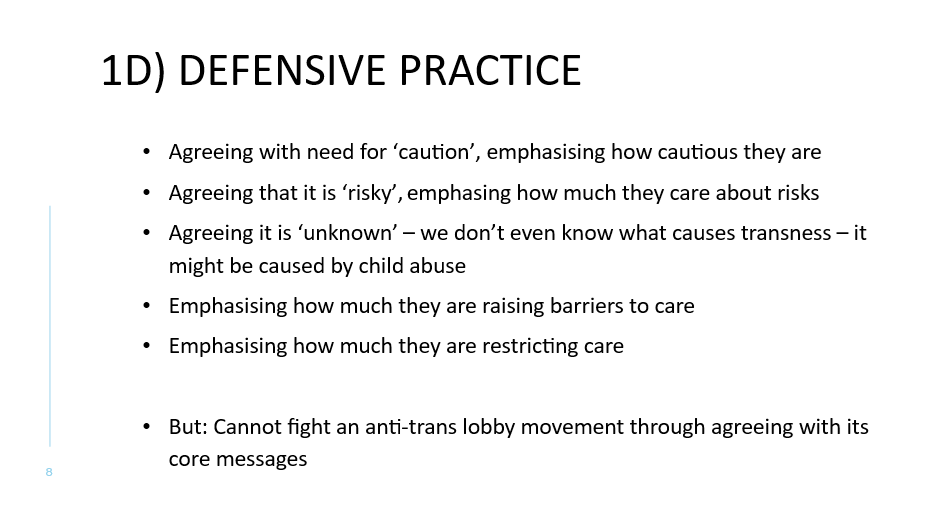
1D) DEFENSIVE PRACTICE
Agreeing with need for ‘caution’, emphasising how cautious they are
Agreeing that it is ‘risky’, emphasing how much they care about risks
Agreeing it is ‘unknown’ – we don’t even know what causes transness – it might be caused by child abuse
Emphasising how much they are raising barriers to care
Emphasising how much they are restricting care

But: Cannot fight an anti-trans lobby movement through agreeing with its core messages
PART 2: where the UK is nowpersecution & state violence
1) State persecution
Criminal bans on trans healthcare for under 18s
Denial of legal recognition and protection to trans children and adolescents
State and legislative attacks on basic rights to exist as a trans person
Institutional threats to affirmative families
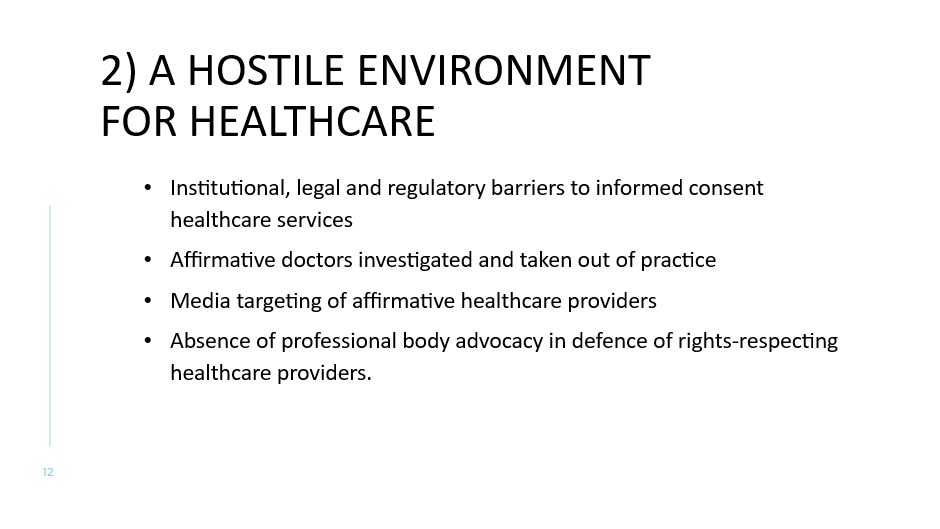
2) A hostile environment for healthcare
Institutional, legal and regulatory barriers to informed consent healthcare services 
Affirmative doctors investigated and taken out of practice
Media targeting of affirmative healthcare providers
Absence of professional body advocacy in defence of rights-respecting healthcare providers.
3) A hostile environment for mental health and well-being 
Hostile and discriminatory school environments
Bans on trans children participating in sports
Barriers to childhood social transition 
Misinformation and hate from media and politics
Co-ordinated, well-funded and influential campaigns against trans children’s rights
4) Pathologisation, control and conversion
Services centred in mental health, diagnosis of identity, gatekeeping
Mandatory, pro-longed and extensive psychological and developmental assessment 
Searching for a cause or other explanation for being trans
Mandatory exploratory therapy or psychotherapy
Stakeholders holding prejudice about trans children permitted to influence healthcare policy.
Delays and conversion practices
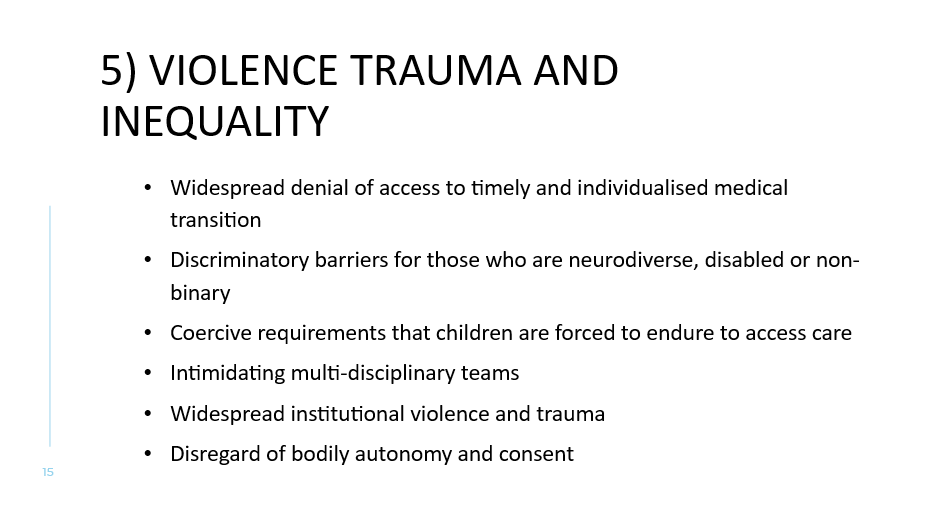
5) Violence trauma and inequality
Widespread denial of access to timely and individualised medical transition
Discriminatory barriers for those who are neurodiverse, disabled or non-binary
Coercive requirements that children are forced to endure to access care
Intimidating multi-disciplinary teams
Widespread institutional violence and trauma 
Disregard of bodily autonomy and consent

When I talk about why the UK is so bad for trans people, why it is so bad for trans children, and for trans children’s healthcare, it is important to talk about the three Ps. Firstly Prejudice. We have a situation where individuals holding acute prejudice about trans people are in positions of influence or leadership over trans children’s healthcare. We have individuals in charge of the new children’s gender service who have never even attended WPATH, yet who have found the time to attend events organised by misinformation groups recognised as anti-trans hate groups.

The second important P is Pathologisation. In the UK you never even here the term ‘trans child’ in our NHS. It is all ‘gender questioning children’ or ‘children distressed by their gender’, ignoring the reality that the major reason that trans children are stressed and distressed is because of the violent persecution they are facing, including from the NHS. The language in the UK always focuses on describing trans children in pathologising terms, describing them as a group that are “complex” with extensive “co-morbidities”.

The third P, that impacts on trans children’s oppression in the UK, is Power. The current situation for trans children in the UK, the current situation for trans people in the UK, is impacted by the systemic exclusion of trans people from positions of establishment power, across and beyond the NHS. In my work, understanding why everything is stacked against trans children, I’ve started to increasingly focus on the concept of cis-supremacy.

Cis-supremacy 
Cis-supremacy is a situation where cis people hold power over trans people, in cis dominated institutions, systems and societies. Cis-supremacy operates through the exertion of power over trans people, with trans people subject to control, systemic injustice and coercive violence
CONTRIVED Authority*
Example 1: The Cass Review. 
Put a stamp of authority on policies that:
1) Closed-down existing healthcare 
2) Erased the existence of trans children
3) Enabled transphobic policy to be labelled as ‘child protection’  
4) Enabled wider persecution of trans people without the question – but what about trans children?
*Dr Natacha Kennedy
CONTRIVED Authority
Example 2: The Commission on Human Medicine. 
Put a stamp of authority on policies that:
1) Defined puberty blockers as ‘dangerous’ (but not for cis people)
2) Criminalised private access to puberty blockers  
3) Helped coerce young people into an abusive puberty blocker trial 

Policy-based evidence making
PART 3: TRANS KIDS in the UK
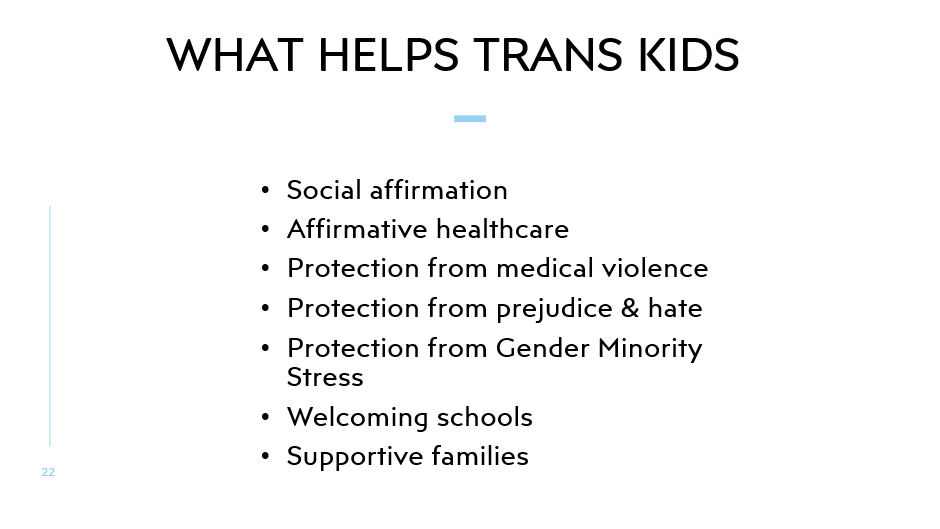
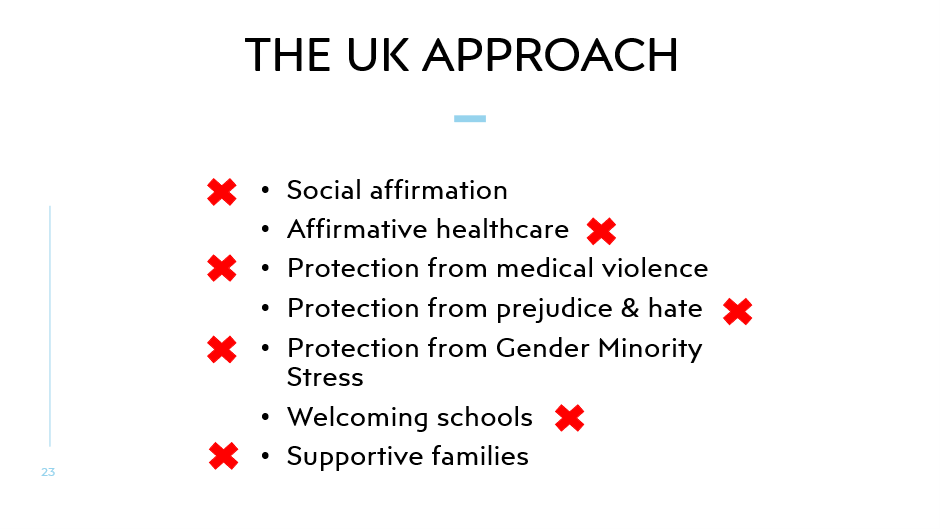
WHAT HELPS TRANS KIDS
Social affirmation
Affirmative healthcare
Protection from medical violence
Protection from prejudice & hate
Protection from Gender Minority Stress
Welcoming schools
Supportive families
This slide shows the same text as the preceding slide, with red crosses next to each point.
HUGE rise in HARMS since CASS
Schools
Gender service
Social services & GPs
Forced medical detransition & forced puberty
Self-harm and suicidal ideation
School drop-out & social withdrawal
Fear & pain & trauma
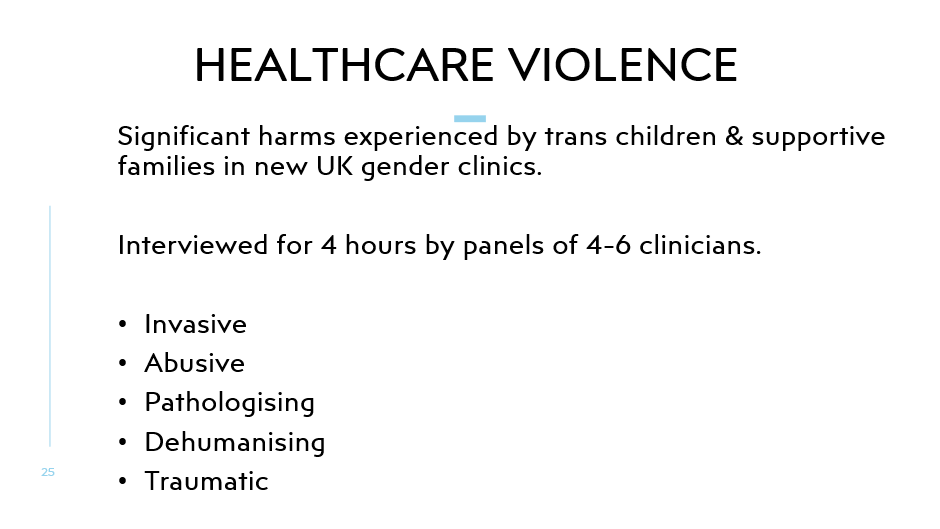
Healthcare Violence
Significant harms experienced by trans children & supportive families in new UK gender clinics.

Interviewed for 4 hours by panels of 4-6 clinicians.

Invasive
Abusive
Pathologising
Dehumanising
Traumatic
Slide showing illustration of being asked inappropriate questions in gender clinic, labelled as 'holistic assessment'.
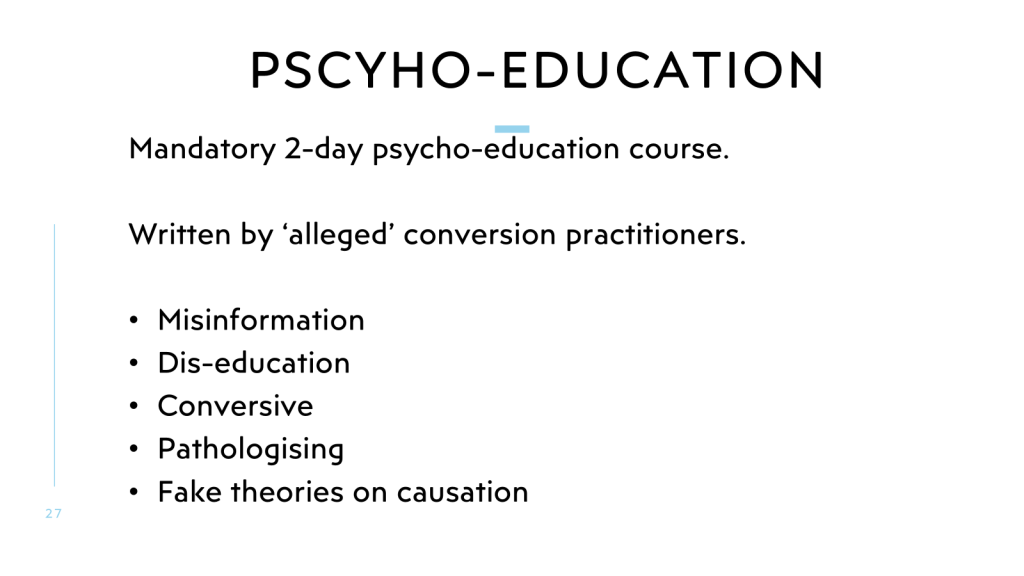
Pscyho-education
Mandatory 2-day psycho-education course. 

Written by ‘alleged’ conversion practitioners.

Misinformation
Dis-education
Conversive
Pathologising
Fake theories on causation
PATHWAYS STUDY
3,000-6,000 youth to be invasively questioned and studied without any medical care. 
113 youth to receive puberty blockers following intensive assessment & approval process
113 youth to receive puberty blockers following additional 1 year delay
PATHWAYS STUDY
Abusive & traumatic over-assessment: 
Extensive physical assessment, cognitive assessments, brain scans, bone scans, urine tests, blood tests, heart monitoring 
Over 314 different psychological assessment questions, repeated – using deeply pathologising and outdated questionnaires

Domination:
Full compliance required. Clinicians can deem ineligible on a whim. Approval reassessed every 12 months.
PATHWAYS STUDY
Mandatory exploratory therapy:
Full compliance with non-affirming and conversive talk therapy a requirement before and throughout the trial. 

Designed to fail:
Key outcome measures are irrelevant and unclearly linked to expected impacts of puberty blockers. Study will not provide clear evidence of the usefulness of puberty blockers. Highly likely has been designed to show minimal or unclear utility.
Rising ANGER. Photos of protests by Trans Kids Deserve Better. 
“In the UK, we as trans young people don't have the right to access gender affirming care. We used to spend years on waiting lists for medical support, but now the doors are fully closed to new patients. The medical support we need is extremely time-sensitive, and many of us die waiting.

Our supportive parents have been threatened with child safeguarding referrals, our pharmacies have been forced to hold back our medications, and our schools have been made battle grounds with us at the same time as weapon, aggressor, and victim. We refuse to live like this. We deserve better.”
Part 4: Autonomy & rights
Priority actions
1. Changing the narrative - Recognising systemic violence
2. Depathologisation
3. Rejecting defensive and conversive approaches
4. Confidently communicating
5. Removing clinical control
6. Centring rights
1. Changing the narrative: Recognising Systemic Violence
Violent schools vs safe schools
Violent families vs safe families
Violent healthcare vs safe healthcare

Role for medical authority

(impossible to read screen shot of infographic on supporting trans kids in schools)
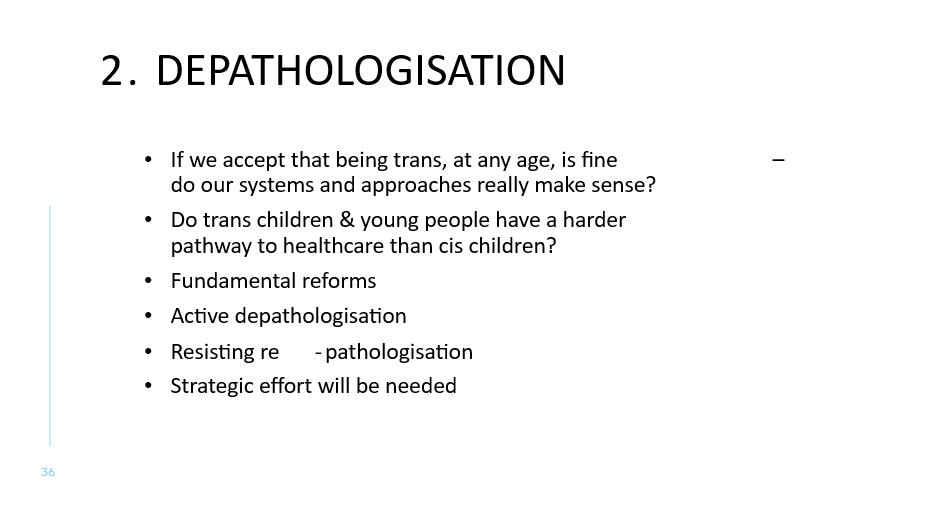
2. Depathologisation
If we accept that being trans, at any age, is fine – do our systems and approaches really make sense? 
Do trans children & young people have a harder pathway to healthcare than cis children? 
Fundamental reforms
Active depathologisation
Resisting re-pathologisation
Strategic effort will be needed
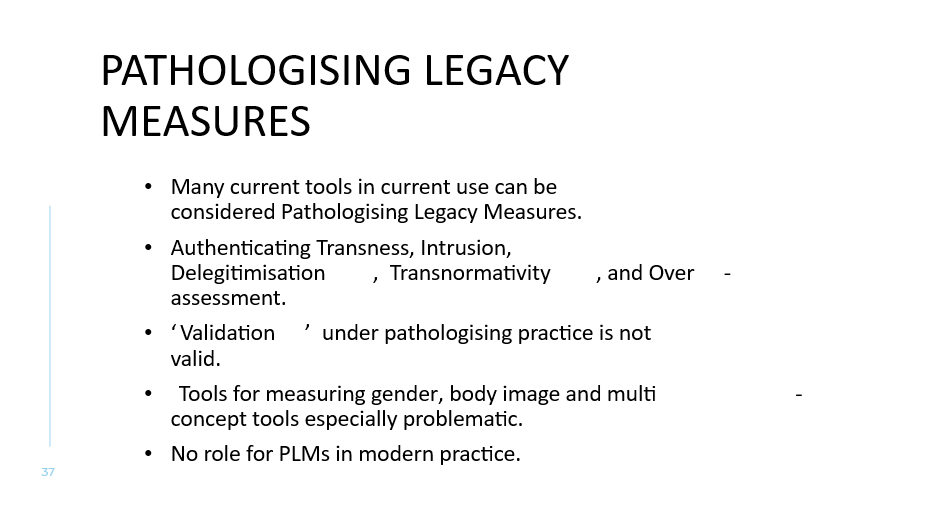
Pathologising LEGACY Measures
Many current tools in current use can be considered Pathologising Legacy Measures.
Authenticating Transness, Intrusion, Delegitimisation, Transnormativity, and Over-assessment. 
‘Validation’ under pathologising practice is not valid.
 Tools for measuring gender, body image and multi-concept tools especially problematic.
No role for PLMs in modern practice.
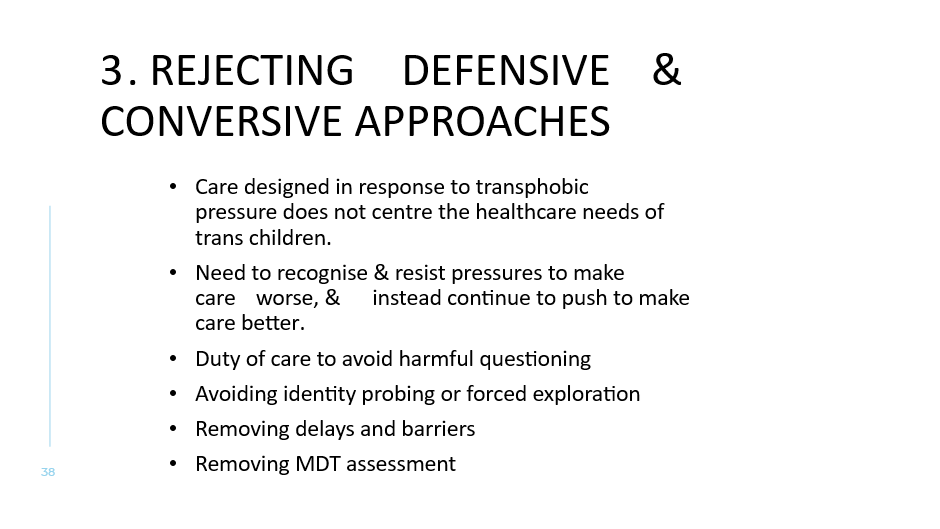
3. REJECTING DeFensive & Conversive Approaches 
Care designed in response to transphobic pressure does not centre the healthcare needs of trans children.
Need to recognise & resist pressures to make care worse, & instead continue to push to make care better. 
Duty of care to avoid harmful questioning
Avoiding identity probing or forced exploration
Removing delays and barriers 
Removing MDT assessment
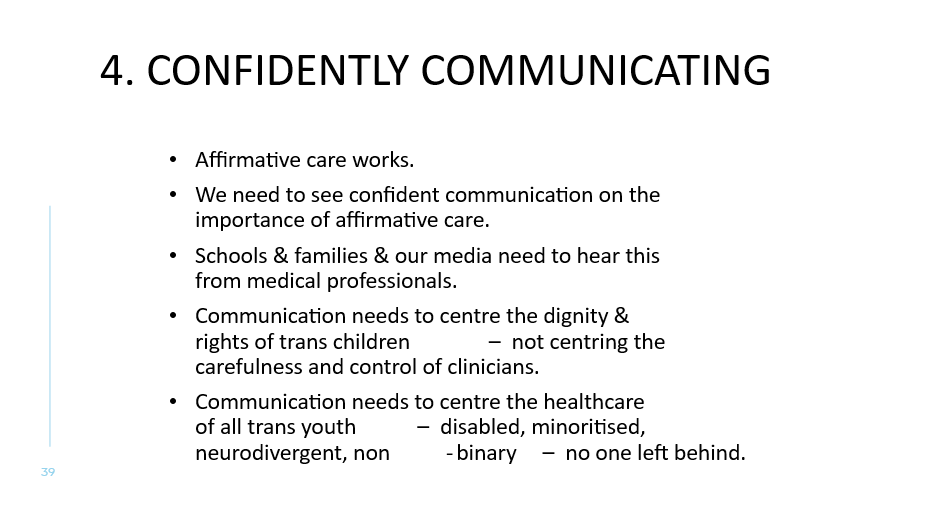
4. CONFIDENTLY Communicating
Affirmative care works. 
We need to see confident communication on the importance of affirmative care. 
Schools & families & our media need to hear this from medical professionals.
Communication needs to centre the dignity & rights of trans children – not centring the carefulness and control of clinicians. 
Communication needs to centre the healthcare of all trans youth – disabled, minoritised, neurodivergent, non-binary – no one left behind
5. Removing Clinical Control 
Dismantling power imbalances
Informed consent for all
Increasing accountability
Centring rights
6. Rights 

(impossible to read screen shot of article on 'Child Rights in Trans Healthcare - a call to action')

Thank you for listening.

My wider reflections on AUSPATH are available here:

Reflections from AUSPATH

Last week I had the huge privilege of being invited to give a keynote speech at this year’s Auspath (Australian association of transgender health) conference, held in Tasmania. I loved being at Auspath, met many awesome people, and enjoyed learning about Australian approaches and best practices, many of which I wish the UK would learn from. There were also a couple of things at Auspath that gave me pause. In this blog I’m going to briefly run through some of the things I liked best at Auspath, before a deeper dive into two areas of that left me thinking. I don’t claim to have all the answers, but am sharing my current thinking – I would love to hear other people’s takes, on their experience at Auspath, on their priorities for improving trans youth healthcare in Australia and beyond, and on their experience and perspectives on the two issues covered at the end of this blog.

Highlights

It was a rare joy to be around so many incredible people fighting hard for a positive future for trans kids. I really valued:

  • Hearing so many clinicians speaking with genuine compassion and respect about trans lives. Even where I took issue with a minority of clinical approaches, the professionals I heard at Auspath clearly cared for trans youth, clearly had a base level of respect for trans lives, clearly wanted the best. It is a very different world from the UK where I can count on one hand the number of NHS professionals I’ve met who I’ve heard speak respectfully about trans kids. I’ve focused the latter sections of this blog on critique rather than praise, because pretty good shouldn’t be the bar – Australia has the potential to be world leading in trans youth healthcare.
  • Hearing so many professionals, advocates, community members, parents, allies, speaking with determination about protecting trans kids and trans healthcare from the abuses spreading across the world.
  • Hearing an impressive and eloquent young person speak about their experiences, including obstacles and barriers to equal access to healthcare.
  • Hearing an impressive and eloquent parent share their experience on the difficult path advocating for a trans child in Australia.
  • Learning about Country and first people’s knowledge and experience. It would have been good to hear more on the topic of first people’s experiences and priorities.
  • Listening to a panel talk about the fight for trans kids in Queensland (I was crying through most of that panel).
  • Feeling really welcomed at the conference, some many people came up to me with kind and friendly words, and I also felt very welcomed as a non-binary person in that space.
  • Hearing a panel of young adults speak on their experience advising on trans health research projects, on the need to include young people who were unable to access paediatric services, the need to include rural youth, the need for fair pay, for both career development opportunities for those who are research inclined as well as keeping space for input from young people with no interest in working in research. The importance of disability justice informed approaches.
  • Meeting young adults who are willing to challenge establishment status quo approaches. I think this is really valuable. So much cis-supremacy and cisnormativity operates through the maintenance of outdated systems and approach that we don’t even question. Having young people speak up and ask these questions is super important. One such question was ‘do we ever need to collect and report on data on assigned sex/gender?’. It’s a really good question. My current answer is ‘I don’t know, but certainly very significantly less than we do at present. This is definitely a question I will carry with me. I’m doing a new piece of research at the moment on non-binary adults and in that survey we are including a specific question ‘do you want to see results from this research broken down by assigned sex/gender?’, along with open text boxes for people to share their reason for or against. These answers should likely be context specific and driven by the information needs of the people whose data it is. Certainly we should have already moved away from the approach I still saw some places in Auspath where a person was introduced as ‘patient A – AFAB – identifies as a boy’.
  • Meeting lots of awesome people from New Zealand, commiserating and strategizing on how to fight and support young people through state enforced discrimination.
  • Meeting lots of healthcare providers working outside of specialist gender clinics, who are working to develop alternative routes to respectful and informed consent care. Many of these are currently supporting adults – with confidence and advice the same care can be extended to under 18s.   

There were two points in Auspath where I heard completely different messages from different people, and that relates to the two topics that I’d like to do a deeper dive into in this blog: MDT assessment and comprehensive bio-psychosocial assessment. Some people came up to me and expressed concern that such things were happening in the UK, and that we should fight them being introduced in Australia. Other people came up to me to share their knowledge of these practices being experienced by trans children in Australia.

In my presentation I spoke about the harms of excessive questioning of trans kids. In the UK this 100% comes from a position of bad faith. Clinicians are encouraged to ask hundreds of questions, with an intention of probing, prodding and undermining trans identities. At Auspath I did not hear any explicitly and intentionally bad faith or actively transphobic intent. I did however, from some clinicians, hear approaches that, whilst coming from a better place, constitute the same excessive questioning. In Australia this excessive questioning was sometimes marketed and justified as ‘adding value’. Even from some brief conversations with service users I heard people share stories of having experienced this ‘added value’ as harmful. I would really like to call attention to the over questioning of trans kids even in nominally affirmative services. Being trans is normal, and trans kids shouldn’t be faced with extensive additional healthcare questioning compared to their cis peers. Any systems that normalise asking additional bio-psycho-social questions of trans kids compared to what is standard for cis kids is a problem. And here, our base comparator should not be the among of questioning that is standard for cis kids who need psychiatrist or psychologist support – our comparator should be an average cis kid who is not under psychologist or psychiatrist led care. Simply being trans, or accessing trans healthcare, does not justify invasive and excessive psychology centred questioning – this approach is a legacy of pathologisation. Two phrases were heard at Auspath more than I would like: Multi-Disciplinary Team Assessment, and Comprehensive Bio-Psycho-Social Assessment.

Multi-Disciplinary Team Assessment

In the UK it is presumed that a trans child needs to be assessed by multiple different professionals, often including a psychologist, psychiatrist, paediatrician, social worker, and that is before assessments with an endocrinologist or fertility specialist. These multiple levels of assessment are abusive and excessive. At Auspath clinicians listed a dizzying array of different professionals being involved in MDT assessment of trans kids. In Spain, in the highly respected Transit service in Catalonia, trans kids see one medical professional, usually a GP. The GPs role is to support informed decision making by a trans young person (and their family depending on age), their role is not to assess and decide upon access to healthcare. In this Spanish service that one medical professional, that one GP, can provide healthcare, including endocrine care for trans adolescents, without input from additional professionals. They do still operate in what they describe as a multidisciplinary team, having different colleagues within their service. This multidisciplinary team allows the GP to offer access to different additional services, optionally, in an opt-in approach. Young people can ask to additionally see a psychologist. They can ask to see a social worker or family worker, to support with school for example. But these additional professionals are additional optional services, a trans young person does not have to see, and certainly does not have to be assessed by, a whole multidisciplinary team of different professionals.

At times in Australia it was unclear to me what different clinicians mean when they refer to multi-disciplinary team working. I hope Australian colleagues can consider and articulate where they are working within an MDT that offers optional opt-in access to a range of different professionals, without mandating that a trans child see an overwhelming range of different professionals. I hope clinicians can be clearer in whether their approach forces trans young people into running a gauntlet of different stages of assessment by a series of different professionals. I hope more attention can be drawn to the harms of forcing trans children through multi-professional assessments where additional professionals are not desired or needed. WPATH SOC 8 recommends an MDT assessment for trans adolescents – I hope Australia can be part of building an evidence base for a better approach in time for SOC9.

Comprehensive Bio-Psycho-Social Assessment.

This is a term that I find really triggering. In the UK this term is used to define practices that are pathologising, intrusive, uncomfortable, and harmful for a trans child. When I first heard this term from clinicians in Australia I assumed it meant something else here. I initially hoped that it was being used as a defensive practice, by clinicians under anti-trans pressure, who are keen to emphasise the thoroughness of their care, using this term as a fancy descriptor for actions that I, as a non-clinician, would describe as ‘having a chat’, or ‘getting to know your patient’. A good GP can ‘have a chat’ with a patient, and quickly find out some useful information about them to better help them understand, build rapport with, and support their patient. This can include some brief questions to understand their life circumstance, their family support, their strengths, supports, stresses or concerns. This can be done rapidly in a first appointment as a non-intrusive, flexible, patient-centred and low stakes chat. This should not be defined as a ‘comprehensive bio-psycho-social assessment’.

I was chatting to one clinician, who described taking notes during such a ‘getting to know you’ chat, with those notes not affecting care pathways but being taken primarily to enable quicker rapport building at the next appointment. I commented that I find it really uncomfortable to have clinicians take notes when I am asked questions about my life and circumstance. This is clearly linked to my own institutional trauma in unsafe healthcare settings where answers to these questions are definitely being judged by clinicians, where answers might end up in a non-consensual case study report, and where these notes do impact on your (or your child’s) access to care. It is important for good healthcare professionals to note how much institutional trauma and distrust many trans people, including trans kids, carry into the clinic. Even young people I met in Australia spoke at length of trauma experienced in encounters with various healthcare professionals who were there to judge and control.

I had initially hoped that references to ‘comprehensive bio-psycho-social assessment’ were just a sign of defensive practice. I was dismayed and at one point upset to hear that actual comprehensive bio-psycho-social assessments are still a core part of care in locations across Australia, particularly in trans children’s healthcare, particularly in services delivered by mental health professionals. I was disappointed to see reference to incredibly detailed family tree mapping, filled with details entirely unrelated to a child’s access to trans healthcare services. I was disappointed to see wide-ranging body mapping exercises, children asked to draw themselves, notes taken on left or right handedness, even assessments of pen grip. Many of these unnecessary and pathologising over-assessments were marketed and justified by professionals as ‘adding value’. If we are seeing a trans kids, we ‘might as well’ assess whether they are having trouble holding a pen. We might as well investigate their full family system for areas of family disfunction. We might as well screen for ADHD, autism, anxiety, anger issues, dyslexia, poor family functioning, disordered eating, sexual health support needs, bullying support needs etc etc.

The list of things we ‘might as well offer’ as ‘added value’ while we are here grows ever longer, especially in trans children’s healthcare. Some of this emphasis on ‘added value’ is perhaps a symptom of some professionals realising that the original reason for their role is outdated, pathologising and unneeded. But why are ‘added value’ assessments brought into trans children’s healthcare? Why are trans children’s healthcare assessments so broad, ill-defined, all encompassing? The answer lies in services that are struggling to adapt from a pathologising model of care.

In terms of unnecessary questioning added on to trans healthcare, I am perhaps least worried about short screening questions that are designed to triage young people to additional support services that might well be beneficial. Some trans kids might also want an ADHD assessment. Some might want support for anxiety. But even then I’d rather this was done transparently, optionally, and with patient consent ‘would you like to do a few additional questions to help us see whether you might benefit from our optional mental health or neurodivergence services including related to anxiety, ADHD, eating disorders etc. For triaging child developmental concern, this can be similar ‘while you are here, would you like us to check your/your child’s pen grip, for dyslexia etc’. This transparency is important as it helps service users understand and have trust in the process, while also letting them tell clinicians when ‘added value’ services are not need, are already being managed by other professionals or are not wanted at this specific time. Crowding all types of assessment into a trans health assessment makes these extra long and stressful.

Then there are areas of a comprehensive bio-psycho social assessment that are clear remnants of past pathologising models. Questions on childhood toys, friendships, family gender roles, sexuality of parent or child, and many other unnecessary questions are inappropriate. At the conference there was one exchange that was particularly noteworthy. A clinician commented that they always ask trans young people about their romantic relationships. They noted that young people commonly respond by querying ‘why are you asking this?’. They said that they then tend to respond ‘Because it helps remind me that you are a full human, more than just your gender/transness’ (I didn’t take live notes and won’t be getting the statement 100% accurate).

I had three reflections on this answer. Firstly, it is important to recognise power dynamics in a clinical encounter. It is hard for any service user to question the approach of their clinician. It is particularly hard in a trans healthcare appointment, and especially so for a child. If young people are questioning our approaches, we would do well to take this as a significant potential indicator of discomfort. It is really hard for a child to question an authority figure, especially one whose approval they need. If we are asking questions that young people indicate some level of discomfort with, if there is not a very strong clinical need, surely we should not be asking those questions.

Secondly, I note that the young person’s question ‘why are you asking this’ was not provided a satisfactory answer. Clincians should not need private information on trans people’s lives in order to remember that we are more than being trans. I don’t think the speaker realised the impact of their words on some trans people in that room. I left the room at that point. There is a long history of trans people, especially trans kids, being asked invasive questions for no reason other than to satisfy clinician curiosity. Curiosity driven questions are entirely inappropriate – we shouldn’t have to humanise ourselves in order to access healthcare.

Thirdly, sexual orientation and relationships questions are often asked without clear purpose. In the UK these questions are deemed necessary based on anti-trans fake theories of childhood transness being a reaction to homophobia or sexual abuse. In the UK’s puberty blocker trial these are also justified through inclusion of a criteria excluding youth with any judged potential for having unprotected sex from eligibility to access the trial.

In less transphobic services these questions are sometimes justified by reference to a need to screen for unmet sexual and reproductive health information and support needs. I would tend to agree that trans youth may have unmet sexual and reproductive health information and support needs. Schools, regular resources and parents may all be ill-equipped to provide trans-inclusive education. But screening for unmet sexual and reproductive health needs can be done transparently, intentionally, none creepily and with consent. It does not need to be untransparently sneaked into a wider trans healthcare assessment, where historically youth have been forced to answer unwanted and intrusive sexual questions driven by clinician curiosity or clinician ignorance, unrelated to screening for sexual and reproductive health services. I would suggest that asking a young trans adolescents about their sexual and romantic relationships or desires is rarely an effective strategy in building rapport. When asking potentially irrelevant questions that are likely to make a young person uncomfortable it is not sufficient to give them an option not to answer. Some questions should not be asked. I’ve accessed specific sexual and reproductive health services as an adult without being asked any of the type of personal questions that psychologists and psychiatrists sometimes feel entitled to ask of trans children.

I would strongly question the appropriateness of insisting on a comprehensive biopsychosocial assessment in trans youth healthcare. I would ask clinicians to document much more clearly the questions they are asking and the purpose or clinical need for each question. I would suggest tat rapport building questions should be short, comfortable, flexible and non-intrusive. I would suggest that ‘added-value’ screening questions to triage to additional support services should be transparent, opt-in areas of questioning, strongly delineated from what is being assessed.

I hope we can quickly evolve away from assessment-based models of care for trans children and young people. And while assessment remains, we all have a shared duty of care to reduce the exceptionally excessive breadth and depth of questions that have become wrapped up in a comprehensive biopsychosocial assessment. Professionals who are able to deliver effective rights-respecting healthcare to trans children and young people in Australia without invasive psychological and psychiatric assessment as standard, please can you more clearly communicate what questions are actually clinically necessary, whilst also documenting the questions that you consider not clinically valid. (I’m happy to anonymously share examples on my blog).

Trans healthcare is not a psychological or psychiatric treatment, and we need to move trans children significantly further from being in positions of psychology/psychiatry-centred questioning and assessment. I’m not against jobs for psychologists and psychiatrists – we can channel those existing resources into helping trans kids with anxiety and stress related to living in a trans-hostile world, and into treating the adults around them who fall into anti-trans radicalisation. Trans kids in rights-respecting healthcare services across different parts of the world receive trans healthcare without a comprehensive biopsychosocial assessment, and we can aspire to this across Australia.

Flight home

After Auspath I tagged on a few holiday days in Tasmania, seeing some beautiful landscapes and wildlife, an incredible experience. I’m writing this blog whilst rather sleep deprived and time-zone confused on a long flight back to the UK. In the two weeks I was away, the UK has completely removed protection for non-binary people (in a legal case that made absolutely no sense); the UK has banned trans girls (and trans women as leaders) from girl guides; and banned trans women from the Women’s Institute. These are all severe blows. Girl Guides has long been one of the best allies for trans girls – an organisation whose inclusive policy we have long pointed to when asking for schools or other organisations to choose equality and inclusion. Having them bow to transphobic pressure is a blow not only for the impact on Girl Guides, but for what this means for the whole state of inclusion of trans girls in UK society.

I have felt so much lighter and safer being in Australia and fly ‘home’ with significant trepidation and fear for the future. At least I am re-energised from feeling safe and hopeful through my days in Australia and at Auspath. But the fight goes on.

Thanks to anyone who got to the end of a very long blog!

In cross-national solidarity,

Cal

Stonewall: Pragmatism or selling out

Pragmatism or selling out the weakest?

Last week Stonewall shared their latest strategy. Reading it you’d barely notice that trans children are facing an acute escalation in  targeted persecution. Life is dire for trans kids in the UK right now. Here’s a very short list:

  • Healthcare – criminalised
  • Trans teens being medically detransitioned
  • Forced conversion practices disguised as therapy
  • Forced identity investigation
  • Social transition denied
  • Segregated and humiliated at school
  • Excluded from sports
  • Can’t even go on a school or DofE camping trip
  • Bullying and violence
  • Supportive families facing social services and police
  • Can’t change institutional records
  • No chance of protection from transphobic parents
  • Barred from trans positive social media connections
  • Fights to ban trans books from school and county libraries
  • Schools teaching transphobia
  • Lessons on the ‘sex-based right to be transphobic’
  • Transphobic and scientifically illiterate lessons on bodies and puberty
  • Ban on school resources about trans lives, esp for younger ages
  • No education for their peers on trans lives or trans rights
  • No action on transphobic bullying
  • Gov refuses to even recognise trans kids

From a policy angle, I can’t think how things can be worse? (don’t tell me how)

Stonewall’s strategy does not mention a crisis. It does not mention trans children facing the worst situation for their rights and wellbeing this century.

If you don’t even acknowledge the problem, how are we meant to believe you are a trusted ally in helping us solve it?

They describe their role as to be “pragmatic conveners”. I always worry when folks use the word pragmatic. It’s a bit like describing yourself as the sensible grownup in the room. It is often a way of talking down to those of us who ask for more, as though it is not possible to hold steadfast to certain principle and then act in pragmatic ways. Too often pragmatic is the word used to defend something else – selling out those who are less important to you.

“Turbulence” is another buzz word that Stonewall is using. It is a term that glosses over the reality that we are not all in the same boat, and this isn’t a bit of rocky weather, but a very clearly targeted and incredibly well funded attack on the weakest parts of our communities.

Our enemies are incredibly strategic and tenacious. Our ‘friends’ appear without strategy.

Stonewall – from foes to friends and back again?

Over a decade ago Stonewall was being protested for its transphobia.

In 2015 they chose to start working for trans people

In 2017 I critiqued their then strategy for failing to have anything to offer for trans children.

Under Nancy’s leadership they were suddenly reliable strong on advocating for trans children.

At the same time as Stonewall got better at sticking up for trans kids, they apparently lost political capital. Perhaps they stopped getting the ear of government. Perhaps they stopped being in the rooms of the powerful.

Does that mean that sticking up for trans kids was the wrong strategy?

Should trans kids be sacrificed in the name of political capital and influence?

Should we operate under this fascist logic?

Should advocacy for trans kids be blamed for Stonewall’s unpopularity amongst a media and political elite in the throngs of rampant transphobia?

Should advocacy for trans kids be blamed for being on the losing side of a culture war?

Would those culture warriors have bowed out and quit if Stonewall had been more pragmatic?

Consensus

The part of the strategy that really stuck in my throat is this sentence.
“We will seek common ground and consensus”.

  • Billions of pounds have gone into the global anti-gender movement.
  • In the UK we have had 8 years of incessant misinformation, lies, propaganda and fearmongering about trans kids
  • Transphobic politicians created the illegitimate and prejudice riddled Cass Review that has greenlit all kind of persecution and discrimination against trans kids
  • Whole organisations have formed to advocate against trans kids rights. Organisations that are terrifying in their connections to those with power and funding.
  • Organisations fighting for trans kids rights have been weakened, have sold out, have been scared away
  • Public opinion has over the past 8 years got worse year after year on topics related to trans kids

We cannot get progress through common ground and consensus.

Common ground and consensus tells me that trans kids’ rights, trans kids’ lives are disposable, while you work on the areas where there is most consensus.
Grow a bloody backbone.

An organisation standing up for trans rights, for trans kid’s rights at this point in history needs to be brave, needs to be principled, needs to proactively reshape the narrative through standing up clearly and articulately and strongly for trans kids’ rights at every turn.

We should be telling everyone who will listen that the current status quo is deeply harmful. That it is unfair. That it is persecuting trans kids just for being trans.

I don’t believe we will see change through consensus. We will see change through clearly putting our marker in the sand, and speaking up again and again and again, leading with our principles.

In the room where it happens

Those who talk of pragmatism and consensus want to be in the room where it happens. They want to have the ear of those in power.

Great for them.

But what message will they be saying in those powerful rooms?

Are they going to hold the government to account on all of its horrendous failings?

Or are they going to play polite, make a couple of challenging points on the less controversial issues, while letting a whole heap slide?

Are they going to bask in the warmth of the powerful while trans kids are out in the cold?

Do they even recognise how bad it is? Do we even trust that they care about all the above violence being pushed by our government onto trans children?

I’ve been in rooms with several leading (cis, white, male) LGBT sector leaders and they have said to my face (in politer terms) that they don’t support trans children. That they are not actually bothered by trans children’s rights violations. That trans children make them uncomfortable. That they are quite on the fence. That its all a bit much isn’t it. That rights for trans children is a step too far. Perhaps even that rights for trans children is harming the wider LGBT endeavour. Trans kids can wait for next century, their time is not now.

For those defending ‘pragmatism’, I am sometimes left to wonder if they are naïve to the real agenda, to the real lack of conviction amongst some leaders.

Is it pragmatism, or is it selling out trans kids entirely?

The good activist

Let’s also be honest here – there is not a shortage of organisations and individuals queueing up to the be ‘reasonable LGBT activists’ who are allowed into the rooms of the powerful.

But at what cost? If you sell out your weakest members to get into those rooms, to stay in those rooms?

Moving the needle

I don’t believe we are where we are due to lack of articulacy.

Or due to not being invited to play the token LGBT friend.

Or due to being too demanding.

I don’t think we have done anything wrong.

We have faced overwhelming power differentials, and have lost because of the scale of those power differentials.

Taking away a lesson that we just needed to do X or we just need to be politer or work more for slow progress or consensus, is learning the wrong lesson.

Being in the room isn’t going to shift the needle when the game is rigged. We certainly can’t win the consensus game in our current media landscape.

Winning through consensus, through playing nice, will take us decades.

And that isn’t winning at all really. It is giving up any chances for the current generation of trans kids. And for the one after. And the one after that.

What can we do?

I see three roles that stonewall can do in this current context:

  1. Calling out persecution and injustice to embarrass those in power

    This role is not nothing. There are parts of the Labour party who do not want to be known as the baddies. Most trans people view them as out and out baddies. Conveying this message to a wider public can embarrass Labour, and empower those in Labour who want to be less terrible.

    2. Calling out persecution and injustice to embolden cis people

    This is for me the biggest priority. There are a ton of cis people across the country working out how to respond to trans kids. Individual school teachers. GPs. Governors. Scouts leaders. Many will by default fall into the path of least resistance, which currently means following gov policy and guidance to harm trans kids. But clear messaging from stonewall on how unacceptable all of this is can embolden people to consider a different act. Most of life does not take place based on detailed following of government decree – it is in the small and everyday decisions and actions of millions of us. Having clear communication from Stonewall that the current government policy harms trans kids can turn the needle on those everyday decisions. Having clear communication from Stonewall that specific actions and policies are part of systemic persecution and genocidal intent (see recent statement from the Lemkin Institute), is something that we can give to individual school head teachers, to individual social workers, to individual family members, to legitimise the messages that we are currently trying to convey.

    3. Calling out persecution and injustice to make us feel less alone

    Even if nothing else, feeling that our current pain and fear is noticed, that we are not abandoned, that we have staunch allies – that actually matters. Even in the face of ongoing and perhaps not easy to fix persecution – it can help us take one more step – help us stay in the fight.

    Today I saw photos of Stonewall smiling and celebrating at a 10 Downing Street ‘pride’ reception. I saw no public call outs of the horrific Labour policies that are destroying the chances of happiness for trans children across the UK. It felt a real kick in the teeth.

    Finding Hope

    The Stonewall strategy talks about being a “a beacon of hope”. I actually agree with this ambition. What does that hope look like? For me, I draw hope from knowing that organisations and individuals will be brave, will stand up and be counted, will call out oppression and persecution and ignorance and hate wherever they find it. This gives me hope. This can give hope to trans kids too – showing that their current atrocious treatment is noticed, showing that we recognise it for bigotry and violence, showing that we stand at their sides. The current Stonewall approach give me zero hope.

    What they have given me, this evening, is rage. I am beyond done with sell outs and folks who are part of the problem. We have enough problems.

    I know that Stonewall are not the real enemy. They are not the reason that life is so goddam hard. They are not the reason I am stressed and afraid.

    I know that it is easy to turn on each other when we feel so powerless and defeated.

    Maybe I should thank them for providing some rage.

    Rage is more motivating than fear.

    I just wish there were other things on the menu these days.

    Is hope really too much to hope for?

    Are a majority of non-binary people cisgender?

    I keep coming across research, written by authors who are not non-binary, that includes the confident statement that a majority of non-binary people are not transgender, or that a majority of non-binary people are cisgender.

    I will start by saying that identity is complex and personal and every individual can identify how they please. Naturally. Personally, I am trans and non-binary. I both identify as trans, and I also consider ‘trans’ as an umbrella term that has space underneath it to capture non-binary identities in general [whilst recognising that some non-binary people, just like some binary-oriented people of trans experience/history, don’t like to be called or recognise themselves as trans].

    I personally feel stressed out and othered by language that defaults to ‘trans and non-binary people’ as though they are two distinct categories (I’m personally happier with a default assumption that the term trans will always include non-binary people, and where folks want to emphatically include non-binary people who reject trans as an umbrella I’m be ok with the cumbersome ‘trans and/or non-binary’. Of course humans are messy and no language will be perfect.

    A conclusive and confident statement about a majority of non-binary people being cisgender always pushes me to ask the question – where is the data coming from?

    In my personal experience, I’ve known many people who start out identifying as non-binary and ‘not trans’, who over time, embrace the umbrella label of trans [I’m not sure I’ve ever met anyone who has gone the other route]. I’ve known many non-binary people who initially feel that they cannot or must not take the label trans, that using such a label would be ‘appropriation’, if they have not medically transitioned enough, if they have not socially transitioned enough, if they have not suffered enough. With connections to trans communities I’ve known many such people come to adopt the label of trans. Whether an individual non-binary person finds meaning under the umbrella label trans is not a static binary and can change over time.

    There is also a curious double standard in some surveys wherein non-binary people can be labelled as cis if they do not actively identify with the word trans, whereas trans is considered a default marker for binary-oriented trans people even if they do not personally identify with the term.

    Lets look at the original report that is the root of the claim that a majority of non-binary people are cisgender and see whether there are any potential problems with that report.

    It is a 2021 report titled “Nonbinary LGBTQ Adults in the United States

    It tells us confidently that “A greater percentage of nonbinary LGBTQ adults are cisgender rather than transgender”. I’ve seen this claim, that a majority of non-binary people are cisgender replicated in many publications.

    There are several points to give us pause about the reliability of this claim.

    Firstly the data comes from surveys conducted in the US in 2016-2018, that were designed in 2014. Identity language and knowledge amongst non-binary communities has been on a huge journey over the past decade. There are way more resources, groups and connections for non-binary people in 2025 than in 2016. Presuming that identity labels for non-binary people in the US in 2016 align with non-binary identity labels (worldwide!) in 2025 is a big assumption.

    Secondly, the surveys from which this claim are drawn were not designed to find out whether non-binary people identify as trans, and were not designed, as far as I’m aware, in collaboration with non-binary authors. The summary report is from the Williams Institute, a research institute that has a history of being critiqued for some failings in the way it considers trans people’s data.

    Take a look at this figure from the 2021 summary report and tell me if it might demonstrate some structural areas of ignorance or bias. As a non-binary reader this figure makes me dizzy. At best it begs some serious questions.

    I tried to find out what was the underpinning data, what exact questions were people being asked in 2016 that led to the above diagram and it is rather complex and confusing.

    The original sample comprised 1,369 LGB(T) people in 2016-2017 (people were asked if they were ‘lesbian, gay, bisexual, queer, or samegender loving’ and respondents needed to answer yes to be included).

    This sample was filtered into two different surveys based responses to these two questions, designed in 2014:

    1. On your original birth certificate was your sex assigned as male or female
    2. Do you currently describe yourself as i) man, ii) woman or iii) transgender.

    [In some versions of the survey a fourth option for part 2 was included “(iv) do not identify as female, male, or transgender”.]

    Respondents who did not pick the option ‘transgender’ above were filtered into an LGB survey called the Generations study. It was presumed to be a study of cisgender people (though respondents were never asked if they identify as cisgender). (27 respondents who clicked man or woman rather than transgender in a way that did not match with their assigned sex were excluded from the Generations survey).

    It is important to note that people only gain access to the Generations study if they click that their identity is ‘man’ or ‘woman’ in the initial filter question (making it harder to access, for say, non-binary people…).

    The presumed cisgender participants of the Generations study are then asked about their gender identity:

    “If you had to choose only one of the following terms, which best describes your current gender identity?” a) woman (744 answered this) b) man (665 answered this) c) non-binary/genderqueer (94 answered this). 15 did not respond.

    Note none of these participants have been asked if they identify as cisgender, they are simply LGBT identifying participants who did not click on ‘transgender’ in the initial screening. These 94 people in the US are deemed to be ‘cisgender non-binary people’. This group of ‘non-binary/gender queer’ individuals are further sub-divided into those who are deemed ‘cisgender LB women’ and those who are deemed ‘cisgender GB men’ based on whether they had ticked man or woman in the very first question. All non-binary people must be a man or a woman.

    People who clicked ‘transgender’ at the first question are steered to a separate survey called ‘transpop‘. Everyone in the second survey is classified as transgender, as they needed to specifically click the option ‘transgender’ for question one.

    People in the transpop survey were asked about their ‘gender identity’.

    They were asked two questions:

    1. Which of the following terms best describes your gender identity? a) man, b) woman or c) genderqueer/non-binary.
    2. Do you currently consider yourself a) man b) woman c) transgender.

    If it seems that the questions options are confusing and non-logical, it is because they are confusing and non-logical.

    Comparing the two surveys

    1518 individuals completed phase one of the Generations survey, of whom 94 identified as non-binary. Only 274 people completed the transpop survey across all waves of that survey, of whom 76 identified as non-binary. The total number of those deemed cisgender non-binary men and cisgender non-binary women in the Generations survey (=96) was greater than the number of non-binary people in the transpop survey (=74). This leads to the confident conclusion that ‘a majority of non-binary people are cisgender. Despite not one non-binary person having been asked ‘are you cisgender’? Despite no questions that specifically recognise a non-binary person’s identity before asking whether the word transgender or trans as an identity term or an umbrella term is meaningful to them.

    I do not find the above reliable or (globally) meaningful for providing insight into non-binary populations in 2025.

    Overall

    This survey from 2016-2017, designed in 2014, makes a range of questionable choices. I don’t think anyone would argue that these choices stand up in 2025 as a useful way of collecting information about trans and non-binary populations.

    Most importantly, it never specifically asks non-binary people ‘do you identify as transgender yes or no’. ‘do you identify as cisgender yes or no’, or the question ‘do you feel comfortable defining your non-binary identity under a broader umbrella as trans’.

    There are plenty of non-binary people who may not specifically identify with the word trans as a key self-descriptor, who nevertheless are happy under a broad ‘trans umbrella’.

    It is a double standard to define all binary trans people as ‘trans’ based on e.g. identification as a man while having assigned gender female even if that individual does not personally ‘identify as’ trans, but limiting non-binary transness to only those who ‘identify as’ trans.

    Overall I think identity and labels are messy, binaries are often false.

    I do not think any of the above is a robust basis on which to make confident claims that ‘a majority of non-binary people are cisgender’.

    Could we, maybe, actually ask non-binary people what we actually think?

    Could we stop relying on surveys such as this deeply flawed 2021 Williams Institute survey for understanding non-binary lives?

    EHRC Consultation: Are We Sure?

    Are we sure?

    Today EHRC released its consultation on the segregation of trans people.

    There seems to be general trans community momentum behind an assumption that we want to get as many people as possible to respond to this consultation.

    I just want to ask…. Are we sure?

    1. Clarity of segregation

    The consultation is not a consultation on whether trans people should be segregated. It is a consultation on whether the recommendations are clear enough.

    Imagine the recommendation was “police should shoot trans people in the head”.

    A consultation on ‘clarity’ would quibble with what do we mean by shoot, does a cross bow count. What do we mean by head – is a grazing wound sufficient or is a kill shot needed.

    A consultation on clarity of discrimination gives no space to consider whether the recommendations are i) legal ii) fair and just and in keeping with equality and decency and what we expect from a modern society.

    • 2. EHRC is in charge

    The EHRC will write up the findings (or they will be written up by a consultant following the terms set by EHRC).

    There is no way of winning this.

    There is no way of submitting in a format that will lead to the EHRC saying that the consultation declared segregation a bad idea.

    At best it will lead to tweaks in the wording to make it clearer how and when we are to be segregated.

    We can add all the protests, all the pleas for human decency, all the testimony of real world harms we are already experiencing to the submissions. It will count for nothing.

    The consultation results will be written up in the way that suits EHRC.

    It will either say that the guidance is clear, or it will provide suggestions on how to clarify it further.

    All other content that does not relate to clarity will simply be discarded.

    It will never result in a report saying that the guidance is out of keeping with human rights and unpopular with public opinion

    • 3. Popularity contests are a losing battle

    Even if the EHRC were willing to capture the number of positive endorsements of their guidance versus the number of criticisms, it will never present this as public support for or against the guidance.

    The EHRC are in charge of the process.

    If there are a majority of positive endorsements of segregation, then this might make it into the EHRC summary.

    If there are a majority of criticisms of segregation, this will never make it into the EHRC summary. They will focus purely on the questions asked, the percentage of respondents who felt the guidance was a) clear b) not clear.

    We cannot win by playing this game

    • 4. The stakes are high

    Trans people (myself included) are bloody worn out. Panic attacks are common. People are afraid.

    People want to do something, whilst working with very little spare energy

    I looked at the consultation briefly today.

    It felt like an actual kick in the stomach to read it.
    It is very long and confusing – it would take me days to properly process it and formulate a response, and I’m an academic used to analysising such stuff

    But more importantly – it felt like an actual kick in the gut to read it.

    It has already caused me harm.

    Do we really want to ask all of our trans friends to do this?

    Knowing what it costs us? Even to read the detailed EHRC documents is a tick in the teeth – reading how the powerful plan to discriminate against us is not a neutral pastime.

    I think very carefully before sharing anything written by hate groups – let alone asking people to read hate group material.

    This material will traumatise some readers. It has left me in tears this afternoon.

    I don’t know why we’d ask our community to go and read that – to feel compelled and threatened into going to read that to protect their safety – when the consultation is not going to be the thing that leads to a life of safety.

    The potential benefits of community-wide filling in of this consultation are infinitesimally tiny.

    Do we also really want to ask our allies to do this?   

    Knowing that most allies will do very little, and if they do this then they will tick off their trans activism badge for the year – is this the single best use of ally time?

    Of course we can stream line the process – providing simple guidance etc. But even engaging with the consultation questionnaire is overwhelming and stressful and made me feel afraid and disempowered.

    Do we want everyone feeling further afraid and disempowered?

    Can we guarentee that the costs are worth the benefits?

    • 5. Charity momentum

    In the UK the ‘trans community’ is very disjointed. There are not any clear mechanisms for actually inputting into decisions on how ‘we’ should proceed.

    Instead we tend to have ‘leadership’ from trans charities.

    If trans charities say we should participate in a consultation, folks tend to follow on,

    If trans charities produce guidance, folks tend to think they should participate.

    But

    I’ve worked in a lot of charities.

    I know how they function.

    Responding to a government consultation is a very core part of being a charity

    It feels like an achievement.

    A box gets ticked. It goes on an annual report to supporters and trustees

    Leadership may ask junior staff to do the consultation response, on an assumption that of course a major trans charity will respond to a government consultation with relevance for their members.

    A charity might well get criticised if they do not respond.

    And once a charity decides to respond, well, it’s only kind to provide clear guidance for other community members to be able to respond.

    And thus charities push the trans community into participation in yet another consultation in which there is no trans power, no trans accountability.

    They push us into a game we literally cannot win.

    A lot of UK trans charities collaborated for many years with the Cass Review process.

    They were used by Cass.

    Their collaboration was used to justify the legitimacy of the process – a process that it was clear from the very start was illegitimate.

    I have not seen one of them publicly reflect upon that collaboration, publicly learn lessons about how trans participation in government ‘consultation’, time after time, is used to legitimise things that should hold no legitimacy.

    • 7. Boycott is an option

    I never hear proper discussion of an organised boycott of such things.

    Why not?

    If we cannot win. If we are guaranteed to lose – why play their game at all?

    Especially when playing is deeply harmful to our well-being.

    Why not stand back and clearly say as a community:

    Trans segregation is wrong.

    We are not interested in unpicking the clarity of the terms under which we are segregated.

    We refuse to be segregated.

    We refuse to engage with processes led by those who hate us.

    We refuse hate and fascism.

    We refuse.

    • 8. Better uses of our time

    Amongst trans communities spirits are low and there are a lot of very significant challenges we face.

    Why is this consultation a good use of any of our time?

    I would love to say to the trans people in my life – do yourself a favour – skip this consultation.

    I particularly don’t want the young trans people who I know to pour their heart out in submissions on the impact of this guidance on their life – in a consultation where that type of testimony will be ignored.

    I would argue we are much better off focusing on legal challenges – arguments that the guidance and the Supreme Court is breaking international and national law.

    I would argue we are much better off focusing on justice and equality and basic decency related arguments, writing public blogs and articles on how the guidance harms us, spending our limited time talking to our MPs, campaigning for actual justice, talking to our communities on the harms of segregation, supporting our trans children to get through the next months, finding the optimism that we and they need, advocating for their rights at school.

    Keeping the focus of our efforts not on telling EHRC on the clarity through which we are segregated, but on maintaining our own wellbeing and self-esteem, refusing to play their game.

    I also think refusal at this point, and refusal in solidarity would be a powerful message and example to underpin the wider refusals that need to continue.

    Through refusal we underpin that we do not accept the terms by which they want to rule our world. We show and practice defiance that we are not going to disappear.

    I’ve lost energy to finish this blog coherently.

    Everything in life takes energy.

    There is so much to be done.

    Above all we need to look after ourselves and our community

    Asking for the community to spend time on this consultation seems like voluntarily smashing ourselves in the face with a brick. It will harm us. It will not harm those who are trying to harm us.

    I don’t know everything.

    I only know I have now done 20 such consultations and every single one led to either no change or to a roll back in rights.

    And this consultation seems more hopeless than every one of those.

    I will go with the collective wisdom, including from those who are wiser than me. But before we all agree to collectively participate in – and to ask our friends and allies to at scale participate in – the consultation – can we at least ask:   

    Are we sure?

    Is this an abusive relationship?

    (or why I won’t be responding to another government consultation on trans healthcare).

    Just weeks after having submitted an invited response (invited as an academic expert) to a government consultation on making a legal ban on puberty blockers permanent, ANOTHER government consultation on trans healthcare has today been launched.

    This one is on adult trans healthcare services. There are many reasons to approach this consultation with concern. The consultation itself provides a link to the incredibly biased and prejudice-ladden letter from Dr Cass which is a driver of this current review.

    I cannot even remember how many government consultations related to trans rights or trans healthcare I have completed over the past 8 years. It is far far far beyond a joke.

    And each public consultation takes the same form. The new NHS adults services consultation even provides a link to an analysis and summary of responses to the 2017 consultation. Reading the executive summary of that analysis is very telling and illustrative of the problem. In the 2017 consultation, responses were divided into three groupings:

    • Current, former or prospective user of gender identity services (30.15% of respondents)
    • Individual member of the public (26.8% of respondents)
    • Clinician (16.75% of respondents)

    The 2017 consultation responses summarises very succinctly the differences between these responses (worth reading on pages 2-6). In short, the current and former users of gender identity services provided detailed and meaningful suggestions on how services could be reformed and improved. Clinician respondents, who were, mostly GPs, broadly didn’t know what to do with trans people and didn’t want to have responsibility. Members of the public felt being trans was a mental disorder and wanted services to be made significantly worse for trans people. The consultation presented all of these contrasting views, with the views of actual trans people in one grouping (glossing over nuances in actual recommendations re different ways of improving trans health), while views that were ambivalent or fundamentally opposed to trans well-being and healthcare rights were given equal weighting to those of actual service users.

    This pattern has then repeated time and time again since 2017.

    This pattern will be repeated in this new NHS consultation. Although now the anti-trans lobby is much more organised and assertive, so I expect even more volume of anti-trans submission, including from transphobic clinicians and medical professionals, and including from those purporting to be prospective service users (or concerned family members of service users).

    This pattern of public consultation for minoritized healthcare is extremely abusive.

    Every consultation response is a huge amount of effort to do well. It is a significant extraction of labour from already exhausted trans people, including from those of us who are called to respond as trans-supportive researchers or on behalf of civil society.

    It is abusive to ask us for consultation after consultation after consultation. Every single one we respond defensively, knowing that the purpose of the consultation is not to improve services and respect rights, but to justify an ever further roll back of those rights, and ever more severe degredation of those services.

    It is abusive to ask trans folks to engage in yet another consultation where the views of those fundamentally bigoted about trans existence are given equal weight.

    It is abusive full stop.

    This particular consultation is where I personally draw a line. It is not acceptable.

    I expect adults trans healthcare will be made worse in the coming years, building upon Cass. I expect this public consultation, including the thousands of responses from profoundly anti-trans individuals and lobby groups, will be used to justify that degregation of essential healthcare. To justify the inclusion of ever greater rights violations in our healthcare. To justify ever greater encroach into the reasons to deny care to those of us who are the wrong kind of trans.

    Esteemed trans healthcare scholar Dr Ruth Pearce wrote all the way back in 2018 (about another consultation on trans health conducted about us yet without us), that “we respond not with hope or optimism, but in fear. This is the power you wield over us”.

    Over the past years I have responded to more government consultations on trans topics than I can count. Every single submission I have written, not out of hope, but out of fear. Out of a feeling of responsibility to use my relative privilege to at least try and change the outcomes, to raise my voice to highlight the current injustices and the harms of abusive practice.

    But we are clearly not being listened to. Time and time again we are not being listened to.

    How long do we keep collaborating in the same pattern. How long do we keep gas-lighting ourselves?

    Today I’m saying no.

    I refuse to remain in any part of this extremely abusive relationship.

    I refuse out of principle to engage in any way with a consultation that is equally interested in the views of non-service users, that does not have really basic ethical commitments to trans depathologisation, dignity and healthcare rights, that does not have trans leadership and trans power at its centre.

    I refuse to respond defensively while having zero hope that my words and my time are going to change the outcome. In this case, as before, I fundamentally don’t believe my inputs will in any way change the outcome. Quite the opposite – I believe my words and my submission, alongside those of others submitted and hard-worked-on out of a feeling of responsibility to our communities, will provide the government/NHS with a veneer of respectability, that they asked and listened to all views.

    Listening to all views is not good enough. I literally cannot stomach another consultation that will be written up as “here’s what trans people want, however here’s what doctors and members of the public want, so we are therefore going to make trans healthcare worse”. It is not good enough. I am out.

    I’m not saying that stepping out of this consultation will be enough to change the outcome. I’m not saying there is a clear path to trans justice.

    But I’m at least not going to waste my time on another heartless and fundamentally flawed process.

    Today I will choose to do something better with my time.

    I hope we can at some point be more coordinated and demanding, standing together in solidarity and power, saying we will not engage with processes that are fundamentally dehumanising and abusive. Most folks I know right now are too worn down by all the loses, by all the pain, by all the energy expended on heartless consultations, to have the energy and reserves to try and take back any power.

    Maybe that is one of the ways forward. For now we take time, we rest, we refuse to respond defensively, we let go of the fleeting hope that our submission will be enough to change power structures that continue to inflict harm after harm.

    We focus our time and energy on ways to keep ourselves and those who are suffering afloat through these tough times.

    We state clearly and in unison that when the government and the NHS decide they believe in our humanity, when they have an ounce of care for justice and equality, when they recognise that anti-trans views are not welcome in consultations on our healthcare, then we have plenty of ideas to share on the meaningful reform of trans healthcare. But until that approach is made in good faith, and with trans people in positions of authority – we have better things to focus on. We focus on surviving the anti-trans hate that continues to grow in the UK, including in senior leadership in the government and NHS.

    .

    WPATH 2024

    At the end of 4 days of trans health presentations from researchers, clinicians and community advocates from across (parts of) the world, I wanted to capture some of my key learnings and reflections. The conference took place the last week of September, in Lisbon, Portugal. This is my first WPATH (a conference of the World Professional Association for Transgender Health). A majority of trans communities have no access to WPATH information, yet WPATH learning is important to many trans people and families. I’ve always appreciated those (especially Ruth Pearce) who try to make conference information available to those unable to attend. I note the significant barriers to attendance for those without an employer or institution to fund expensive attendance fees and travel, to those with disabilities or caring responsibilities unable to travel, for those without a visa to come to Europe, to those facing other barriers to attendance.

    Overall vibe

    The overall vibe was better than I had expected, although my expectations were drawn from hearing really poor experiences at past WPATH conferences. I found overall the tone of trans positivity, depathologisation, treating trans people as equals, centring research and healthcare ethics, was better than I had expected. However, there were still a portion of content and conversations where biases were clearly on display. I particularly noticed these biases in the very frequent exclusion of non-binary existence, on the continued pathologisation, mistreatment and exoticisation of trans children, and on a very significant domination of a US and white perspective, with notably limited representation from global majority populations. I gather only 3 attendees were from Africa (out of 1,445 registered in-person attendees). I also am scratching my head to think if there was even a solitary reference to the experiences of trans children in care in the presentations I attended – I don’t think there was.

    The event had a trans chill out room where trans attendees could step away from the main event to decompress and reflect. It was noticeable that few trans attendees spent time there in the first days of the conference, with the fullness of the room growing over time, as trans researchers, clinicians and advocates encountered more challenging content and interactions. On the third day I heard one person reflect that despite WPATH improvements, it is noticeable just how many trans people are sat in the trans space burnt out by negative engagements by day three of four. I myself had a number of negative and hostile encounters, and a number of presentations that I could not sit through, finding some content taxing or upsetting, particularly where content demonstrated abusive clinical or research practices towards trans children. There were a number of other challenges at the conference, with no encouragement of sharing pronouns (apparently pronoun ribbons were lost in shipping), not being able to find gender neutral toilets on the first evening, and apparently some staff policing of toilet usage which was rather surprising in a trans health conference.

    There were also a large number of encounters and presentations that were an absolute delight. I met a huge number of people from across different countries and disciplines who deeply care for improving equality and justice for trans people of all ages and situations. I heard some research that shows where we should be in terms of ensuring research and healthcare is centring the rights and needs of trans communities. One clear highlight was an opportunity to connect with TPATH, the trans professional association for transgender health, including an opportunity to connect with some Portuguese trans folks who were not able to attend the conference.

     Session structure

     The session included plenary speeches, symposia, oral abstracts and posters. I will write about each in turn.

    Plenary sessions.

    On each day there were two plenary sessions, that were hour long speeches to the full audience, from one or two speakers, with a moderator. The plenary speakers were appointed by the WPATH president. Three were related to surgery, which I won’t engage with here as its not an area I focus on or know a lot about. A broader reflection was that at times the plenaries overall were a source of pathologisation, erasure of non-binary people, dehumanisation, exoticisation, and demonstration of clinical control over trans communities. There were several sessions where, if one had a bingo card of common areas of biases and indicators of cis-supremacy, one might have ticked off many exemplars. The speakers also privileged a white, cis, US/European, abled, and clinical position. Of the plenary sessions, the one I enjoyed the most was the opening plenary, delivered capably by an American, the US state representative for Montana, Zooey Zephyr. It was a powerful and moving speech, capturing the challenges that we currently face. I particularly resonated by the words (that I am paraphrasing), that when anti-trans laws are passed, when communities face state persecution, the harm comes severe and fast, whilst processes to overturn such harms are drawn-out and slow. Those words certainly resonated with my experience in the UK, where the harms of recent criminalisation of adolescent healthcare has indeed been severe and fast. The speech and presentation was excellent, but very US centred for an opening plenary. I wouldn’t expect anything less than US centred content from a US state representative, so this US centring is more a question for WPATH leadership than for the presenter. Why would a WPATH opening plenary would be so US centred. The tendency for WPATH (the World association) to act as US-path on holiday does appear to continue to be on display. However, this opening plenary was at least very strongly trans-positive, centring trans rights, calling attention to the abuse, control and persecution of trans communities, including trans children. The other plenaries alas did not all maintain this important commitment on trans-positivity, rights and justice. Several centred a clinical perspective grounded in assumptions of clinician control over trans lives. The plenary on trans children was particularly problematic and disappointing, presenting to a wide audience some older concepts and research that are problematic and outdated, centring and justifying clinical control over trans children. There were times across the plenaries where trans community and service user voice and perspectives were absent, with speakers prioritising a cis, adult, white, global North, clinician perspective. 

    I was disappointed to have the plenary on puberty blockers delivered by stakeholder from the Dutch clinics, whose model does not centre trans child and adolescent rights. The presentation itself summarised older research (some of which is problematic) and failed to update the audience on newer research findings from other countries. It was a really lost opportunity to update general attendees on the most up-to-date research on puberty blockers. I also wish we could hear more from Dutch trans communities and service users, particularly child service users, on the Dutch approach. My own research has centred the experiences of service users in the English Children’s Gender Service, which aimed to replicate the Dutch model. My own experience and my research with that service has demonstrated widespread clinical abuse and harms to trans children in that service. (My research, including on experiences in gender clinics, experiences of childhood social transition, experiences with puberty blockers, and on pathologisation and cis-supremacy in healthcare can all be found here).

    I hope the next WPATH can better centre child rights, trans rights, an ethics of depathologisation and equality in future plenary sessions, ensuring that any presentations from clinicians centre some fairly basic ethical commitments.

    Parallel sessions

    Across the conference there were 14 different sessions (hour long time slots), during which attendees had to choose between 5 parallel options, 3 of which were usually symposia and 2 of which were oral abstract sessions. That meant there were a total of 70 hour long sessions, that we could attend only 14 of. The sessions we could attend are recorded and available to watch on catch-up, and I’ll certainly check in on some of the ones I missed in coming weeks. Here I’ll comment on some of the symposia of oral abstract sessions that I attended.

    Symposia

    On being a target

    There was an excellent session on trans researchers being a target of hate and harassment. Unsurprisingly it featured two UK researchers, talking about the amount of targeted hate that comes with being a trans researcher in the UK. We need to find better ways of supporting trans researchers. And we need our institutions to step up, both to protect trans researchers from external abuse, and to ensure research spaces and universities are actually safe from organised transphobia.

    Trauma-informed approaches to care

    This session talked about trauma informed approaches. I’ve not heard much discussion of this before, and certainly not on how to ensure child and adolescent care is trauma informed. I noted particularly the discussion on how certain mindfulness techniques are inappropriate and triggering rather than relaxing for those living with trauma. I recognised this in myself (I find mindfulness unbearable), but wasn’t aware this was a more general phenomenon. There has been a big recent focus on mindfulness in schools in the UK, and I wonder how this is being experienced by children living with trauma, which will include a lot of trans children.

    Evolution of gender expression care

    This session focused on the support that trans people, and especially younger trans children, may benefit from in areas of their life not related to medical care. The presenters are including the term ‘gender expression’ care to capture support with social transition, gender expression and finding gender joy, as distinct from and running parallel to medical transition support.

    New long-term research on adolescent gender-affirming medical care

    This session was excellent, with three important presentations from the US, from Diane Chen, Laura Kuper and Kristina Olson. I will write up some more detail on these three presentations soon as they are very timely and relevant. This is now written up as a separate blog post here.

    Preserving evidence-based trans healthcare for adolescents in Europe and North America

    This included presentations on how clinicians are navigating care restrictions and challenges to care. It included a focus on the UK, USA, Croatia, as well as discussion on upcoming guidelines from Switzerland, Germany and Austria. It included discussions of clinical care on the defensive, and how to ensure services that are under attack are shifted to the most defensible positions. I would have liked a more significant focus on how to ensure ethical principles and child rights within services that are under attack. I would have liked more explicit discussion of the impacts on trans children of a shift into defensive practice, which often includes bringing in or maintaining approaches that are not in a child’s best interest. I would have liked more consideration of how to ensure child rights and prioritised while operating under defensive practice, and more explicit acknowledgement of the harms, and more proactive work to ameliorate such harms. I’d also like more discussion of how a shift to defensive practice can provide a cover for coercive and harmful practices beyond what might be 100% essential. And how those shifting to defensive practice need to be more rather than less accountable to criticism of their practices. We also need to consider whether shifting to the most defensible positions actually appeases or reduces criticism from trans-hostile actors – in the UK this was certainly not the case, every shift to the defensive led to more attacks on care. I think a ethical and rights based defense of care is stronger than any effort at appeasement. (This session clashed with another session on “Research-based, ethical, lifesaving: findings from a long-term satisfaction study on pediatric gender affirming care” that I hope to catch up on later.

    Centring Gender Diverse Young Children’s Voices and Experiences in Clinical Care and Research

    A tool developed by Zucker (1977) was presented, with discussion of its cisnormative flaws and failings. The presentation then talked about experience of modern research using this tool. I don’t understand using an outdated and inappropriate tool developed by Zucker with modern trans children. I didn’t stay for the full presentation so perhaps I misunderstood something. I worry about research practices that do not centre trans children’s well-being and do not protect from research related harms. In my experience every question asked to a trans child by a professional, of any type, is an example of that child being treated differently. Children notice when their identity is treated differently. They notice when they are being studied. All research needs to consider the potential for children feeling shame. I returned to the session later for a discussion on the use of dolls to help children display their gender. I was probably not in the best head space for the doll discussion. Again, I was prompted to ask myself how many cis children are asked to dress a doll in a meaningful outfit under adult stranger/professional scrutiny. How do those trans children feel. I’m sure this can be done in a really positive way, and I don’t doubt the researchers presenting who seemed lovely do this in a positive way. But there was also suggestion of sharing this approach and these dolls much more widely. I didn’t stay for the whole session. I hope there was also significant discussion on the many trans children who do not want to dress dolls while under adult scrutiny, on the children who don’t want to be treated differently just because they are trans. I hope there was discussion on the ways in which a doll dressing exercise can be done really badly by the wrong facilitator, how it could be experienced by a child as being a subject of adult curiousity of how different and weird they are compared to their siblings and peers who are not asked to do this task. I worry about any initiative that en masse treats trans children in a different way to cis children, and anything that is not individually determined and centred. The younger children who I have known most closely would have hated being asked to dress a doll to present themselves, especially at a point in time early in transition where their clothing and expression is being most extremely scrutinised and judged and commented on by those around them. For all of these tools, I guess the context and the intent is really important. In a really safe environment, where children are not already feeling hostility and judgement and shame, perhaps a doll dressing challenge could be a source of gender joy for some children. How do we know which environments are safe for this? How do we know which children will enjoy it? How do we offer this as one of very many, many, fun activities, and ensure children do not feel compelled to engage as part of defending their existence to the adults around them. Given the choice of a coordinated doll dressing activity and a game of tag or watching a movie, a majority of the trans kids I know best would choose tag or watching a movie. In my experience, younger trans children, especially those early in transition, are very very tuned in to any areas of their life where they are treated differently or scrutinised. How do we ensure that activities that treat them differently do not make them feel like there are being judged or assessed, or make them feel they need to perform to meet adult expectation or approval.

    Oral abstracts

    Engaging Family

    There were several presentations on engaging with families. It is interesting to see the work that is being done with families who help them to better understand and support their trans children. One reflection that I had, was on how can support services better recognise a diversity of support needs amongst parents.

    From my own experience I wonder about the targeting. In my experience the parents and carers who show up, who are reachable with interventions, are less likely to benefit from basic trans 101 education and support with things like ‘ambiguous loss’. As a trans person and a parent in such spaces, I have found some ‘support’ to be really upsetting, and I know plenty of cis parents who have felt the same – who have needed support in managing state oppression and the minority stress of being a family facing overt anti trans abuse and hate, who have found sessions focused on ambiguous loss or trans 101 a world away from the support that they actually need.

    On the topic of ambiguous loss I also wonder how we can better recognise the way in which rhetorics of ambiguous loss provide some parents with a cushion that enables them to gain emotional support from trans-ignorant cis communities – for that parent, moving away from a rhetoric of ambiguous loss also means moving away from their available emotional support network. That support network needs to be replaced by a trans-positive support network, and I’d really be interested in seeing how support for parents can focus less on trans 101 or on dealing with ambiguous loss, and more on building trans positive emotional support networks, reducing the isolation of supportive parents/carers, and on providing meaningful support to help families facing state persecution, helping parent/carers emotionally stay afloat whilst engaging in constant advocacy for child rights and whilst facing harassment, isolation and abuse.

    Especially in context where oppression is high and rising, I would love to see more focus on how to ensure supportive parents and carers can not fall apart under the strain. Of course, the trans-hostile and trans ignorant parents are also very important – I would just not assume that they are the parents who will voluntarily walk through the door. Unless you have other means of reaching such parents (eg direct referral from the GP, or targeted outreach with a less supportive parent building on a connection with a more supportive parent), I wouldn’t assume you are ever meeting those parents.     

    I would also like to see more consideration within those facilitating and organising parent/carer support groups of how to ensure the spaces do not expose parents/carers to an excessive amount of anti-trans opinion. In my experience those spaces work best when they are a good mix of parents who have become strongly supportive and educated, who are actively fighting for trans children’s rights and those parents who are new and managing their own learning curve. I have noted a tendency for the facilitation of these spaces to have shifted towards younger, non-parent and trans facilitators. I have also noted a growth in space for parents to discuss at length their own transphobic assumptions, where facilitators perhaps want every parent to have their say and don’t feel able to police any minimum standards of respect. The last ‘support’ group I attended I was directly called a ‘traitor to feminism’ for being a non-binary person in a facilitated group discussion without any backup.

    (as well as being a toxic work environment for a younger trans facilitator) this ‘let everyone speak their mind’ approach is also driving away those parents who are more supportive. The cis parents who are attending in search of a safe space away from a trans-hostile world are encountering yet more trans hostility in those facilitated support spaces, and many are stopping attending. I myself more often than not find such spaces traumatising rather than reinvigorating, and I know many cis parents who feel the same. If the more supportive parents, who are looking for support on trans advocacy and dealing with transphobia get deterred from support groups, then that is a huge loss to those new parents who usually learn a lot of trans positivity and how to better support their children from parents who have walked the same path. I would be interested to hear more research that recognises the diversity of positionality within parents groups (including the existence of trans parents in those spaces), how to ensure those spaces are overall safe spaces for all parents (whilst providing some space for parents sharing their worries), and a mechanisms for more targeted approaches where a trans 101 isn’t the starting point for all families, with an emphasis on the support required beyond trans 101.

    I always find the topic of ‘ambiguous loss’ a bit triggering. Clearly some parents do experience it, and need some therapeutic support with it. I wish there was more recognition of the diversity of ambiguous loss. In my experience a majority of parents experience ambiguous loss, which when you dig deeper is about a loss of safety. Especially for white families in countries and areas not particularly affected by violence or conflict, parents have an expectation of safety for their child. When they realise their child is trans, parents can have a reaction of fear, that their child is not going to be safe, in the present or in the future. This loss of expected safety is something that parents can find emotionally upsetting. In a world where there isn’t much language, parents can fall to a language of ‘grief’ to explain this loss. For some parents who I know, the language of grief is a mis-application, describing something that is different to grief. I’d like to see more focus on loss of safety as a concept, including helping parents to re-examine and re-conceptualise what they are feeling, especially where their feelings are not really about grief.

    Clearly some parents also feel something like grief. One presenter mentioned an initiative on creative writing to help parents process their emotions. They included a description of a parent writing a eulogy. I am not a counsellor and don’t know how best to help parents who feel that way. I do worry about how much acceptance or space we should give for a grief narrative in more general or plenary spaces. It is clearly offensive. I also worry about the impact of giving space to a grief narrative on those parents and carers who have actually lost a child. Parent support spaces should be a safe space for those parents too, and I think more care should be taken over how ‘ambiguous loss’ is dealt with, including ensuring there are spaces for parents who want to talk about a loss of safety without having to hear other parents talk about ‘grief’ for a still alive child.

    Law, Policy and Ethics

    This included a presentation on the reasons why a proposed NHS research trial on puberty blockers is unethical, as well as evidence on the negative impacts of US healthcare bans.

    Community engagement

    This was a fantastic session, centring trans led research including from India, centring trans-led community designed research, the roles of community initiatives in steering research or clinical practice, and the importance of gaining service user trust.

    Other conversations

    I had many other interesting conversations. In many countries it was shocking to me to hear just how very far ahead of the UK in terms of treatment and support for trans children and adolescents they are. Folks from many countries expressed concern and solidarity on just how bad the UK is right now, seeing it as so very far behind acceptable levels of care, law and policy. I heard about interesting upcoming work, about current practice in the US, Canada, Australia, New Zealand, about support for trans youth in countries like South Africa and Vietnam, about upcoming research on disassociation, about initiatives to support folks under state violence. I met many awesome people who I hope to stay in touch with.

    Trans children’s experiences in primary healthcare in the UK

    This is a pre-publication version of an article on trans children’s experiences with GPs in the UK.

    Abstract

    Background: Increasing numbers of trans children and parents are engaging with primary healthcare providers. There is limited research on the primary healthcare needs and experiences of this group.

    Aim: This research aims to understand the primary healthcare experience of socially transitioned trans children and their families.

    Design and Setting: Qualitative research with supportive families with trans children from England, Scotland and Wales.

    Method: Interviews were conducted with 30 parents of trans children average age 11 (range 6-16) who socially transitioned at average age 7 (range 3-10. In-depth semi-structured interviews generated data on experiences in healthcare, in families and in education. This article analyses a subset of data on experiences in primary healthcare, applying reflexive thematic analysis within Nvivo.

    Results: Findings showed a range of negative experiences with GPs, including dismissal and ignorance about trans children, encounters with prejudice, and approaches grounded in fear and a narrow view of risk, leading to refusal of care. Many families reported losing trust and confidence in health professionals, while others highlighted the positive impacts where GPs listened to families, were willing to learn, and provided empathetic trans-positive care.

    Conclusion: Trans children and supportive parents’ negative experiences in primary care indicate a need for greater education, trans awareness and commitment to trans de-pathologisation in UK healthcare. GPs can play a critical role in encouraging and supportive parents to affirm and provide trans-positive care for trans children.

    Keywords.

    Transgender persons, primary health care, general practice, qualitative research, gender identity, health services, adolescent, child

    How this fits in:

    Trans children and their families are known to experience challenges within healthcare settings, though there is limited research into experiences specifically within primary healthcare. This study examines these challenges, highlighting experiences of dismissal, prejudice, or refusal of care, with parents losing confidence and trust in primary healthcare providers. The study highlights significant opportunities for progress and positive impact, emphasising how primary healthcare providers can support parents, in turn supporting trans children’s mental health and well-being. The study concludes with recommendations for primary healthcare providers to better meet the needs of trans children and their families.  

    Introduction

    Lesbian, gay, bisexual and transgender (LGBT) communities are known to be at risk of experiencing poor care, due to a lack of awareness or prejudice within healthcare (1). A national survey of over 14,000 trans and non-binary respondents over the age of 16 by the UK Government Equality Office reported 21% had experienced healthcare professionals ignoring their specific needs in the past year, and 18% stated they avoided seeking healthcare for fear of discrimination or intolerant reactions (2). Trans adults commonly report additional barriers to routine healthcare, experiencing systemic inequality in cisnormative services not designed for trans service users, encountering transphobia and discrimination, as well as experiencing ‘trans broken arm syndrome’ where all medical concerns are ascribed to being linked to trans specific medical care (3). Within primary healthcare, a survey using a convenience sample of 92 trans adults reported 60% experiencing discrimination from a general practitioner (GP), noting that trans patients felt unable to complain “because they did not expect to be taken seriously… and felt powerless” (4).

    Poor experiences and negative expectations can be a deterrent to trans people accessing healthcare from providers including in primary care (3,5,6). Healthcare systems have made some efforts to ensure services are welcoming to all, with initiatives like the doctors’ licensing body, the General Medical Council (GMC) producing LGBT patient guidance on rights to equality and dignity in healthcare (7). This guidance explicitly confirms that doctors must not deny trans people access to treatment or services based on personal beliefs, and that doctors must not express personal beliefs in a way that is likely to cause a patient distress.

    Trans people face a range of barriers in primary care, including experiences of bias and prejudice, insensitive care, and encounters with professionals who lack knowledge of trans healthcare or broader trans lives (8). The UK’s General Medical Council has authored guidance on supporting trans adults, although his guidance does not cover trans children and families (9). As with adult gender services, trans child and adolescent tertiary care services in the NHS have waiting lists of many years, with many trans people forced to rely on private healthcare services. For pre-pubescent trans children, gender affirmation comprises a social transition, with a child being socially accepted as their gender, commonly including a change in pronoun. At and after puberty, medical transition can include access to puberty blockers and sex hormones, although not all trans adolescents desire to pursue a medical transition.

    Current literature on trans-inclusive primary healthcare focuses predominantly on the experiences of trans adults, or on the experiences and perspectives of healthcare professionals (3,10). Research with trans adolescents has emphasised the importance of creating a welcoming primary care environment for trans youth, with respect for affirmed name and pronoun (11). One study with parents of trans children has highlighted specific barriers to primary healthcare providers engaging in shared care for trans adolescent healthcare (12). Existing literature provides limited insight on the primary healthcare experiences of younger trans children or their parents, presenting a critical knowledge gap. Our study aims to explore the challenges and barriers to healthcare faced by trans children and their families, highlighting areas for improvement, alongside recommendations for policy and practice.

    Method

    In-depth interviews were conducted to explore the experiences of supportive families with trans children in England, Scotland and Wales. 30 parents of trans children, with parents accessed through six closed support groups for parents of trans children in the UK. Interviews were conducted remotely via Microsoft Teams during the period December 2020 to September 2021 (during periods of COVID-19 pandemic related restrictions). Access to hard-to-reach families and children was enabled by the author’s positionality as a non-binary parent of a trans child, helping overcome trust related barriers to hearing from this cohort.

    Semi-structured interviews, covering broad topics including healthcare, education and families, lasted 1-3 hours (average 2 hours). This article examines a sub-set of the wider data corpus considering references to primary care. References to primary care came from responses to questions such as “Tell me about your experiences with healthcare professionals”, or following prompts used flexibly to elicit further responses, for example “What happened when you discussed your child with your GP?”.

    Interviews were transcribed by the first author and coded in Nvivo, applying reflexive thematic analysis (13), adhering to the 20-point checklist for quality reflexive thematic analysis (14). The analysis combined indictive and deductive coding, with the major themes, experiences in primary care and confidence in primary care, mirroring interview questions on 1) what were your experiences in primary care? and 2) how have your experiences impacted you and your child? The analysis comprised re-reading each transcript to become familiar with the data and generation of initial codes, coding sub-themes diversely without pre-conceived coding categories. The initial sub-themes were then reviewed to ensure they were internally coherent, consistent, distinctive, and accurately captured the dataset. Each sub-theme was analysed, and interpreted, including with reference to existing literature. Indicative quotations from a range of interviewees were selected to accurately illustrate each sub-theme. The research built in ethical best practices for trans-related research (15).

    Results

    30 parents of trans children were interviewed, discussing experiences with 30 trans children (15 girls, 12 boys and 3 non-binary children) who socially transitioned at average age 7 (range 3-10 years old), and whose average age was 11 at the time of the interview (range 6-16 years old). All parental interviewees were cisgender, 27 were white, 28 were female and 7 were disabled.  

    Challenging experiences with GPs

    The first section of the results presents findings relating to challenging experiences with GP. Four sub-themes are presented, considering experiences of 1) dismissal 2) negativity 3) disrespect and 4) hostility to trans healthcare.

    1. Dismissal of a trans child’s identity

    A common theme in parental accounts was dismissal of their child’s identity, with GPs telling parents that their child would ‘grow out of’ being trans, that it was a passing phase. Some parents were told not to take their child’s identity seriously, to ‘give it six months’. For these families who had come to their GP for support and advice, dismissal left them feeling disregarded and not listened to, or as one parent described it ‘a bit fobbed off’.

    ‘Well, first of all, I went to see the GP who said, don’t worry about it, it’s nothing to worry about, give it six months, it’s no big deal kind of thing. So I felt a bit fobbed off’.

    Several parents referenced their GP believing that their child was ‘too young’ to be trans, using age to dismiss their identity or to dismiss their parent’s request for advice.

    ‘Your GP generally is completely freaked out by this stuff, thinks your child is too young and doesn’t know what to do’.

    Several parents were reassured by their GP that being trans would be temporary.

    ‘When she was about five, we went to the GP. And I had a GP who kind of patted my arm very reassuringly, and was like, “Don’t worry, they grow out of it”’.

    Others were told that all children go through such as phase, dismissing their current identity. This parent was thankful that they didn’t listen to their GP and dismiss their child’s identity.

    ‘So the GP initially told us, don’t worry about it. Everyone goes through this, come back at the age of eight, if there’s a problem. This is, you know, and I went to them at age four. Thankfully, I didn’t listen to them’.

    2. Negativity

    A common theme in parental accounts was a perception that GPs held negative attitudes or biases towards trans children or towards parents supporting a trans child. Parents noted negativity through GP language or body language. One family noted their GP’s discomfort, interpreting this reaction as a sign of trans negativity or prejudice.

    ‘The first time we went to the GP to be referred. That’s when we really encountered some bigotry, straight up bigotry… She could not wait to get us out of her room. She was so uncomfortable, like visibly, visibly, uncomfortable, that I brought a child in with this thing…like, viscerally upset, that it was even a thing…she implied that my daughter had got the ideas from outside, not from herself’.

    This parent’s GP suggested that something external had caused a child to assert a trans identity, a suggestion that other parents had also encountered. One parent was shocked that their GP insinuated their child being trans was likely a result of child abuse.

    ‘We had an appointment at the doctors, and [the Dr] basically blamed my husband said that he must have done something to her when she was younger. To make her want to be a girl rather than a boy’.

    Several parents reported that they avoided discussing their child’s identity with their GP through fear of GP trans negativity or judgement.

    I’ve never taken her to the GP about her gender ever. Purely because I felt like talking to a load of old white men about something that historically, they were probably going to judge me on was not going to be helpful. it’s probably a bad judgement to make, but I just didn’t feel comfortable doing it’.

    Another parent who had brought their young trans child to an appointment to discuss their identity and ask for GP advice and support, shared her experience of GP trans negativity, and its impact on her child.

    ‘The doctor turned to me with [Child] in the room and said “If you told [him] to behave [himself], you wouldn’t be doing this”. I literally collapsed internally. I really did…And as we were leaving the doctor’s surgery, he (child) said, “Am I naughty? Am I naughty for being [Child’s affirmed name]?” And I had to say, “Don’t listen to that doctor”. I mean, how messed up is that to say to a 5-year-old? That’s like saying, when the lollipop lady tells you to cross the road? Ignore her. She doesn’t have a fucking clue what she’s talking about’.

    The parent felt their child had been let down in this encounter, with potential negative impacts on their child’s self-confidence or trust in GPs. Several parents perceived that their GP’s approach was influenced by bias or negativity towards a child being trans.

    3. Disrespect towards trans children

    A majority of families referenced examples of feeling they or their child was disrespected during encounters with their GP. One parent described their GP responding to a request for support with derision.

    “I did (go) to a doctor’s initially, and the doctor laughed me out of the office…the doctor basically said they couldn’t help me. And then I said about her gender dysphoria and stuff and she, almost – she smirked at me really. It was almost, she was trying to stifle a bit of a laugh. And so, I just, you know, I left and nothing else ever came of that’.

    Several parents reported their GP being unwilling to respect their child’s identity, title or pronoun. For one family, their GP continued to use inappropriate pronouns in clinical appointments with their child.

    ‘The doctors have been very reticent to use the pronouns that we’ve put on the application forms’.

    Another family encountered GP unwillingness to update administrative records, leading to their child being misgendered and outed publicly when attending an appointment.

    ‘So we went to the doctor, and they changed her name, but they still had Mr. At the front of it. And it was on this big TV. We’re surrounded by people’.

    For other families, unwillingness to respect a child’s identity influenced their approach to wider identification, with the GP refusing to support an application to update their sex marker on their passport.

    ‘She had spoken to, like the people who assess risk, the lawyers, whoever they are, for the doctors. And the recommendation was not to write the letter to change the name on the passport. And her language, I found quite disturbing in terms of either ignorance, or anti trans but her response was, “I’m not – we’re not going to do that”’.

    Several of these families felt themselves and their children were not treated with respect in primary healthcare.

    4. Hostility to trans healthcare.

    Parents perceived GP hostility to trans healthcare in a number of ways, through words, actions and refusals to support. One parent’s GP refused to sign a referral to NHS tertiary gender services, even when asked to do so by secondary care professionals.

    ‘So CAMHS (Child and Adolescent Mental Health Services) then referred back to the doctor and said, yeah, this child should be referred on to GIDS (Specialist Gender Service). The doctor still refused to sign the referral form’.

    Another parent was aware of their GP’s hostility to trans healthcare, having been told that supporting a trans child was ‘against God’s will’.

    ‘(Current GP) refuses point blank to have anything to do with [Child’s] medical needs around (being trans). Who has phoned me up and told me that I’m going against God’s will- I should be ashamed of myself… And as such as a practice, they will not have anything to do with the prescribing of medication for this’.

    In both these examples, GP attitude created a barrier to healthcare access. Parents described GPs having discomfort or hostility to families who accessed private healthcare. Several parents described their relationship with their GP deteriorating when they accessed private healthcare whilst on a multi-year wait list for NHS services. One GP initially agreed to support a trans adolescent with taking blood for hormone monitoring, but then withdrew the offer of support.

    ‘(When) we went with [Provider], you know, the private provider. She was a little bit less supportive. With us choosing to go down the private route. Initially said she’d do bloods and then withdrew it… I think when we went private, she then distanced herself from us a little bit. Cos she didn’t want to be seen to be supporting us going private’.

    The parent felt the withdrawal of support was prompted by the GP wanting to avoid any association with private healthcare. A parent who felt private healthcare was critical for their adolescent shared their experience when asking for GP support in administering a private prescription.

    I spoke to the GP hoping they might support us with a private injection from (Private Provider). My GP said I should think about because it might be seen as a child protection issue. I’ve just was so, so, upset when I came off the phone to her – cried, and I just – I had the day off work, couldn’t work. I was so upset. I just feel – you just feel like there’s all these barriers being put up and you’re kind of pushing them down, and then another one will come up. So it’s just been a nightmare’.

    The parent described the significant impact the GP response had on them, feeling their GP was yet another barrier or threat to their child receiving critical healthcare. Parents noted that GPs were uncertain how to support trans adolescents seeking medical transition, with responses grounded in fear.

    ‘But it just felt like a fight in so many different places. You know, and especially at the doctors – like that surprised me. The lack of understanding, information, and the lack of like clear procedures and practices, you know, they just have no idea and they’re so afraid to do anything’.

    Parents perceived that uncertainty or discomfort with trans adolescent healthcare left GPs ‘afraid to do anything’, with trans adolescents and supportive families left without GP support.

    Negative impacts on parents and children

    The second section of the results presents findings relating to the impacts of experiences with GPs on families. Three sub-themes are presented on 1) a loss of confidence 2) a search for trans-positive GPs and on 3) GP learning.

    1. Loss of confidence in GPs

    Loss of confidence in GPs was significant theme across many parental accounts. One parent summed up the impact of poor experiences in primary healthcare.

    ‘I’ve lost faith and I’ve lost trust in the health care system’.

    Another parent spoke of exhaustion related to poor experiences with GPs, holding low expectations for future care.

    I haven’t got the energy to defend myself against services that are not supposed to be there to degrade what you’re trying, when you’re trying to do the best for your child. I have not – I could not. Right now I could not fight’.

    The parent chose to avoid any engagements with primary healthcare professionals, rather than risking further judgement or hostility. This distrust between parents seeking the best care for their child, and primary healthcare providers, risks driving children and families towards less safe methods of healthcare, and risks deterring families and children from engaging with routine non-trans healthcare needs. Several parents whose own experiences of hostility had contributed to anxiety and depression, had deterred, or avoided seeking their own mental health care from their GP, due to their apprehension of GPs.

    ‘I avoid GPs at all costs, if I can’.

    Another parent described how negative experiences with a GP had put their child off wanting to see a GP under any circumstance.

    ‘It was an awful experience with both [Child] and I. And she didn’t want to go see a doctor at all after that’.

    These accounts highlight significant ongoing impacts on supportive parents and trans children, with a loss of confidence in their GP.

    2. A search for a trans-positive GP

    Several parents spoke of their search for, or wish for, a trans-positive GP, someone who would support them and their child without displaying trans negativity or hostility. Parents spoke of how hard and stressful it is to search for a trans positive GP for a trans child.

    You never know what their stance is on this particular topic because it’s quite contentious’.

    The parent felt that GP stance or bias directly impacted on their capacity to provide trans positive care. Several spoke of their inability to complain about poor practice. Feeling their concerns would not be taken seriously, or even that complaints could put them in a more precarious position.

    ‘Because it’s our only GP surgery locally, I didn’t (complain). I was too scared to – to be honest with you. I was too scared to’.

    Several spoke of wanting to find a trans positive GP, but not knowing how to locate one.

    I want to, I really want to find a new doctor. But I don’t even know how to go about doing that…(how do I) find out if they’re trans friendly and trans friendly towards children?’.

    3. GP learning to provide respectful care for trans children and families

    A final sub-theme relates to GP learning, with parents sharing examples of GPs adapting and growing in their ability to provide respectful care for trans children and their families. For all our interviewees, their child was the first trans child their GP had encountered. Despite inexperience, several GPs demonstrated their ability to provide respectful care. One GP emphasised that they had never supported a young trans child but was able to build upon their experience with trans adults.

    ‘I was like, I don’t know if you’ve ever come across this before? And he was, no, I definitely have, this is just the youngest person I’ve ever come across this with…And he was very good’.

    Another parent shared an example of a GP whose initial reaction was not respectful or well-informed, but who reflected upon their approach, and phoned the parent back to apologise.

    ‘He rang me back… the same GP and he said, after you left, I went online, I was online for about four and a half minutes, and I realised my approach was really wrong… Because he said, I have children. And because none of them have done this, I didn’t recognise this. I didn’t recognise this. And I pushed that on to you. So this is an apology.

    This example demonstrates the importance of GP willingness to reflect and learn, especially when GPs are unfamiliar with trans children and their healthcare needs.

    Discussion

    Summary

    Parents of trans children and trans children themselves have encountered a wide range of poor experiences with their GPs, characterised by scepticism, dismissiveness, and lack of knowledge of how best to care for trans children. In several cases GPs failed to treat trans children and families with respect, dignity, and empathy. In many cases families experienced refusal to provide both medical and non-medical aspects of healthcare. Several families experienced acute prejudice, and many felt unable to challenge poor practice. Negative experiences reduced parent and child confidence and trust in primary care providers, and risk deterring access to healthcare.

    Strengths and limitations

    This research provides qualitative insights into an under-researched group, examining the primary care experiences of parents who have supported and affirmed their trans children in pre-adolescence and is the first study to focus on this cohort. The research provides indirect insights into the experiences that trans children have with GPs, highlighting an area for further research. Importantly, the research does not illuminate the experiences with GPs of trans children or teenagers with unsupportive parents, nor does it consider the experiences of trans teenagers who come out at adolescence. The parental sample is diverse in several respects, though a large majority were cisgender white women, with scope for future research with individuals facing multiple axes of marginalisation, including children within the care system.

    Healthcare bias

    Existing literature has examined how healthcare professionals’ attitudes, prejudices, lack of knowledge, lack of training or lack of cultural competency can negatively affect their ability to effectively care for trans people (16–19). Studies have explored trans adults’ experiences in healthcare, with examples of trans adults encountering ignorance, prejudice or refusal of care (3,5,20). Experiences of discrimination or stigma in healthcare can lead to distrust and disengagement from healthcare services, contributing to wider health disparities in trans populations (6). This study contributes to the literature, examining trans children and their families’ encounters with ignorance, prejudice or hostility in primary healthcare, highlighting the negative impacts on their confidence in healthcare providers.

    Minority Stress

    Research has documented the challenges parents of trans children face when engaging with under-informed or prejudiced professionals (21–24). Parents and carers of trans children can be vulnerable to associative stigma and minority stress caused by interactions with institutions and individuals, including healthcare professionals, who respond to parents of trans children with ignorance or hostility (25,26). This study adds to the literature on parental minority stress, illuminating how negative experiences in primary healthcare contributes to parental stress, worry and distrust of healthcare professionals.

    Safeguarding child mental health

    Family affirmation is known to be critical to trans children’s mental health (27,28). Many parents of trans children initially struggle to understand and support their trans children, with research highlighting the importance of trans-positive information and affirmative support from professionals (29–31). This study highlights an opportunity for GPs to provide trans-positive reassurance to parents of trans children, playing a critical role in safeguarding trans children’s well-being and mental health.

    Implications for research and/or practice
    A trans-positive and well-informed GP can make a significant difference to trans children and family experiences in primary care. In the absence of UK guidance on support for trans children and families in primary care, healthcare professionals can look to international guidance, such as guidance for GPs contained in the ‘Australian Standards of Care and Treatment Guidelines for Trans and Gender Diverse Children and Adolescents’ (32). Fear of GP prejudice and ignorance can leave trans children and supportive families isolated and afraid, with distrust in primary healthcare providers risking negative impacts on current wellbeing, on social determinants of health and on future equality of healthcare outcomes. These findings reinforce the critical importance of GPs building knowledge and competence to work with trans children and their families. GPs need the confidence and trans-positivity to affirm, depathologise and de-problematise childhood gender diversity.

    Poor primary care practice also misses a critical opportunity to educate unsupportive or uneducated parents of trans children. Trans children who are supported, respected and affirmed, especially by their families, are known to have good levels of mental health, whereas family rejection is strongly correlated with poor mental health, depression, self-harm and suicidal ideation (27,28). With family affirmation a key protective strategy to safeguard trans children’s mental health, GPs may need to reorient their interpretation of ‘risk’, prioritising the protection of trans children’s mental health and well-being.

    Trans positive reassurance from primary health care providers like GPs is a critically important preventative mental health intervention that would be expected to deliver double mental health benefits. A supportive GP will reduce the minority stress burden on supportive parents of trans children, helping them to better care for their children. Trans positive advice from GPs to unsupportive or uneducated parents can help provide safe, nurturing family environments for trans children, facilitating trans children’s wellbeing and mental health.

    Further research bringing together GPs, supportive families, trans children and trans adolescents can explore the barriers to affirmative primary care for trans children and their families. Such research can explore how to build GP confidence and competence; how to ensure safe and trans-positive access mainstream healthcare. Additional research can also explore how GPs can support access to affirmative trans healthcare for trans adolescents, drawing lessons from countries where trans adolescent healthcare is managed in primary or secondary, rather than tertiary healthcare.

    Families reported the enormous difference made by having a GP who understood trans children’s healthcare, understood the failings in the NHS system for trans children, and who would put their child’s wellbeing as their top priority. Parents of trans children highlighted that they wanted to have GPs who are:

    Trans-positive, with understanding that childhood gender diversity is not a problem or something to be pathologised (33), that trans children thrive with love and support.

    Knowledgeable about research that emphasises the importance of family supportiveness, of respecting a child’s identity at any age, the importance of using a child’s pronoun, or having identification that matches their identity. Evidence shows that supported and socially affirmed trans children have good levels of mental health.

    Aware of the prevalence of misinformation on trans children’s healthcare, the prevalence of transphobic attitudes or ignorance including from professionals, and the negative impacts of isolation, transphobia, hostility and minority stress. 

    Child-Centred, applying the above knowledge to ensure primary care providers put a trans child’s wellbeing at the heart of their approach.

    References

    1.         Bachman C, Gooch B. LGBT in Britain: Health Report [Internet]. London, UK: Stonewall; 2018 [cited 2021 Jun 6]. Available from: https://www.stonewall.org.uk/system/files/lgbt_in_britain_health.pdf

    2.         Government Equalities Office. National LGBT Survey: Research Report. Manchester: Government Equalities Office; 2018.

    3.         Pearce R. Understanding Trans Health: Discourse, Power and Possibility. Bristol: Policy Press; 2018.

    4.         LGBT Foundation. Primary Care Survey Report [Internet]. Manchester: LGBT Foundation; 2017 [cited 2021 Jun 6]. Available from: https://s3-eu-west-1.amazonaws.com/lgbt-website-media/Files/f7a0343c-67ee-4777-8882-739a44d41a70/LGBT%2520FOUNDATION%25202016-17%2520Primary%2520Care%2520Survey%2520Report.pdf

    5.         Vincent B. Non-Binary Genders – Navigating Communities, Identities, and Healthcare [Internet]. Policy Press; 2020 [cited 2021 Aug 21]. Available from: https://policy.bristoluniversitypress.co.uk/non-binary-genders

    6.         Poteat T, German D, Kerrigan D. Managing uncertainty: a grounded theory of stigma in transgender health care encounters. Soc Sci Med 1982. 2013 May;84:22–9.

    7.         General Medical Council. LGBT Patient Guide [Internet]. General Medical Council; 2021 [cited 2021 Jun 6]. Available from: https://www.gmc-uk.org/Ethical-guidance/Patient-guides-and-materials/LGBT-patient-guide?utm_source=press&utm_medium=press%20release&utm_campaign=LGBT

    8.         Crowley D, Cullen W, Hout MCV. Transgender health care in primary care. Br J Gen Pract. 2021 Aug 1;71(709):377–8.

    9.         General Medical Council. Trans Healthcare Hub. [cited 2023 Aug 22]. Trans healthcare. Available from: https://www.gmc-uk.org/ethical-guidance/ethical-hub/trans-healthcare

    10.       Mikulak M, Ryan S, Ma R, Martin S, Stewart J, Davidson S, et al. Health professionals’ identified barriers to trans health care: a qualitative interview study. Br J Gen Pract. 2021 Dec;71(713):e941–7.

    11.       Guss C, Woolverton GA, Borus J, Austin SB, Reisner S, Katz-Wise S. Transgender Adolescents’ Experiences in Primary Care: A Qualitative Study. J Adolesc Health. 2019 Jun 1;65.

    12.       Davy Z, Benson J, Barras A. Shared care and gender identity support in Primary Care: The perspectives and experiences of parents/carers of young trans people. Health (N Y). 2022 Nov 26;13634593221138616.

    13.       Braun V, Clarke V. Using thematic analysis in psychology. Qual Res Psychol. 2006 Jan;3(2):77–101.

    14.       Braun V, Clarke V. One size fits all? What counts as quality practice in (reflexive) thematic analysis? Qual Res Psychol. 2021 Jul 3;18(3):328–52.

    15.       Vincent B. Studying trans: recommendations for ethical recruitment and collaboration with transgender participants in academic research. Psychol Sex. 2018 Apr 3;9(2):102–16.

    16.       Brown S, Kucharska J, Marczak M. Mental health practitioners’ attitudes towards transgender people: A systematic review of the literature. Int J Transgenderism. 2018;19(1):4–24.

    17.       Riggs DW, Sion R. Gender differences in cisgender psychologists’ and trainees’ attitudes toward transgender people. Psychol Men Masculinity. 2017;18(2):187–90.

    18.       Stroumsa D, Shires DA, Richardson CR, Jaffee KD, Woodford MR. Transphobia rather than education predicts provider knowledge of transgender health care. Med Educ. 2019;53(4):398–407.

    19.       Turban JL, Winer J, Boulware S, VanDeusen T, Encandela J. Knowledge and attitudes toward transgender health. Clin Teach. 2018;15(3):203–7.

    20.       Mikulak M. For whom is ignorance bliss? Ignorance, its functions and transformative potential in trans health. J Gend Stud. 2021 Feb 3;0(0):1–11.

    21.       Carlile A. The experiences of transgender and non-binary children and young people and their parents in healthcare settings in England, UK: Interviews with members of a family support group. Int J Transgender Health. 2020 Jan 2;21(1):16–32.

    22.       Galman SC. Parenting Far from the Tree: Supportive Parents of Young Transgender and Gender Nonconforming Children in the United States. In: Ashdown BK, Faherty AN, editors. Parents and Caregivers Across Cultures: Positive Development from Infancy Through Adulthood [Internet]. Cham: Springer International Publishing; 2020 [cited 2020 Apr 12]. p. 141–53. Available from: https://doi.org/10.1007/978-3-030-35590-6_10

    23.       Katz-Wise SL, Galman SC, Friedman LE, Kidd KM. Parent/Caregiver Narratives of Challenges Related to Raising Transgender and/or Nonbinary Youth. J Fam Issues. 2021 Sep 20;0192513X211044484.

    24.       Kuvalanka KA, Munroe C. Parenting of Trans Children. In: Goldberg A, Beemyn G, editors. The SAGE Encyclopedia of Trans Studies [Internet]. Thousand Oaks: SAGE Publications, Inc.; 2021. p. 597–601. Available from: http://sk.sagepub.com/reference/the-sage-encyclopedia-of-trans-studies

    25.       Hendricks ML, Testa RJ. A conceptual framework for clinical work with transgender and gender nonconforming clients: An adaptation of the Minority Stress Model. Prof Psychol Res Pract. 2012;43(5):460–7.

    26.       Hidalgo MA, Chen D. Experiences of Gender Minority Stress in Cisgender Parents of Transgender/Gender-Expansive Prepubertal Children: A Qualitative Study. 2019 [cited 2020 Jul 12]; Available from: https://journals.sagepub.com/doi/abs/10.1177/0192513X19829502

    27.       Olson KR, Durwood L, DeMeules M, McLaughlin KA. Mental Health of Transgender Children Who Are Supported in Their Identities. Pediatrics. 2016 Mar;137(3):e20153223.

    28.       Russell ST, Pollitt AM, Li G, Grossman AH. Chosen Name Use Is Linked to Reduced Depressive Symptoms, Suicidal Ideation, and Suicidal Behavior Among Transgender Youth. J Adolesc Health Off Publ Soc Adolesc Med. 2018;63(4):503–5.

    29.       Kuvalanka KA, Weiner JL, Mahan D. Child, Family, and Community Transformations: Findings from Interviews with Mothers of Transgender Girls. J GLBT Fam Stud. 2014 Aug 8;10(4):354–79.

    30.       Matsuno E, McConnell E, Dolan CV, Israel T. “I Am Fortunate to Have a Transgender Child”: An Investigation into the Barriers and Facilitators to Support among Parents of Trans and Nonbinary Youth. J GLBT Fam Stud. 2021 Oct 20;0(0):1–19.

    31.       Pullen Sansfaçon A, Robichaud MJ, Dumais-Michaud AA. The Experience of Parents Who Support Their Children’s Gender Variance. J LGBT Youth. 2015 Jan 9;12:39–63.

    32.       Telfer MM, Tollit MA, Pace CC, Pang KC. Australian Standards of Care and Treatment Guidelines for Trans and Gender Diverse Children and Adolescents. Melbourne: The Royal Children’s Hospital; 2018.

    33.       Horton C. Depathologising diversity: Trans children and families’ experiences of pathologisation in the UK. Child Soc. 2022;37(753–770). Available from: https://onlinelibrary.wiley.com/doi/abs/10.1111/chso.12625

    Ban on social transition is cruel and anti-science

    In December 2023, the UK government released school’s guidance, proposing restrictions on social transition, including a complete ban on social transition at primary school.

    The guidance is non-statutory, meaning schools do not need to follow it. Indeed, leaked civil service legal advice revealed that even government lawyers recognise the guidance as likely to be illegal, and likely to fail when it will be challenged in court. Any school considering following this guidance needs to know that their actions will likely be found unlawful when challenged in court.

    Here I want to outline the reasons the guidance is not just cruel, but also anti-science. I will focus on one aspect of the guidance, the proposed restrictions on social transition, and the proposed ban on social transition at primary school. I am well-qualified to write on this topic, having focused my entire PhD on researching the experiences of trans children and families who socially transitioned at primary school in the UK, and being myself a parent of a trans child who similarly socially transitioned at primary school.

    The guidance claims to be an effort to address ideology, but it is very clear that the guidance is entirely driven by anti-trans ideology, rather than by evidence, science, or indeed by listening to the experiences of those with lived experience of being or supporting a trans child.

    Last week I published my 14th peer reviewed article on the topic of trans children. Within science and evidence based policy-making, peer review in credible journals is a vital part of assessing evidence, ensuring our decisions are based on the best available evidence. My latest peer reviewed article analyses and synthesises all existing studies on the topic of social transition. It examines them in detail, clarifying what evidence underpins their conclusion. Within all modern (post 2013) literature, evidence concludes that social transition is either beneficial, or neutral. The vast majority of studies conclude that social transition is beneficial for trans children. Just two studies conclude that social transition is neutral, neither beneficial nor harmful. My latest article examines one of those two studies, highlighting a wide range of limitations that undermine its stated conclusions.

    The latest government guidance states that social transition is not neutral, raising the suggestion that it is either beneficial or harmful. If they looked to the evidence they can see that there is zero modern (post 2013) evidence that social transition is harmful, and multiple studies, of multiple types (qualitative, quantitative, retrospective), from multiple countries (UK, USA, Spain) demonstrating that social transition is beneficial, indeed critical for trans children’s well-being, self-esteem and happiness.

    Claims that social transition is harmful are supported by the most pathetically flimsy of evidence, comprised of two main strands.

    One flimsy strand of evidence used by opponents of social transition, looks to a 2011 published study of 2 Dutch girls, who changed their gender expression (wore trousers or cut their hair short) and then regretted changing their clothing and haircut due to the bullying that ensued. Neither child asked to be seen as a boy, neither child changed pronoun. There was no social transition in this study, nor is it clear that the children in question were even trans. I wrote about this back in 2017. The 2011 study on two girls who never socially transitioned was used by WPATH in their standards of care version 7 (published in 2013) to caution against social transition, guidance that has caused uncalculated harm across the world. (This poor science from 2011 also made it to version 8 of the standards of care).

    You cannot tell me that 2023 social policy on social transition should be governed by a 13+ year old study of two children, neither of whom socially transitioned, or even asked to socially transition. The fact this same study is influencing gov guidance in 2023, ignoring all the continually growing body of modern evidence that social transition is vital and life-saving, is beyond belief.

    The second flimsy strand of evidence used by opponents of social transition, argues that it is social transition itself that makes children remain trans. It argues that support for social transition somehow changes a child’s future trajectory, keeping children trans who would otherwise escape into a life of cis normality. The evidence for this claim of social transition ‘concretising’ identity is entirely speculative. Anti-trans voices look to the high degree of consistency in trans children in 2023, where a majority (but not all) of socially transitioned trans children continue to identify as trans into adolescence and adulthood. They compare this with studies from the 1950s-2000s, where children in gender clinics did not commonly identify as trans in adolescence. There is one humungous problem with this pet theory. Gender clinics in the 1950s-2000s did not focus on trans children at all. Instead they focused on boys who were deemed excessively and problematically feminine, boys who were referred to by research study leaders as ‘sissy’ or ‘proto-gay’. Clinics were not focused on trans children at all, instead they were focused on making feminine boys ‘man-up’, lest they become either gay or trans in the future. A scholar who experienced such gender clinics as a boy, who has written about the deep harm the experience had on him, is now a gay man. He wrote how conversion therapy at gender clinics left him feeling that there was something deeply wrong with him, that he was unacceptable for being gender non-conforming. These older abusive studies should in no way guide modern practice for two reasons. One, they did not focus on trans children. Indeed, one analysis from this cohort claimed, without no self-awareness, that they had deducted that a good way of distinguishing the children who would grow up to be a trans woman from those who would grow up to be a gay man was to actually ask them, whether they were a girl, with the majority i) not identifying as a girl and ii) not growing up to be a trans woman. Almost like researchers need to actually listen to those whose lives they seek to understand! The second reason to discount the findings from these earlier studies conducted from the 1950s onwards, is that there were deeply abusive and coercive sites of conversion therapy, a practice now recognised as abusive and harmful.

    Literature conducted in the modern era in fact reveals the opposite conclusion to that speculated by anti-trans actors. A study by Olson et al concluded that social transition did not concretise identity, but was in fact a consequence of the children who felt most strongly and consistently being most likely to be supported to social transition.

    All modern (post 2011) studies on social transition shows either neutral or positive impacts. The vast majority of studies show overwhelmingly positive impacts of social transition. The only two studies that show neutral impacts, were situated in gender clinics and have significant study limitations, including not bothering to actually ask the children in question for their views.

    Positive benefits concluded by a majority of studies on the topic include reduced anxiety, reduced depression, increased self-worth, reduced suicidal ideation, reduced suicidal behaviour, improved mood, increased confidence, increased happiness.

    Trans children have a right to their identity. They have a right to health, happiness, equality. They have a right to social transition. Denying a child’s social transition is oppressive, abusive and harmful.

    For more detail, please do click on this article here:

    The importance of child voice in trans health research: a critical review of research on social transition and well-being in trans children

    Please see these articles on experiences of social transition:

    “Euphoria”: Trans children and experiences of prepubertal social transition

    “I never wanted her to feel shame”: parent reflections on supporting a transgender child

    Read this research on the harms of denying social transition

    “I Was Losing That Sense of Her Being Happy”—Trans Children and Delaying Social Transition

    And these articles on trans children’s experiences at school:

    Gender minority stress in education: Protecting trans children’s mental health in UK schools

    Institutional cisnormativity and educational injustice: Trans children’s experiences in primary and early secondary education in the UK

    Thriving or Surviving? Raising Our Ambition for Trans Children in Primary and Secondary Schools

    Trans children have a right to a safe and happy childhood. Trans children have a right to social transition.

    You can respond to the government’s abusive proposal here

    Trans kids in 2023: Optimism and defiance

    Caring about trans kids in 2023 continues to be heart-breaking. Worry and far too many tears.

    Over the past 4 years, most ‘spare’ hours in my day (or more usually in the night) have been focused on my PhD: “Cis-supremacy: Experiences of trans children and families in the UK”. I chose to embark on a PhD in frustration at the bad science that informed policy and practice across the UK, frustration borne from failed attempts to advocate for trans children’s rights since 2015.

    I have now submitted my PhD (phew), having already published 12 peer reviewed articles on the experiences of trans children and supportive families (research that has to date been ignored by UK media, NHS and policy makers…).

    At this point of transition from PhD to what comes next, I’ve been taking stock on the last 7+ years of trying to advocate for trans children in the UK.

    At first, my reflection was rather subdued. Since 2015, year upon year, across a host of different indicators of progress, the situation in the UK has got worse. Healthcare for trans kids has gone from abysmal to worse than abysmal. Media coverage has got worse. Discrimination appears harder to combat. Guidance for schools has got worse.

    Having tried for so many years to help build a better world for trans kids than the one I saw in 2015, it has been beyond dispiriting to see everything year upon year seem worse. Year upon year it has been harder to make room for hope.

    But

    That is not the end of the story.

    I was actively searching for the signs of optimism that I need to keep up the fight.

    The thing I ended up on, our greatest strength, (and the reason why we will win) lies in supported and self-confident trans kids.

    Since 2015, year upon year, more and more trans kids are being supported by their families. Amidst private forums, the numbers of affirming families continue to rise. Families whose kids know that they are respected, valued and cherished for who they are.

    Year upon year I have seen families supporting trans kids at a younger age, families waiting shorter and shorter periods before affirming and embracing their trans kids, requiring trans kids to fight less hard for parental love. Year on year I have seen more families react with instant positivity, affirmation and love to a child sharing their identity. A noticeable shift from even 5 years ago when that was a rarity.

    Year upon year I have seen majority discourse within family support groups shift from a focus on ‘loss’ or worry about a child’s identity to love and pride.

    Year upon year I have seen more families stand up alongside their child at any age and argue for their equal rights.

    Year upon year I see more trans kids who can speak up and claim their rights even in primary school (not that I think trans kids should carry this burden…)

    Year upon year I see more families and kids demand genuine equality and respect from their wider families, schools and communities, not settling for tolerance or segregated accommodations.

    I see within communities of trans kids the difference that this trans positivity makes. I meet trans kids who have been supported, who have grown up expecting to be treated as genuine equals to their cis peers. Trans kids surrounded by love and support can grow up without the heavy blanket of shame that so many older folks carry through our lives (see toxic shame).

    When I look back over the past years of advocacy, the issue that gives me most pride is every family who I have in some small way supported to gain the knowledge and confidence to support and advocate for their trans kid. Every single supported trans kid makes a difference.

    Those supported trans kids go out into the world a bit stronger, a bit less kicked down by this trans-hostile world. Many such trans kids and trans positive families end up providing a safe space for trans kids without affirming families. Many trans kids (whether supported at home or not) end up supporting a whole network of trans youth, providing peer advice, validation and mutual aid.

    Every trans kid makes the world a better place.

    This is why transphobes are so afraid of social transition.

    Because trans kids who are supported young are less likely to grow up overwhelmed by shame or self-hatred.

    Trans kids with self-respect will fiercely demand their rights. And they will fight even harder for the rights of their friends.

    Trans kids are no longer isolated and alone.

    Some trans kids stand on many strong pillars of support and trans-positivity. Some trans kids wobble on only a few. Every bit of support and trans-positivity matters.

    Transphobes, including in the NHS, are trying to formally discourage social transition. To deny trans kids support. To deny them connection. To instil in them shame.

    But, in the internet age, that boat has already sailed. Trans kids can’t be kept in the dark any longer. Their route to self-knowledge and self-actualisation cannot be controlled by the NHS, the media, transphobic parents or transphobic politicians.

    Families of trans kids are now able to connect to each other. Amongst private parent support groups the case for social transition is recognised fact. Family after family after family report what is glaringly obvious to any trans person. Trans kids need love and support, and with love and support they can thrive.

    So yes, the UK context is dire. It is dire in a way that continues to cause immense harm to trans people, especially trans children.

    But, the fight does not primarily lie in legislation or in policy or in the NHS. Those fights are vitally important and will continue.

    But even while those fights are slow, demoralising, unjust and depressing as hell, the real victory is coming from every single trans kid who grows up without being overwhelmed by shame. From every trans kid who grows up expecting equality. From every trans kid who believes there is space for them in this world.

    That is where the real battle lies. And that is where we will win.

    Because trans kids are easy to love. They are easy to respect.

    Trans kids who have love and respect will claim their place. Trans kids can and do have childhoods filled with excitement and joy.

    Trans kids change the world, family by family, school by school, community by community.

    Happy trans kids change the world. Pissed off and angry at all the bullshit trans kids change the world.

    Every single time you show love and support for a trans kid (or for a family struggling to stick up for a trans kid) you are shifting our world towards a better place. Towards a kinder place.

    So, for everyone beaten down by cis-supremacy and transphobia – think how many individual lives you have touched in some way with trans-positivity. That matters.

    For every family who is struggling to keep their trans kid happy and safe – know that being affirmed and celebrated in childhood is setting your kid up for the future, and that is a huge part of this fight.

    It is so easy to be overwhelmed by fear and stress.

    It is so easy to see no light at the end of the tunnel.

    Focus on the trans kids in our world. They probably don’t even want to go through that tunnel anyway. Follow their lead (with swords at the ready).

    Keep up the fight.