Harming trans kids – Using art to capture the impacts of the Sussex ICB investigation

When puberty blockers were banned in June 2024, the legislation included a clause stating that those currently on blockers would not be medically detransitioned, and could continue care if adopted by an NHS GP.

Only one NHS GP practice, WellBN in Brighton, agreed to take over this care, with trans adolescents and families from across Great Britain moving to their care. Patients have reported extremely high rates of satisfaction with this care.

In May 2025 ICB Sussex (ICB = Integrated Care Board, the level of bureaucracy above a GP practice and below NHS England) and NHS England launched an investigation into this care. The investigation has already caused a high level of harm to trans adolescents and families. Essential care is under threat of being taken away, with a threat of forced medical detransition. One person (I can’t share their identity) put this situation into a series of illustrations, capturing powerfully the current situation. This has been shared on instagram, but for those who don’t use it, they gave me permission to share here. I’ve added a bit of extra context.
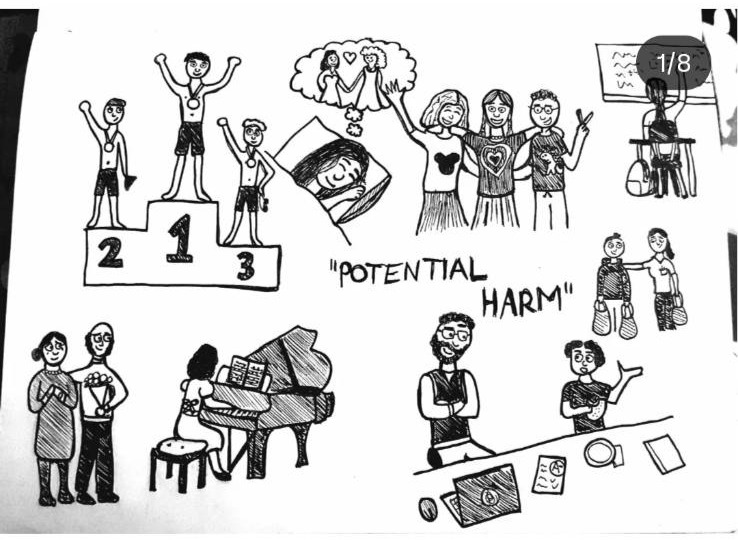
Image one captures the ICB’s allegation of trans adolescents having been exposed to ‘potential harm’. What we instead have seen, is young people thriving and excelling through access to respectful affirmative healthcare.

[Description of image 1 “Potential Harm”: One trans young person is winning at sports; One is dreaming of a happy future relationship and marriage; one is hanging out with friends; one is doing their school work; one is playing the piano while proud parents watch; one is going shopping with a parent – while professionals write up reports of potential harm]
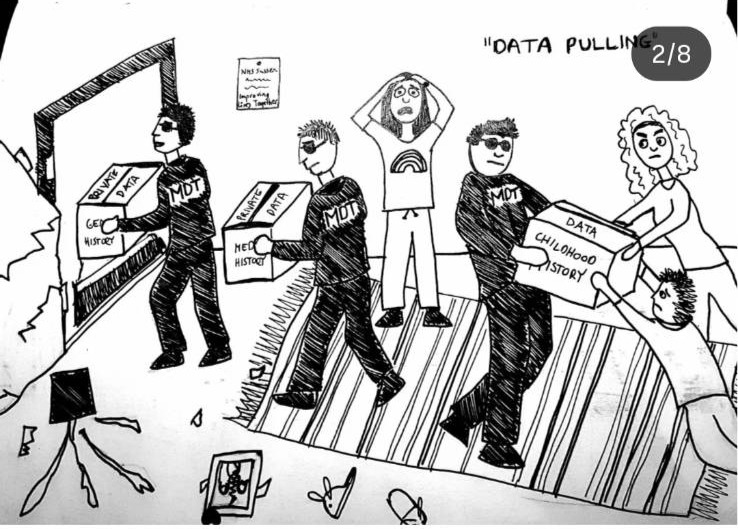
Image two captures the NHS’s approach to data collection. GP practice patients refused consent for the ICB taking their private patient data. GP practice patients, adolescents and parents, added notes to their files formally refusing permission to share their data. The GP practice did not want to share this data, and refused for several months. The GP offered anonymised data – the ICB was not interested in anonymised data. The ICB and NHS England stated that consent was not necessary due to ‘patient safety concerns’ despite no evidence of harm. The ICB finally threatened to cancel WellBN’s whole NHS contract, closing down a GP surgery with 25,000 patients, if they didn’t hand over patient data. WellBN at this point folded and handed over all trans children’s data. Information commissioner office complaints have been submitted.

[Description of image 2 “Data Pulling”: A house is being trashed with objects broken. Men in black suits (with the words Multi-disciplinary team on their top) are forcibly removing boxes of data, while adolescents and families try to keep hold of them. The boxes are labelled ‘private data’, ‘gender history’, ‘medical history’, ‘childhood history’.]
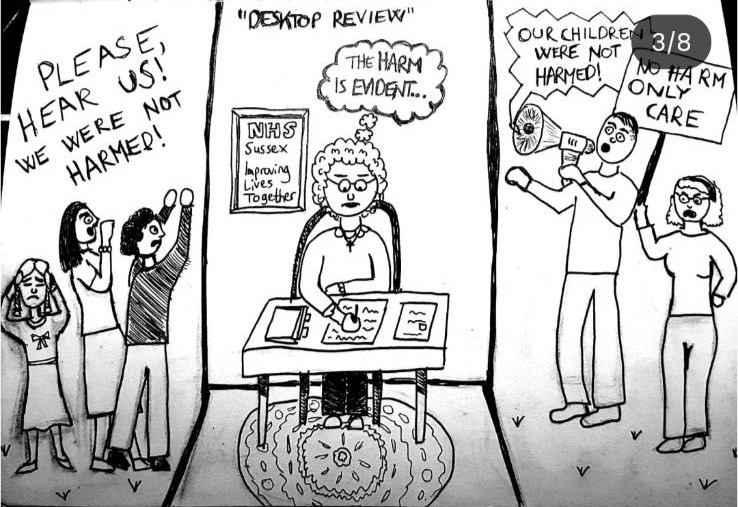
The third image covers the evaluation of patient harm. A patient harm investigation is being conducted without speaking to a single trans adolescent or family. It is being conducted purely based on clinical notes. The conclusion has been pre-determined with the investigation clearly considering affirmative care inherently a form of harm. Trans adolescents and families have prepared testimony on the reality that not only has there been no harm, their care has been excellent. Trans adolescent and family voices are not being heard.

[Description of image 3 “Desktop Review”: Adolescents and families are shut outside, using loud speakers to say ‘Please hear us, we were not harmed’; ‘children not harmed’, ‘no harm only care’. Inside, behind thick walls sits the head of the investigation team doing a ‘desktop review’ writing ‘harm is evident’.]
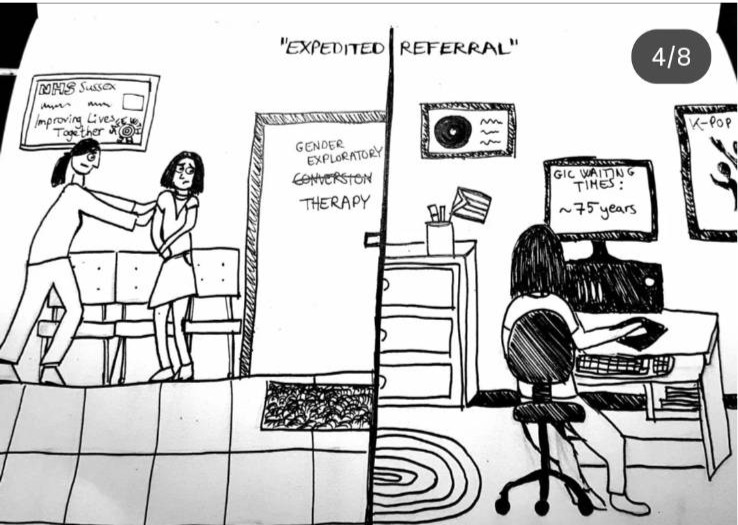
The fourth image focuses on the ICB’s plan to close all WellBN Care and refer patients elsewhere. Trans youth who are under 17 are to be forced to into gender clinics that offer conversive talk therapies focusing on investigating trans identities. 17 year olds will join waiting lists for adult care that stretch into years and years long.

[Description of image 4 “Expedited Referral”: A scared young person is being pushed into a room. The room was labelled ‘conversion therapy’. The word conversion has been crossed out, and in its place the words ‘gender exploratory’ therapy are now scrawled. In another scene a slightly older adolescent sits at a computer where the screen states ‘Gender Identity Clinic waiting times: 75 years].
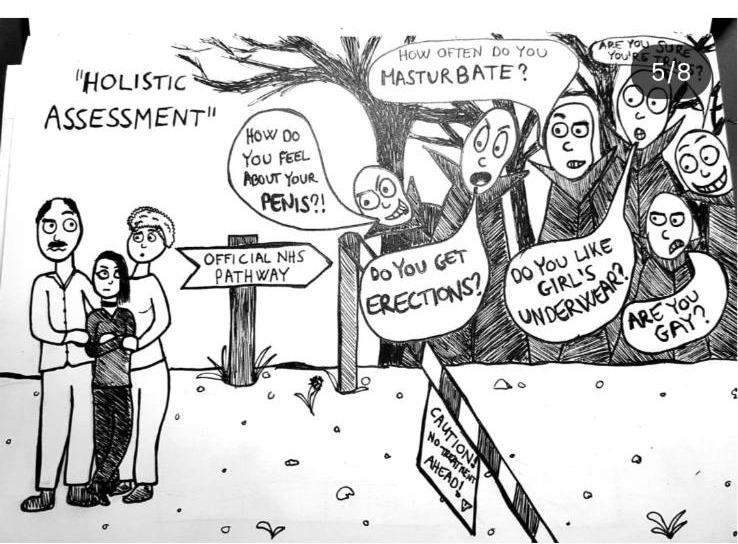
Image 5 covers the preferred NHS approach for trans youth, gender clinics that focus on invasive, traumatic and inappropriate questioning of trans youth.

[Description of image 5 “Holistic Assessment”: Worried looking parents embrace a worried looking adolescent on one side. Ahead of them is a barrier labelled ‘caution no treatment ahead’. Behind the barriers are six faces with word bubbles ‘how do you feel about your penis?’; ‘do you get erections?’; ‘how often do you masturbate?’; ‘Are you sure you’re trans’?’; ‘Do you like girls’ underwear?’; ‘are you gay?’].
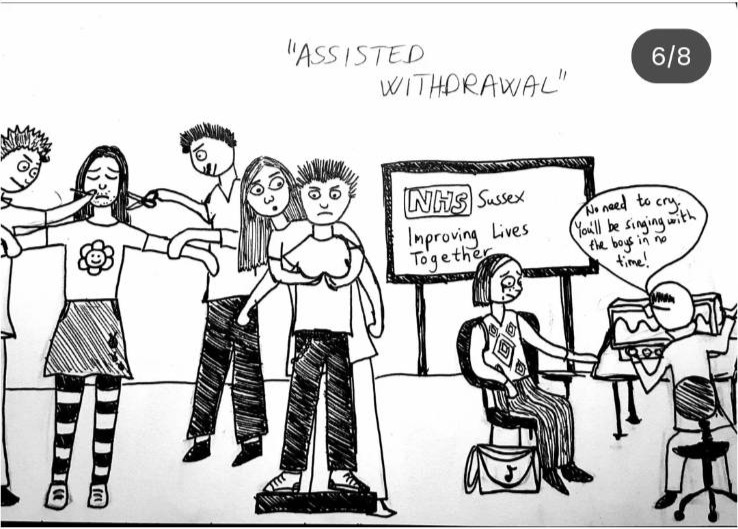
Image 6 focuses on the ICB’s intention for ‘assisted withdrawal’ of affirmative healthcare. This is forced medical detransition. It is abusive and harmful.

[Description of image 6 “Assisted Withdrawal”: A trans girl is having her long hair cut and facial hair painted onto her face; a trans boy is having breasts added; a young girl musician is crying while a professional says ‘don’t worry you’ll be singing with the boys in no time’]
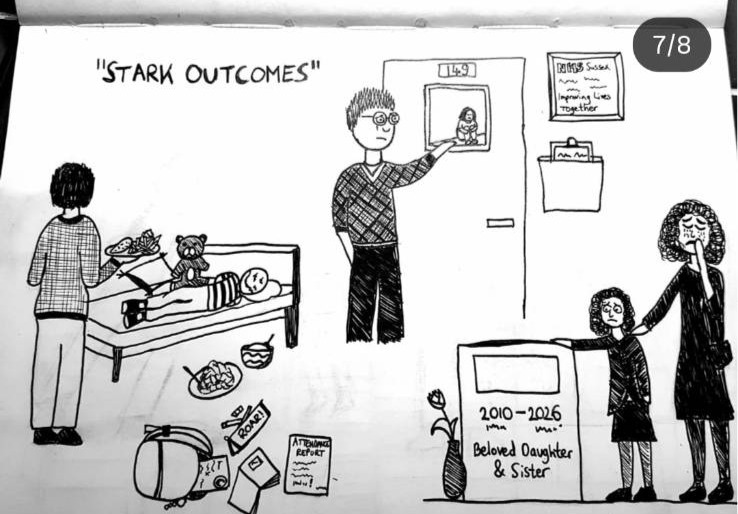
The ICB have stated that they expect the outcomes to be ‘stark’ for impacted trans youth ‘especially the younger ones’. This image powerfully captures the type of stark outcomes that the ICB is well aware of as possibilities, having included these risks in their own risk assessment.

[Description of image 7 “Stark Consequences”: The image shows various depictions of children and adolescents having serious mental health consequences, including school drop out, stopping eating, mental health crisis and death]

The eighth image captures the ICB and NHS England’s intended ‘robust tracking approach’. Now that they have full patient data on adolescent and supportive families, they intend to ‘robustly’ track these children and families, keeping their data for 20 years, and tracking what adolescents and families do next. They have stated that if they think families and adolescent will continue to access medication through private means, they will be reported by the ICB to social services. Families and adolescents feel extremely threatened, extremely unsafe. Many are trying to find ways to flee the country.

[Description of image 8 “Robust Tracking Approach”: A scary large figure with a magnifying glass stares down at a scared looking child, while parents try to pull the child away to somewhere safer]
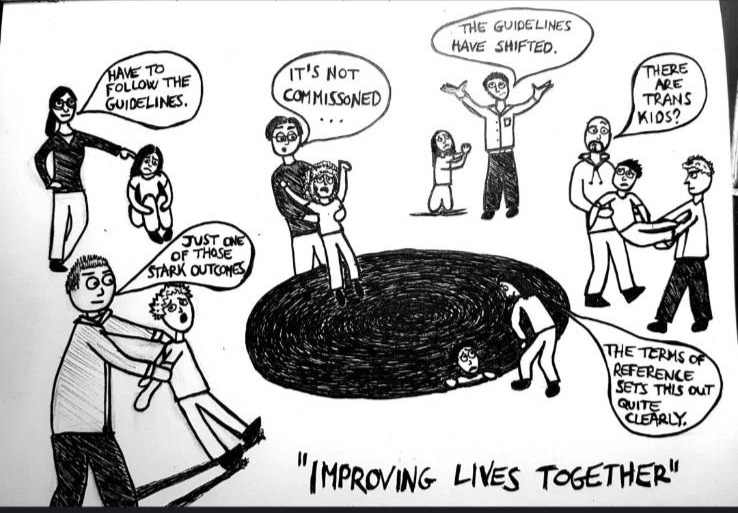
The final image shows scared young people being pushed into a black hole.

[Description of image 9 “Improving Lives Together”: Scared young people, some of whom are crying are being pushed into a black hole. The adults pushing them in are saying statements like “just one of those stark outcomes”; “have to follow the guidelines”; “It’s not commissioned”; “the guidelines have shifted”; “there are trans kids?”; “the terms of reference sets this out quite clearly”.

Across all of the above images the artist has included ICB Sussex’s tagline ‘Improving Lives Together’.

Trans health waiting lists are a political choice

I’m just back from an awesome trans healthcare conference in Norway (blog on that to follow). Here I wanted to share information from a presentation by the founder of the transit trans healthcare service in Catalonia (Barcelona region), Spain. Transit is respected across the world for being a service that is leading the field in informed consent depathologised healthcare. Here I will share information on the approach, the history, how it works today and reflections on trans health waiting lists. First a quick spoiler for why you should read on: their waiting list for new referrals is 3 weeks.


The approach
The transit service was set up with a strongly trans affirming philosophy of care, building from principles including 1) a firm commitment to depathplogisation, that trans people have a right to affirmative healthcare without being under psychological or psychiatric control and without requirement for psychological assessment or diagnosis.2) commitment to Informed consent,that trans people of all ages have a right make their own decisions about their own healthcare 3) commitment to avoid diagnosis, recognising that a doctor or psychologist can never know someone’s gender identity.


The history
The transit service ran from 2012-2016 as a service running outside of state management and state funding. It ran in parallel to a state run gender clinic that was pathologising and gatekeeping. Transit was very popular amongst trans communities. The state run gatekeeper service was widely disliked. Three things happened. One, trans communities across the state united behind one clear demand and goal, to demand the closure of the state run gatekeeper service and the transfer of funding to the popular informed consent service. Two, communities organised and did activism growing support and unity behind their goal. Three, they managed to gain the support of a state politician who had the authority in a devolved spanish system to make a change. In 2016 state funding was shifted to the transit informed consent service and the gatekeeping psychology and psychiatry dominated service closed.


How it works today
Trans people always have a first appointment with a medical doctor able to prescribe hormones and never have a first appointment with a psychologist, psychiatrist or psychoanalyst. Fifty percent of patients receive hormones on that first appointment. The waiting list for the service is three weeks, meaning half of patients wait three weeks from referral to hrt.

The service does not deny hrt at first appointment for those who ask for it. For those who come to the appointment asking for hrt, they are usually well informed about her, and hrt discussions take up a very small part of the appointment, instead defining the appointment as a safe space where they can talk about any parts of their life that are difficult, with this discussion having no impact on them getting hrt which is guaranteed as it is their decision to make.  The reason people do not take hrt at first appointment is that they have not yet decided what they want and the patient themselves asks for more time, more support or other support.

The first appointment is 45 mins to one hour. There are zero required questions and no assessment of diagnosis. Doctors state that their job is not to assess or diagnose but to support their patient take decisions. The service operates what it describes as a multidisciplinary team but this means something completely different to what this term means in NHS children’s services. In transit it means that in addition to the medical doctor who takes the first appointment there are other professionals who the patient can request to see for additional support. A patient can ask to see a therapist to talk through their worries, history or mental health. A younger patient can ask to see a family support worker to get advice on getting support at school. They can choose to see a voice therapist. All of these additional professionals are offered and not required. The MDT offers value to service users,and does not operate as an abusive multi professional assessment, approval and gatekeeping gauntlet as happens in the UK. This same informed consent approach is followed for under 18s, with parents and legal guardians also involved in decision making for under 16s.

The transit service, with its three week waiting list, covers a population of 8 million, equivalent to the population of Scotland and Wales combined, or one seventh of the population of England, like one of our major regions. It has a total of 43 staff, a majority of whom are very part-time, working 6-7 hours per week for the transit service and working in other areas of healthcare the rest of the week. It has very high patient satisfaction rates. The key areas of complaint the service receives relates to the unavailability of particular formulations like injectable oestrogen, and complaints from parents who would prefer their child had gatekeeping in a slow psychological assessment and diagnosis model. The service has health provision in 8 locations across Catalonia, meaning people don’t have to travel far for an appointment.


Waiting
Last week UK trans healthcare advocates and journalists produced important work on the waiting lists for UK services. Those numbers are appalling. Whilst critiquing these ridiculous waiting lists I also hope we can do three other things:

1) Recognise the political and institutional choices that cause this waiting list: The NHS and our government choose to demand a gatekeeping psychology-led service that is the number one cause of our harmful waiting list. This is about the model of care, not about the amount of funding. In children’s care an increase in funding has led to an increase in the resources allocated to gatekeeping, not to any improvement in access to care. We should be long past arguing that increased funding is an form of solution without systemic reform

2) Recognise how easy it is to make better choices. Harmful gatekeeping services can be closed down and defunded. Respectful informed consent services can be funded and quickly expanded, delivering improved care at a smaller price. Importantly, a demand for informed consent care can and should be made for trans people of all ages, including trans children and adolescents. We need to stand together.

3. Recognise that the way in which we measure our waiting list matters. I hope we can move away from centring the metrics that our NHS and government think matter, and focus more on the metrics that actually matter. I would argue, that the key metric we should be counting, is a metric of the minimum expected time from referral to first getting a prescription for endocrine care, broken down by different characteristics including age and neurodivergence. Measuring a waiting list for access to a first appointment is entirely without merit in a service where the gap between first appointment and endocrine care is measured in years.

The UK children’s service has long had a waiting list of over 6 years for a first appointment. That statistic is likely to reduce. Trans under 18s are being forcibly discharged from the service for not attending identity exploration sessions, trans young people and families are ‘choosing’ to ask to be deregistered from a service that they find harmful and know won’t help them, trans young people and families are deregistering from the waiting list, and reforms to the referral system have made it increasingly impossible to get a new referral. But if that waiting list for the service goes down, does that matter? When those are the end of that wait have to wait for many year more, perhaps until they are 18 (or 25…) for approval for endocrine care.

For adults there has long been a minimum 1+ year delay from the end of the waiting list to getting endocrine care. That is part of the waiting. For many that wait is far longer than one year, and some people go years or never receive NHS approval for endocrine care. We need to focus less on the wait for a first appointment and more on the wait for endocrine care. This data could be collected, by the NHS or by ourselves.

Questions could be asked at the point of a first prescription including:
1. How long did you wait between referral and getting this prescription ?
2. How much of that wait was spent doing things that you found beneficial (counselling you chose to pursue before hormones, time for thinking, time for working through other issues including housing , employment and social transition that you chose to pursue before hormones, time to work through other mental health issues you chose to pursue before endocrine care, time to understand medical transition options). This can be defined as acceptable and patient-centred waiting for healthcare.
3. How much of that wait was not beneficial or harmful to you? (This can be defined as unacceptable waiting for care). Unacceptable and unwanted waiting for essential healthcare is a systemic inequality. Where this this number is counted in months or years rather than weeks, it is a form of state violence against trans people.

Huge waiting times for trans healthcare in the NHS, both in children’s and adult services, are there by design. Better political and institutional decisions in locations like Spain have removed this waiting list, delivering far better outcomes at a fraction of the cost. We demand better from our national healthcare.

Diagnostic Overshadowing

In this short blog I want to draw our attention to the term ‘diagnostic overshadowing’ and its use by anti-trans actors to mask attempts at conversion practices.

Diagnostic overshadowing is a medical term used to describe the situation where one medical condition or diagnosis ‘overshadows’ another one, leading to mis-diagnosis.

Trans communities will recognise the concept in the well documented ‘trans broken arm syndrome’. Transphobic or inexperienced medical practitioners can go into panic when treating a trans person, and mistakenly attribute completely unrelated medical issues to a person being trans or taking gender affirming hormones.

Trans patient: Look, my arm is clearly broken in several places, I need a plaster cast.

Emergency care Dr: Oh, you are trans! Are you on HRT? I don’t know how to treat you, we’d better send you to the psychologist.

In trans communities this type of ‘diagnostic overshadowing’ is recognised as a problem that we want and need medical providers to acknowledge and avoid. Trans people should not receive poorer medical care from professionals who presume their transitude is at the root of unrelated health conditions.

In these cases, diagnostic overshadowing is a problem, and something to be avoided.

HOWEVER,

Transphobes like to use the term diagnostic overshadowing in a different way, one that we need to be aware of and protect against.

Transphobes do not recognise self-identification as trans. They focus on transness as a diagnosis or medical condition, with an emphasis on people suffering from the condition of ‘gender dysphoria’. Rather than considering a trans person ‘being trans’ with affirmative healthcare are a route to self-actualisation and gender euphoria, they focus on a person ‘suffering from gender dysphoria’ with affirmation one of many potential ‘treatments’ for that distress.

 Transphobes then use the term diagnostic overshadowing in a manipulative way that masks their true intentions.

For a transphobe, a trans child or teen is likely to have ‘mis-diagnosed’ themself as suffering from gender dysphoria. They are likely to ‘misattribute’ their anxiety, depression or suicidal ideation as being wrapped up in their mis-diagnosis. They are likely to argue that gatekeepers should ‘protect’ trans youth from mis-diagnosing their depression or anxiety as being linked to dysphoria or to being trans in a transphobic world. Transphobes argue that the first step in any service is to look for other causes and other ‘treatments’ for anxiety or depression before enabling affirmation. They argue that an affirmative approach (where clinicians accept a child’s identity) is going to result in ‘diagnostic overshadowing’ of other past traumas or mental health issues. Transphobes do not accept that being trans is a healthy part of human diversity, and do not recognise the mental health burden of being trans in a transphobic world. Importantly, their transphobic approaches to ‘treating’ gender dysphoria by denial of affirmation are already proven to be harmful, unethical and ineffective.

Transphobes then wield the term ‘diagnostic overshadowing’ to criticise affirmative healthcare. They say that any healthcare professional who accepts a child or teenager’s ‘self-diagnosis’ of transitude or dysphoria or transphobia as at the root of their mental health problems, is practicing ‘diagnostic overshadowing’ – allowing a self-diagnosis of gender dysphoria to explain other mental health issues (that, transphobes claim, are instead driving their gender confusion). Transphobes argue that to avoid ‘diagnostic overshadowing’ health professionals and teachers and parents need to take a ‘critical’ approach to a youth’s self-understanding. Clinicians need to look for ‘causes’ and ‘treatments’ for all areas of trauma, neurodiversity, depression, anxiety etc BEFORE enabling affirmation.

Florence Ashley’s scholarship is relevant here see (here, here and here)

The Danger

Diagnostic overshadowing is already recognised as a ‘bad practice’ in healthcare. Something that we all want to avoid.

So, when transphobes say ‘we want to avoid diagnostic overshadowing’ this can easily be interpreted as something benign, as something positive.

BUT they are manipulating the term, to enable conversive practices. To enable harm to trans youth.

I am therefore extremely concerned to see the term used multiple times by Cass, including in her recent response to the draft NHS service specification.

I am extremely concerned at a lack of community push back to Cass’ use of this term – I have spoken to folks who didn’t really understand the term and simply assumed it was something benign, which is why I wanted to publish this blog.

I do think ‘diagnostic overshadowing’ is a genuine problem in trans healthcare. But in a transphobic NHS it is primarily a problem leading to denial of trans healthcare. Youth who are neurodiverse, disabled or mentally ill routinely experience ‘diagnostic overshadowing’ with clinicians focusing on their co-existing differences as a potential driver of their gender distress, with neurodiverse, disabled or mentally ill trans youth denied affirmative healthcare.

 Cass is not tackling this type of ‘diagnostic overshadowing’. Instead, she is presuming that the NHS at present is allowing self-identification as trans to ‘overshadow’ other mental health problems or allowing mis-diagnosis as trans to get in the way of more pressing need to ‘treat’ anxiety or depression (without gender affirmation).

This interpretation is baked into the proposed service specification.

A service that was trying to ensure neurodiverse, mentally ill, disabled or traumatised trans youth have equitable access to trans healthcare would be designed with steps to ensure those youth have equitable access without their diversity counting against them. The new service spec does the opposite.

The new service spec instead looks for ‘solutions’ and ‘treatments’ outside of affirmation and affirmative healthcare.

This way conversion therapy lies.

Cass is enabling this without clearly saying so, using the term ‘diagnostic overshadowing’ to justify a marked shift to a conversion therapy adjacent model.

Cass is dangerous because she is enabling conversion practices by saying ‘we need to avoid diagnostic overshadowing’. This unclear term leads most people to just nodding in agreement, assuming the NHS knows best, always underestimating the power of institutional transphobia and trans-pathologisation.

When folks caution about the rise of fascism they remind us that fascism doesn’t (always) come with Heil Hitler salutes and swasticas, it comes with calls to protect family, nation, tradition.

We need to similarly recognise that a return to conversion therapy doesn’t come with a banner saying ‘Conversion here’. It comes wrapped in ‘gender exploratory therapy’ and a call to avoid ‘diagnostic overshadowing’.

I’m deeply concerned for trans children and teens under the NHS

I’m sick of folks (and organisations) giving Cass the benefit of the doubt just because she avoids inflammatory rhetoric.

Trans kids deserve better – they have a right to evidence-based affirmative healthcare. They have a right to safety from harmful conversive practices.

Australia Presents a Gold Standard of Care for Trans and Gender Diverse Children

Part 1. The Guidelines for Trans and Gender Diverse Children and Adolescents

Introduction

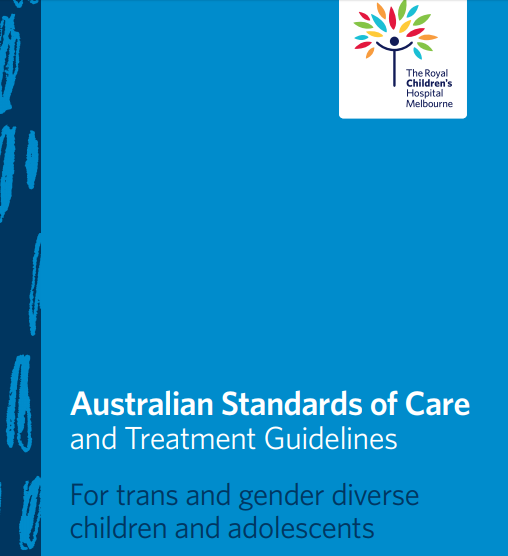
This week Australia’s Royal Children’s Hospital Gender Service has launched the “Australian Standards of Care and Treatment Guidelines for Trans and Gender Diverse Children and Adolescents”. These guidelines are compiled by the leading Australian experts, based on the best and most current evidence from around the world. These guidelines are endorsed by ANZPATH (the Australian and New Zealand Professional Association for Transgender Health) and were launched at the recent ANZPATH conference. They are now the official guidelines for all health professionals working with transgender children in Australia.

The standard is clearly written and concise and it is definitely worth reading in full. Here,  for convenience, please find below a brief synopsis of selected key extracts from the document. In Part 2 we will look at Why this standard matters, and why it should be adopted in the UK NHS.

Australian Standards of Care and Treatment Guidelines for Trans and Gender Diverse Children and Adolescents (pdf)

 aus standard care

Key extracts from the document:

Evidence Based:

“Recommendations are made based on available empirical evidence and clinician consensus”, “developed in consultation with professionals….from multiple disciplines, trans and gender diverse support organisations, as well as trans children and adolescents and their families”.

Numbers expected to increase:

“with increasing visibility and social acceptance of gender diversity in Australia, more children and adolescents are presenting ….requesting support, advice, and gender affirmative psychological and medical treatment”. with “approximately 1.2% of adolescents identifying as trans” “it is likely that referrals. ….will continue to rise in the future”.

Natural:

“being trans or gender diverse is now largely viewed as being part of the natural spectrum of human diversity”.

(This Australian guidance was completed before the latest Endocrinology guidelines, stating that “there is a durable biological underpinning to gender identity”.

Affirmative care:

“increasing evidence demonstrates that with supportive, gender affirmative care during childhood and adolescence, harms can be ameliorated and mental health and well being outcomes can be significantly improved”.

General principles for supporting trans and gender diverse children and adolescents

  • Individualise care”. Emphasises the “importance of tailoring interventions”, recognising each individual’s “unique clinical presentation” and “individual needs”.

  • Decision making should be driven by the child or adolescent wherever possible, this applies to options regarding not only medical interventions but also social transition”.

  • “Use respectful and affirming language”.

  • Avoid causing harm”. “withholding of gender affirming treatment is not considered a neutral option, and may exacerbate distress in a number of ways including depression, anxiety and suicidality, social withdrawal, as well as possibly increasing chances of young people illegally accessing medications”

  • “consider legal requirements” outlines legal requirements that are barriers to “obtaining identity documents that accurately reflects their gender”. Considers “implications for young people’s right to privacy and confidentiality when enrolling in school or applying for work”.

Children vs adolescents:

“the clinical needs (of children vs adolescents) are inherently different, and consequently we provide separate guidelines for trans and gender diverse children and adolescents”

Psychological Support for a younger child:

  • “Supporting trans and gender diverse children requires a developmentally appropriate and gender affirming approach”.

  • “for children, family support is associated with more optimal mental health outcomes”

  • “trans or gender diverse children with good health and wellbeing who are supported and affirmed by their family, community and educational environments may not require any additional psychological support beyond occasional and intermittent contact with relevant professionals in the child’s life such as the family’s general practitioner or school support”.

  • “others may benefit from a skilled clinician working together with family members to help develop a common understanding of the child’s experience”.

  • “when a child’s medical, psychological and/or social circumstances are complicated by co-existing mental health difficulties, trauma, abuse, significantly impaired family functioning, learning or behavioural difficulties …. a more intensive approach with input from a mental health professional will be required”.

Social Transition for a younger child:

  • “social transition should be led by the child and does not have to take an all or nothing approach”.

  • “provision of education about social transition to the child’s kindergarten or school is often necessary to support a child who is socially transitioning to help facilitate the transition and minimise …bullying or discrimination”.

  • “social transition can reduce a child’s distress and improve their emotional functioning. Evidence suggest that trans children who have socially transitioned demonstrate levels of depression, anxiety and self-worth comparable to their cisgender peers”.

  • “The number of children in Australia who later socially transition back to their gender assigned at birth is not known, but anecdotally appears to be low, and no current evidence of harm in doing so exists”.

Key roles for a clinician of younger child:

  • Supportive exploration of gender identity over time

  • Work with family to ensure a supportive home environment

  • Advocacy to ensure gender affirming support at school

  • Education (to child and family) on gender identity and signposting to support organisations for child and for parents

  • If child is expressing desire to live in a role consistent with their gender identity, provision of psycho-social support and practical assistance to the child and family to facilitate social transition

  • Referral to endocrinologist ideally prior to onset of puberty

Supporting Adolescents:

[For] “adolescents with insistent, persistent and consistent gender diverse expression, a supportive family, affirming educational environment and an absence of co-existing mental health difficulties, the adolescent and parents may benefit from an initial assessment followed by intermittent consultations with a mental health clinician”

Supporting Parents of Adolescents:

“adolescents often encounter resistance from their parents when their trans or gender diverse identity is first disclosed during adolescence”. “For the clinician, investing time for parent support… will assist in creating a shared understanding….and enable optimisation of clinical outcomes and family functioning”

Fertility Counselling for Adolescents:

“Although puberty suppression medication is reversible and should not in itself affect long term fertility, it is very rare for an adolescent to want to cease this treatment to conduct fertility preserving interventions prior to commencing gender affirming hormones. It is therefore necessary for counselling to be conducted prior to commencement of puberty suppression or gender affirming hormones”

Commencement of puberty suppression

“Puberty suppression is most effective in preventing the development of secondary sexual characteristics when commenced at Tanner stage 2”. ”reduction in the duration of use of puberty suppression by earlier commencement of stage 2 treatment must be considered in adolescents with reduced bone density to minimise negative effects.”

Commencement of gender affirming hormone treatment

  • “The ideal time for commencement of stage 2 treatment in trans adolescents will depend on the individual seeking treatment and their unique circumstances” “adolescents vary in the age at which they become competent to make decisions that have complex risk-benefit ratios”. “The timing…will also depend on the nature of the history and presentation of the person’s gender dysphoria, duration of time on puberty suppression for those undertaking stage 1 treatment, co-existing mental health and medical issues and existing family support”

  • “While later commencement of hormone treatment during adolescence provides time for further emotional maturation and potentially lessens the risk that the adolescent will regret their decision, this should be carefully balanced by the biological, psychological and social costs to the adolescent of delaying treatment”.  “Biological implications of delaying hormones include ….relative osteopenia, and (for) trans females …linear growth…” “Psychological costs may include the negative contribution treatment delay may have on an adolescent’s sense of autonomy and agency, and may contribute to, or exacerbate, distress, anxiety or depression with subsequent increase in self-harm or suicide risk”. “Social costs of delayed treatment include peer group and relationship difficulties with pubertal development occurring significantly behind expected norms”

Surgical interventions

  • “Chest reconstructive surgery may be appropriate in the care of trans males during adolescence”.

  •  “delaying genital surgery until adulthood is advised”

Transition of care to adult care providers

“the young person’s GP is vital in facilitating a smooth process and many GPS continue as the primary doctor involved in hormone prescribing and monitoring of mental health after engaging in a shared care agreement during paediatric treatment”.


In Australian Standard of Care Part 2. (Below) we discuss:

  • Why this standard matters, 
  • Why it should be adopted in the UK NHS
  • A comparison between the Australian Standard and UK Service Specification
  • A comparative analysis of the evidence base underpinning the Australian and UK approaches