AUSPATH KEY-NOTE SPEECH

In late November I attended the AUSPATH (Australian Association of Transgender Health) conference in Tasmania, Australia. I had been invited as the key-note speaker on the first full day of the conference, given a 50 minute slot (followed by 40 min panel discussion with head of WPATH and head of PATHA (New Zealand Association of Trans Health). The audience was 555 people invested in trans healthcare, mostly trans healthcare professionals and advocates from across Australia, with a 50+ contingent from New Zealand. For transparency, as an invited key-note speaker I had my travel and accommodation paid by Auspath – I did not receive any other payments. A few people have asked if I can share my presentation – it was not recorded but I have captured a lot of the presentation content here, a mixture of my notes and memories combined with some of my slides.

Hi everyone, I’m absolutely delighted and honoured to be here today. I’ve already learned a lot about Australia in just a few days – I’ve learnt what a drop bear is. I’ve understood that my taste in Australian beer (VBs) is apparently bogan.

My name is Dr Cal Horton, I’m a trans and non-binary researcher from the UK. I’m also a parent of a trans kid. Being an advocate for and parent of a trans kid is not a particularly great position at the moment in the UK, so I will ask for no photos today please. I am currently based at both Oxford Brookes University and University College London. I am actively looking for routes out of the UK for my family, so if anyone is looking to hire a researcher, get in touch. I have no declared conflicts of interest – big pharma hasn’t come knocking yet – any day now, I’m sure.

Before I begin my presentation, I want to start with a reflection on the time and place at which I’m talking. In terms of place, I want to acknowledge the Muwinina and Palawa people as the traditional owners of this Land. I recognise histories of violent colonialism and brutal dispossession, and pay my respect to Aboriginal Elders past and present across Lutruwita. Sovereignty was never ceded, this was and is Aboriginal land. In terms of time, I recognise that we are speaking following two years of live streamed genocide in Palestine. In the UK we have a long and brutal history of colonialism and violence against marginalised groups. I note that this year the Lemkin Institute for Genocide Prevention raised a red flag warning for risk of genocide for trans and intersex communities in the UK.

Today my presentation is going to focus on how we move from pathologisation and violence to autonomy and rights in trans healthcare, with a focus on trans children. I’m using the term trans child to refer to everyone under the age of 18, though will sometimes reference more specific terms like trans adolescents where relevant.

When I talk about why the UK is so bad for trans people, why it is so bad for trans children, and for trans children’s healthcare, it is important to talk about the three Ps. Firstly Prejudice. We have a situation where individuals holding acute prejudice about trans people are in positions of influence or leadership over trans children’s healthcare. We have individuals in charge of the new children’s gender service who have never even attended WPATH, yet who have found the time to attend events organised by misinformation groups recognised as anti-trans hate groups.

The second important P is Pathologisation. In the UK you never even here the term ‘trans child’ in our NHS. It is all ‘gender questioning children’ or ‘children distressed by their gender’, ignoring the reality that the major reason that trans children are stressed and distressed is because of the violent persecution they are facing, including from the NHS. The language in the UK always focuses on describing trans children in pathologising terms, describing them as a group that are “complex” with extensive “co-morbidities”.

The third P, that impacts on trans children’s oppression in the UK, is Power. The current situation for trans children in the UK, the current situation for trans people in the UK, is impacted by the systemic exclusion of trans people from positions of establishment power, across and beyond the NHS. In my work, understanding why everything is stacked against trans children, I’ve started to increasingly focus on the concept of cis-supremacy.

PART 1: where the UK startedpathologisation & defensive practice
1A) Pathologisation 
Trans children’s care siloed in psychoanalysis
A trans child as a problem
The focus on understanding why a child is trans (what has gone wrong)
No focus on supporting happiness & well-being in trans children
Denial of recognition of a ‘trans child’ even as a concept
1B) WEAK Ethics and Accountability 
No routes to complaint for harmful practice
Research without consent
Interpretation bearing no resemblance to service user perspective
About us yet definitely without us

Growing levels of service user dissatisfaction
Growing demand for affirmative care
UK Clinicians becoming positioned as ‘the bad guys’
1C) CULTURE WAR HITS the UK
Formation of anti-trans groups focusing on children
Media fear mongering about trans children
BBC anti-trans advocacy influencing public opinion
Lobbying and court cases for removal of healthcare 

Culture war embraced by gender clinicians
Positioned as ‘the sensible middle’ between anti-trans and trans radicals 
Encouraged rather than knocked down misinformation ‘complex’, ‘difficult’, ‘unknown’
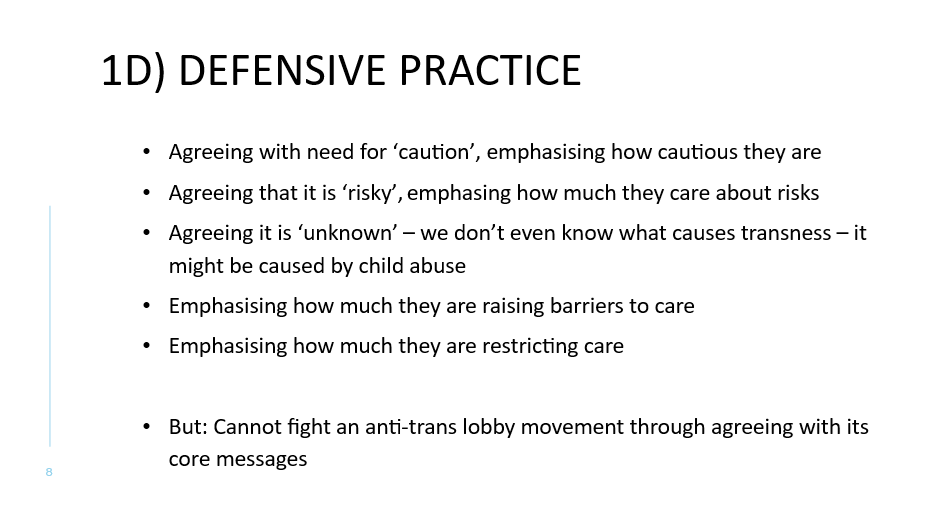
1D) DEFENSIVE PRACTICE
Agreeing with need for ‘caution’, emphasising how cautious they are
Agreeing that it is ‘risky’, emphasing how much they care about risks
Agreeing it is ‘unknown’ – we don’t even know what causes transness – it might be caused by child abuse
Emphasising how much they are raising barriers to care
Emphasising how much they are restricting care

But: Cannot fight an anti-trans lobby movement through agreeing with its core messages
PART 2: where the UK is nowpersecution & state violence
1) State persecution
Criminal bans on trans healthcare for under 18s
Denial of legal recognition and protection to trans children and adolescents
State and legislative attacks on basic rights to exist as a trans person
Institutional threats to affirmative families
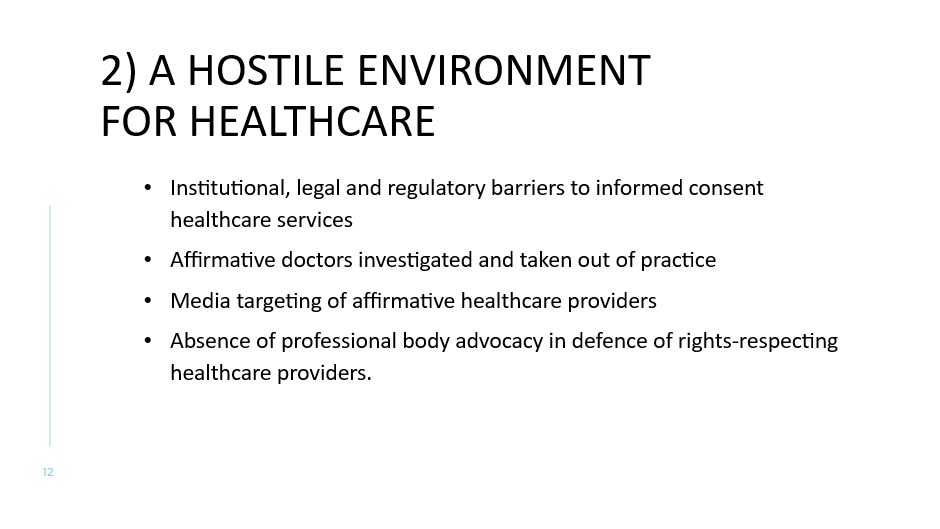
2) A hostile environment for healthcare
Institutional, legal and regulatory barriers to informed consent healthcare services 
Affirmative doctors investigated and taken out of practice
Media targeting of affirmative healthcare providers
Absence of professional body advocacy in defence of rights-respecting healthcare providers.
3) A hostile environment for mental health and well-being 
Hostile and discriminatory school environments
Bans on trans children participating in sports
Barriers to childhood social transition 
Misinformation and hate from media and politics
Co-ordinated, well-funded and influential campaigns against trans children’s rights
4) Pathologisation, control and conversion
Services centred in mental health, diagnosis of identity, gatekeeping
Mandatory, pro-longed and extensive psychological and developmental assessment 
Searching for a cause or other explanation for being trans
Mandatory exploratory therapy or psychotherapy
Stakeholders holding prejudice about trans children permitted to influence healthcare policy.
Delays and conversion practices
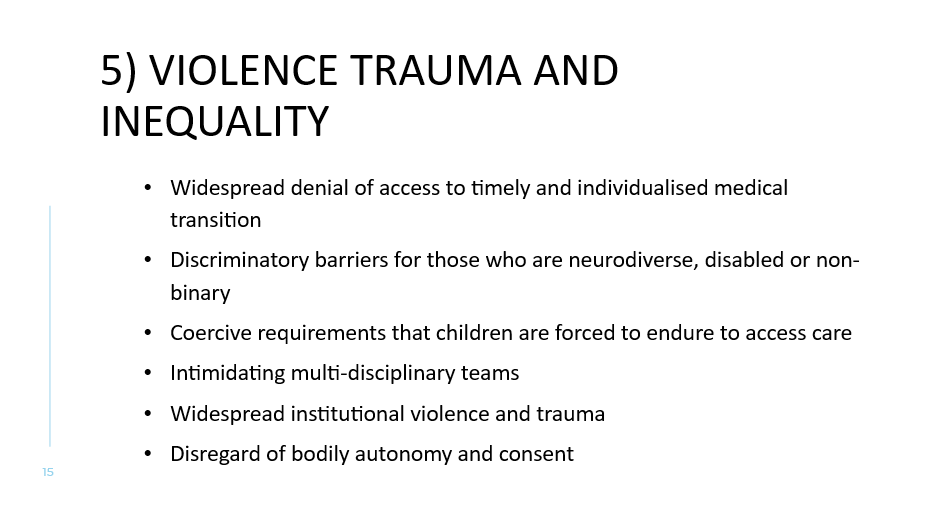
5) Violence trauma and inequality
Widespread denial of access to timely and individualised medical transition
Discriminatory barriers for those who are neurodiverse, disabled or non-binary
Coercive requirements that children are forced to endure to access care
Intimidating multi-disciplinary teams
Widespread institutional violence and trauma 
Disregard of bodily autonomy and consent

When I talk about why the UK is so bad for trans people, why it is so bad for trans children, and for trans children’s healthcare, it is important to talk about the three Ps. Firstly Prejudice. We have a situation where individuals holding acute prejudice about trans people are in positions of influence or leadership over trans children’s healthcare. We have individuals in charge of the new children’s gender service who have never even attended WPATH, yet who have found the time to attend events organised by misinformation groups recognised as anti-trans hate groups.

The second important P is Pathologisation. In the UK you never even here the term ‘trans child’ in our NHS. It is all ‘gender questioning children’ or ‘children distressed by their gender’, ignoring the reality that the major reason that trans children are stressed and distressed is because of the violent persecution they are facing, including from the NHS. The language in the UK always focuses on describing trans children in pathologising terms, describing them as a group that are “complex” with extensive “co-morbidities”.

The third P, that impacts on trans children’s oppression in the UK, is Power. The current situation for trans children in the UK, the current situation for trans people in the UK, is impacted by the systemic exclusion of trans people from positions of establishment power, across and beyond the NHS. In my work, understanding why everything is stacked against trans children, I’ve started to increasingly focus on the concept of cis-supremacy.

Cis-supremacy 
Cis-supremacy is a situation where cis people hold power over trans people, in cis dominated institutions, systems and societies. Cis-supremacy operates through the exertion of power over trans people, with trans people subject to control, systemic injustice and coercive violence
CONTRIVED Authority*
Example 1: The Cass Review. 
Put a stamp of authority on policies that:
1) Closed-down existing healthcare 
2) Erased the existence of trans children
3) Enabled transphobic policy to be labelled as ‘child protection’  
4) Enabled wider persecution of trans people without the question – but what about trans children?
*Dr Natacha Kennedy
CONTRIVED Authority
Example 2: The Commission on Human Medicine. 
Put a stamp of authority on policies that:
1) Defined puberty blockers as ‘dangerous’ (but not for cis people)
2) Criminalised private access to puberty blockers  
3) Helped coerce young people into an abusive puberty blocker trial 

Policy-based evidence making
PART 3: TRANS KIDS in the UK
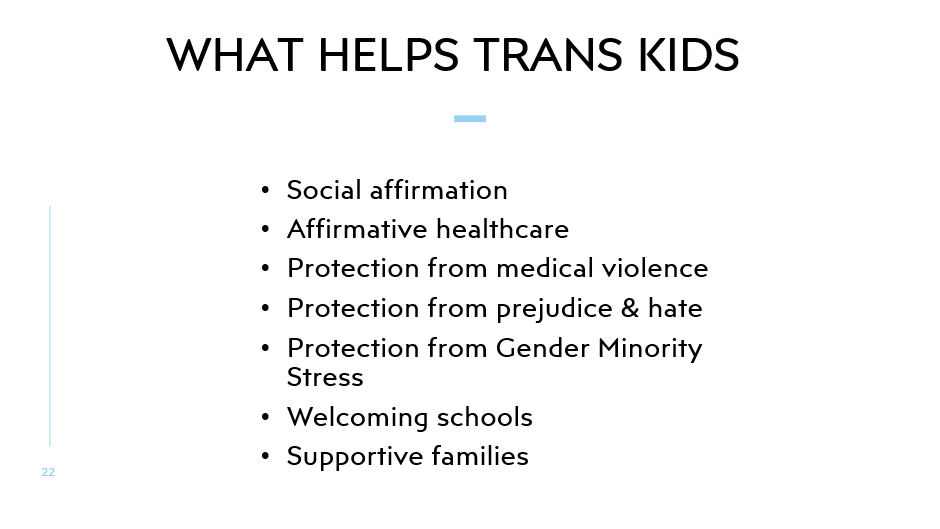
WHAT HELPS TRANS KIDS
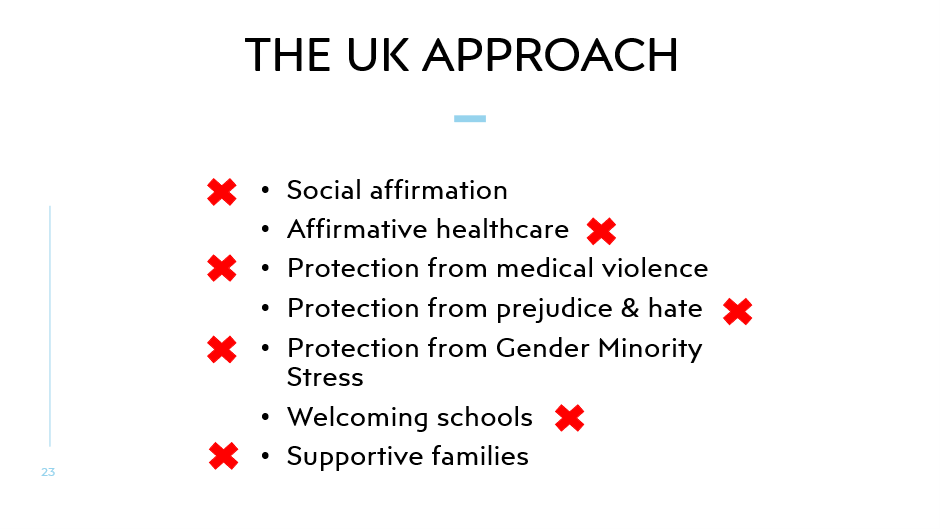
Social affirmation
Affirmative healthcare
Protection from medical violence
Protection from prejudice & hate
Protection from Gender Minority Stress
Welcoming schools
Supportive families
This slide shows the same text as the preceding slide, with red crosses next to each point.
HUGE rise in HARMS since CASS
Schools
Gender service
Social services & GPs
Forced medical detransition & forced puberty
Self-harm and suicidal ideation
School drop-out & social withdrawal
Fear & pain & trauma
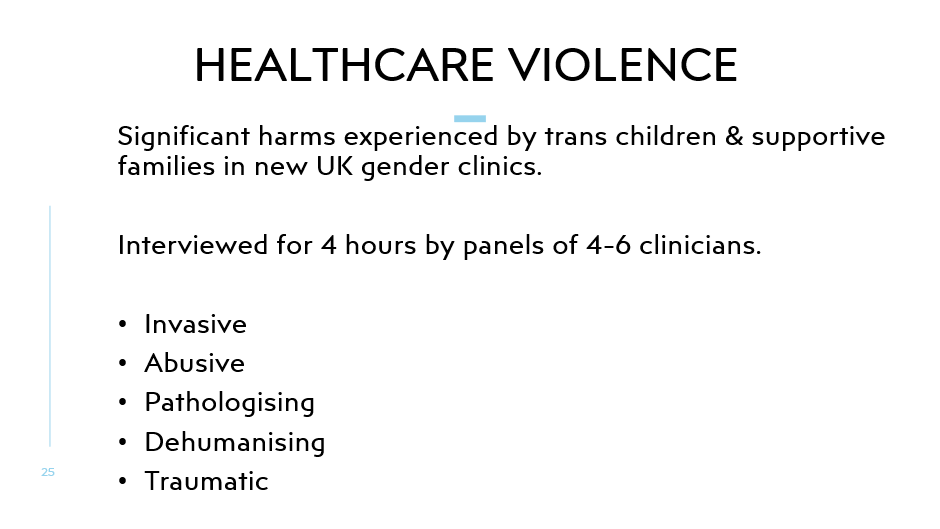
Healthcare Violence
Significant harms experienced by trans children & supportive families in new UK gender clinics.

Interviewed for 4 hours by panels of 4-6 clinicians.

Invasive
Abusive
Pathologising
Dehumanising
Traumatic
Slide showing illustration of being asked inappropriate questions in gender clinic, labelled as 'holistic assessment'.
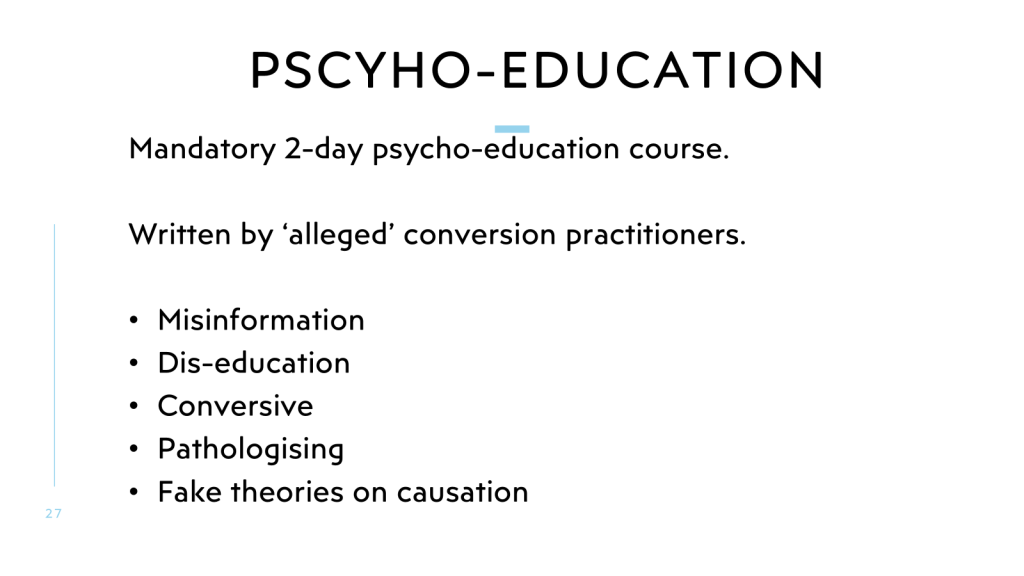
Pscyho-education
Mandatory 2-day psycho-education course. 

Written by ‘alleged’ conversion practitioners.

Misinformation
Dis-education
Conversive
Pathologising
Fake theories on causation
PATHWAYS STUDY
3,000-6,000 youth to be invasively questioned and studied without any medical care. 
113 youth to receive puberty blockers following intensive assessment & approval process
113 youth to receive puberty blockers following additional 1 year delay
PATHWAYS STUDY
Abusive & traumatic over-assessment: 
Extensive physical assessment, cognitive assessments, brain scans, bone scans, urine tests, blood tests, heart monitoring 
Over 314 different psychological assessment questions, repeated – using deeply pathologising and outdated questionnaires

Domination:
Full compliance required. Clinicians can deem ineligible on a whim. Approval reassessed every 12 months.
PATHWAYS STUDY
Mandatory exploratory therapy:
Full compliance with non-affirming and conversive talk therapy a requirement before and throughout the trial. 

Designed to fail:
Key outcome measures are irrelevant and unclearly linked to expected impacts of puberty blockers. Study will not provide clear evidence of the usefulness of puberty blockers. Highly likely has been designed to show minimal or unclear utility.
Rising ANGER. Photos of protests by Trans Kids Deserve Better. 
“In the UK, we as trans young people don't have the right to access gender affirming care. We used to spend years on waiting lists for medical support, but now the doors are fully closed to new patients. The medical support we need is extremely time-sensitive, and many of us die waiting.

Our supportive parents have been threatened with child safeguarding referrals, our pharmacies have been forced to hold back our medications, and our schools have been made battle grounds with us at the same time as weapon, aggressor, and victim. We refuse to live like this. We deserve better.”
Part 4: Autonomy & rights
Priority actions
1. Changing the narrative - Recognising systemic violence
2. Depathologisation
3. Rejecting defensive and conversive approaches
4. Confidently communicating
5. Removing clinical control
6. Centring rights
1. Changing the narrative: Recognising Systemic Violence
Violent schools vs safe schools
Violent families vs safe families
Violent healthcare vs safe healthcare

Role for medical authority

(impossible to read screen shot of infographic on supporting trans kids in schools)
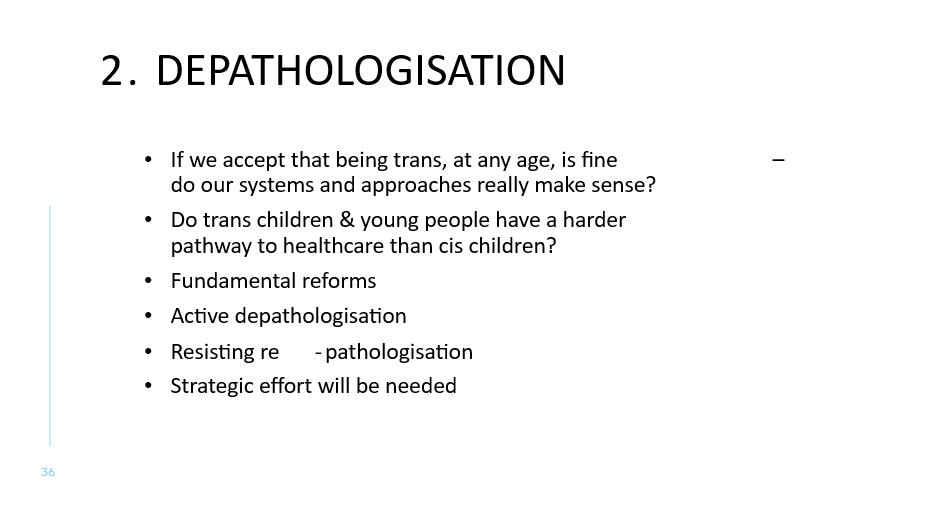
2. Depathologisation
If we accept that being trans, at any age, is fine – do our systems and approaches really make sense? 
Do trans children & young people have a harder pathway to healthcare than cis children? 
Fundamental reforms
Active depathologisation
Resisting re-pathologisation
Strategic effort will be needed
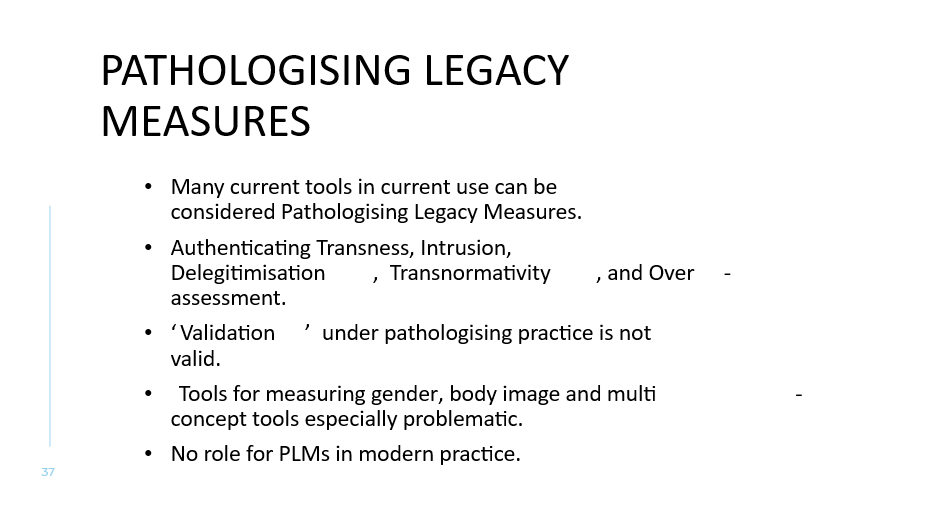
Pathologising LEGACY Measures
Many current tools in current use can be considered Pathologising Legacy Measures.
Authenticating Transness, Intrusion, Delegitimisation, Transnormativity, and Over-assessment. 
‘Validation’ under pathologising practice is not valid.
 Tools for measuring gender, body image and multi-concept tools especially problematic.
No role for PLMs in modern practice.
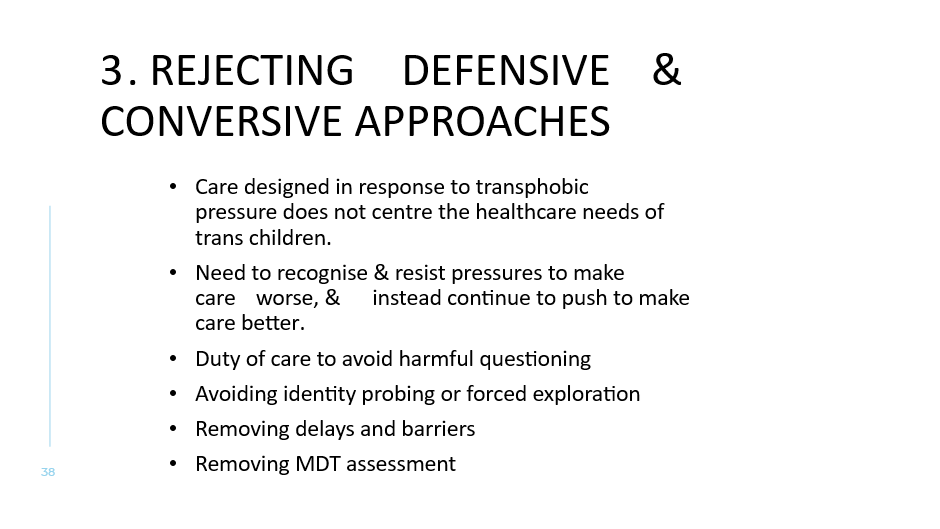
3. REJECTING DeFensive & Conversive Approaches 
Care designed in response to transphobic pressure does not centre the healthcare needs of trans children.
Need to recognise & resist pressures to make care worse, & instead continue to push to make care better. 
Duty of care to avoid harmful questioning
Avoiding identity probing or forced exploration
Removing delays and barriers 
Removing MDT assessment
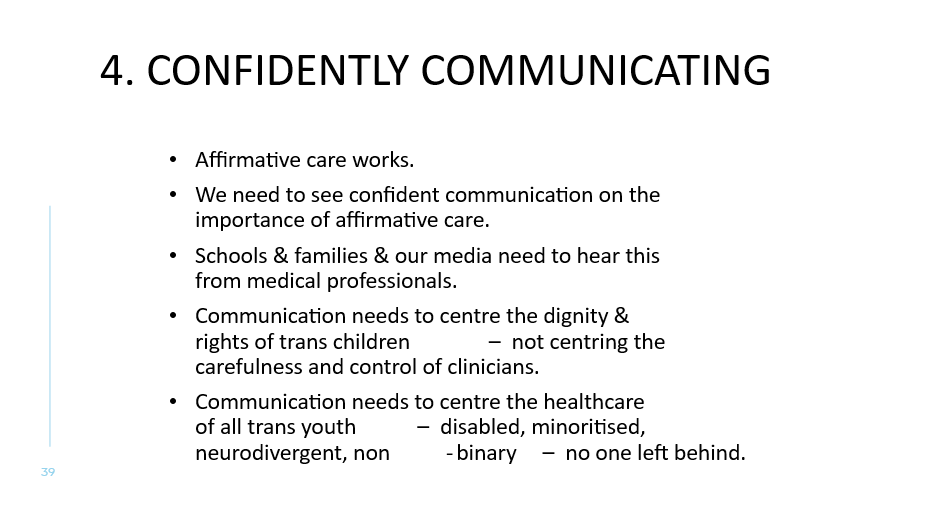
4. CONFIDENTLY Communicating
Affirmative care works. 
We need to see confident communication on the importance of affirmative care. 
Schools & families & our media need to hear this from medical professionals.
Communication needs to centre the dignity & rights of trans children – not centring the carefulness and control of clinicians. 
Communication needs to centre the healthcare of all trans youth – disabled, minoritised, neurodivergent, non-binary – no one left behind
5. Removing Clinical Control 
Dismantling power imbalances
Informed consent for all
Increasing accountability
Centring rights
6. Rights 

(impossible to read screen shot of article on 'Child Rights in Trans Healthcare - a call to action')

Thank you for listening.

My wider reflections on AUSPATH are available here:

Leave a comment